Democracy Gone Astray

Democracy, being a human construct, needs to be thought of as directionality rather than an object. As such, to understand it requires not so much a description of existing structures and/or other related phenomena but a declaration of intentionality.
This blog aims at creating labeled lists of published infringements of such intentionality, of points in time where democracy strays from its intended directionality. In addition to outright infringements, this blog also collects important contemporary information and/or discussions that impact our socio-political landscape.

All the posts here were published in the electronic media – main-stream as well as fringe, and maintain links to the original texts.

[NOTE: Due to changes I haven't caught on time in the blogging software, all of the 'Original Article' links were nullified between September 11, 2012 and December 11, 2012. My apologies.]

Wednesday, July 06, 2011

Toronto Pride rocked by 'Israeli apartheid' spat

A dispute over political protest is simmering in the wake of Toronto's Pride weekend, after a group supporting the Palestinian cause took part in Saturday's Dyke March, and the organization Queers Against Israeli Apartheid unfurled a banner alongside Sunday’s parade.

Coun. Giorgio Mammoliti, a staunch ally of Mayor Rob Ford, filmed the Dyke March and said he will use his footage to try to axe Pride’s $125,000 in city funding.

“You have the Jewish community that’s very upset at what’s going on. And so some of us thought we resolved this thing at City Hall by saying just have them not show up. But they did show up, and now we’ve got a decision to make,” Mammoliti told media on Monday.

A group called Dykes and Trans People for Palestine took part in Saturday’s march, holding up banners reading “We stand with queers in Palestine” and “Free Palestine” and chanting “We’re sexy, we’re hot, Israeli apartheid’s not.”

Mammoliti, the councillor for Ward 7 (York West), alleges the contingent consisted largely of people from Queers Against Israeli Apartheid, which some Jewish groups say promulgates anti-Israel “hate speech."

The group said in April it wouldn’t participate in Sunday’s parade because it didn’t want to give Ford and his allies a pretext to cut Pride’s funding.

Full Article
Source: CBC news 

Toronto elected a mayor, not a priest

It’s not easy being mayor. And it shouldn’t be. Not in a big city with complex relationships, disparate dreams, and citizens sprung from the corners of the globe and brought together to navigate ancient grievances.

No, it’s not easy being a mayor of a large city with a world view and global reach.

So, there is only a little corner of sympathy today for Mayor Rob Ford, the people’s choice who chose to fold his arms when extended hands were what Toronto required this past week of gay community events.

Stubbornly clinging to a narrow view of his role, his purpose and his job, the mayor squandered a civic moment and laid the carpet for many hateful people to engage in cruel thoughts and spout vitriol.

I got a full dose of that, following a column stating Mayor Ford had a civic duty to attend the Parade or some other Pride week event. Yes, a full 90 per cent of the reaction supported Ford’s decision to snub Pride.

I expected the same from friends, family and fellow church members.

I understand where Ford is coming from — all the excuses about family time at the cottage notwithstanding. If family time was the real reason, the mayor would have spent the past weekend with his immediate family and still find time to spend one hour or fraction thereof with the gay side of his civic family. There were a multitude of events that need not upset his sensibilities or offend his sense of right or wrong.

So, the mayor didn’t have to attend the Pride parade. Many citizens refuse to attend the parade because it’s too risqué, too racy, too much nudity, too much exhibitionism for their prudish, some say sexually conservative or repressed selves.

Those are moral choices made by the individual, the citizen, not the civic father.

If the only way to give a civic, secular imprimatur to this major city event was to attend the parade, then, as mayor, you must bury your personal misgivings and attend. Alas, Ford had many other options — including the Pride flag-raising on the civic square right outside his office.

By avoiding every single event, no matter how innocuous, Ford sent out the signal that gay people are not part of his city. He will take their taxes. He will take the economic benefits that flowed from the event. He will even give a couple hundred thousands in seed money to deliver millions. But gays don’t count.

Full Article
Source: Toronto Star 

Julian Assange of WikiLeaks & Philosopher Slavoj Žižek In Conversation With Amy Goodman

In one of his first public events since being held under house arrest, WikiLeaks founder Julian Assange appeared in London Saturday for a conversation with Slovenian philosopher Slavoj Žižek, moderated by Democracy Now!’s Amy Goodman. They discuss the impact of WikiLeaks on world politics, the release of the Iraq and Afghanistan war logs, and Cablegate — the largest trove of classified U.S. government records in history. “From being inside the center of the storm, I have learned not just about the structure of government, not just about how power flows in many governments around the world that we’ve dealt with, but rather how history is shaped and distorted by the media,” Assange said. Assange also talks about his new defense team, as well as U.S. Army Private Bradley Manning, the accused Army whistleblower who has been jailed for the past year. Assange is currently under house arrest in Norfolk, outside London, pending a July 12 appeals hearing on his pending extradition to Sweden for questioning in a sexual misconduct case. He has now spent six months under house arrest, despite not being charged with a crime in any country. Assange was wearing an ankle monitor under his boot and Saturday’s event concluded shortly after 6 p.m. so he could return to his bail address by his curfew. The event was sponsored by the Frontline Club, founded in part to remember journalists killed on the front lines of war. Today we play highlights from part one of their discussion.

Video
Source: Democracy Now! 

Pride funding in jeopardy after Mammoliti video gets rise from City

Seventeen minutes of amateur video shot by one of the mayor’s closest allies during Pride festivities has set the stage for an intense battle over publically funded events in Toronto.

In the short-term, Councillor Doug Ford suggested the city may withhold hundreds of thousands of dollars in Pride funding already promised to organizers.

In the long-term, the footage, which shows dyke parade participants carrying anti-Israeli apartheid signage, could have drastic implications for every entity that receives city grants, from Caribana to the Toronto International Film Festival.

“We shouldn’t be funding any political messaging at all,” said Councillor Giorgio Mammoliti. “I think that we have to re-evaluate and reconsider everything we do with taxpayer’s dollars, which yes,” also applies to the arts community.

Mammoliti has the support of Deputy Mayor Doug Holyday, who wants the city to create a policy that will prevent public dollars being spent on a political message.

Holyday said art grant recipients — which are paid out of the same city fund as Pride — will also need to be scrutinized, but he isn’t sure the same rule should apply to them.

“I do think it extends to all communities, but I’d need to think a little bit more about that,” he said. “I wouldn’t want to say just because a movie is controversial or delivers a political message that it doesn’t deserve our funding.”

On Saturday, Mammoliti — who describes himself as the mayor’s quarterback and is a member of the powerful executive committee — stood on the sidelines of the Dyke Parade documenting what he says are violations of the agreement between Pride organizers and the city.

Full Article
Source: Toronto Star 

Push to secretly approve GM corn in Pakistan leads to resignation of chief GM regulator

(NaturalNews) Attempts by biotechnology giant Monsanto to thwart the proper approval process for its GM corn in Pakistan have led to massive outcry by various stakeholders who recognize they have been deliberately ignored and betrayed by their own government. And the uproar against this high-level corruption has been so strong in recent days that Dr. Iftikhar Ahmad, head of a government subcommittee that tried to secretly aid Monsanto's efforts to push through its GM corn, recently resigned from his position.

"It's a deliberate attempt to keep these discussions and proceedings in low profile in order to avoid any outcry by the farmers and conscious citizens," said some outside sources to Pakistan's International News, concerning the committee's unethical behavior. According to Pakistan's Ministry of Food and Agriculture, officials have been meeting privately with Monsanto to discuss the mass cultivation of GM corn, instead of appropriately holding open meetings where stakeholder and other public input can be received.

"Besides holding pragmatic scientific debate, there should be extensive public debate on this important issue as it deals with what we eventually eat," added the stakeholders. Not only did the committee members in question help Monsanto try to bypass the rules for GM approval, they also allowed large-scale field trials of GM corn to occur without approval. They even tried to adopt the findings of these illegitimate trials which, of course, were compiled by Monsanto, instead of performing an independent review and petitioning for an environmental impact report.

Upon his departure, Ahmad tried to invoke pity by claiming that outsiders had unfairly hatched prejudice against his committee by accusing it of scandalous behavior. But the facts speak for themselves, illustrating what now happens all around the world when Monsanto infiltrates governments and pulls the strings of the corrupt and gullible to get its "Frankcrops" illegally approved.

Full Article
Source: Natural News 

USA 3.0

LONDON -- As I write this I'm flying back to America, specifically New Orleans, to celebrate July 4 by watching fireworks over the Mississippi River. I say that right up here at the top to establish my Yank bonafides. In addition, my parents sought out this country as a refuge (one denied, it should be noted, to many of their equally desperate compatriots), so I've never stopped being grateful that, at least for them, for that special moment, the golden door was open.

But we're three trillion dollars down, the latest reports say, in trying to -- to what? Protect ourselves? Export freedom? Make the world safe for our oil interests? It's hard to know. This America 2.0 would be impossible for the Founders to recognize, even with folks running around with the banner of the Tea Party. After all, the Founders, slave-owners mostly, wouldn't see themselves in Michele Bachmann's characterization. Nor would they recognize a country that thinks nation-building in the graveyard of empires is the spunky little republic they established.

On this Independence Day, though, I just want to mull over for a moment the latest meme from the conservative meme factory (a wholly-owned subsidiary of Newt Gingrich's third marriage): American exceptionalism. This phrase has just recently crawled out of the poli-sci books and into our semblance of a national discussion. And it fascinates me. It's so important for so many Americans to believe that we're... special, and not in the special-ed sense.

So let's look at the record for a moment. Yes, we've had a civil war. Yes, we attempted genocide of the indigenous population. Yes, we've had slavery. That list certainly sets us apart from the run of nation-states. The riposte will come, "but we don't seek territory." Meaning that Puerto Rico and Guam, for God's sake, and, for a long time, the Philippines, just attached themselves to us like so many little charming barnacles?

So what makes us exceptional? Most Tea Partiers will tell you it's the existence of a written Constitution. So that puts us in the category of... most of the nations in the world, with the exceptions of New Zealand, the UK, and Israel. Morocco has a written Constitution. So does Myanmar, apparently. That's almost as amiable a set of companions as the countries that agree with us about the death penalty. Google that.

Full Article
Source: Huffington 

What Michele Bachmann and Her Teapot 'Patriots' Do Not Know About America

The unsettling thing about Michele Bachmann’s failed discussion of the founders and slavery is not that the Tea Party “Patriot” knew so little about the birth of the American experiment that she made John Quincy Adams—the son of a somewhat disappointing founder (John) and the cousin of one of the true revolutionaries (Sam)—into something he was not.

Bachmann has for some time peddled the notion that the nation’s founding fathers worked “tirelessly until slavery was no more in the United States.” She is simply wrong about this. The last of the revolutionaries generally recognized by historians as the founders—signers of the Declaration of Independence and the Constitution, and their chief political and military comrades—passed in 1836, with the death of James Madison. That was twenty-seven years before the Emancipation Proclamation was issued, and twenty-nine years before the finish of the Civil War.

But Bachmann has never been bothered by the facts. Until now.

As she has moved from the fringe of the House Republican Caucus—which earlier this year dismissed her candidacy for a minor leadership role—into serious contention for the Republican presidential nomination, she has finally begun to be called out on some of her more outlandish statements.

Noting that many of the founders were slaveholders, George Stephanopoulos asked Bachmann the other day on ABC News’s Good Morning America to explain how she came to her distinctive view of the nation’s founding. “Well, if you look at one of our founding fathers, John Quincy Adams, that’s absolutely true,” the Minnesota congresswoman chirped. “He was a very young boy when he was with his father serving essentially as his father’s secretary. He tirelessly worked throughout his life to make sure that we did in fact one day eradicate slavery…”

In fact, John Quincy Adams was just 8 when the Declaration of Independence was signed and just 20 when the Constitution was being cobbled together at a convention that agreed to a “compromise” that identified a slave as three-fifths of a human being. He did not sign either document. Nor did he participate in any significant manner in the debates regarding those documents—or the compromises contained in them—until the last years of his life.

John Quincy Adams was, like his father, a critic of slavery. But as a diplomat, Cabinet member and president, he was relatively cautious in his approach to the issue -- fearing the divisions that an honest and thorough debate would stir. Only when he was in his mid-60s, after finishing his one term as president, did Adams emerge as an outspoken critic of human bondage. When he did so, his was a radical act of departure from the corrupt political consensus that allowed slavery to be maintained. Adams’s courageous stance in opposition to states rights and in favor of a strong federal government with a commitment to liberty and justice for all is surely worthy of note.

Full Article
Source: The Nation 

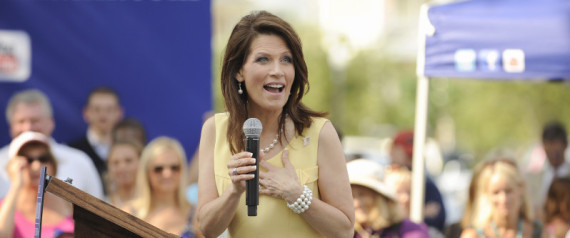
Michele Bachmann: As President, I'll Create 'Real Jobs' For Obama, Timothy Geithner

MARSHALLTOWN, Iowa — Republican candidate Michele Bachmann spent Saturday shaking hands in Iowa diners and strolling through a bustling farmers market as she tried to capitalize on her early popularity in the state that kicks off the presidential campaign season.

An Iowa native, the tea party favorite ranked nearly even with GOP frontrunner Mitt Romney in a recent poll of Republicans likely to participate in the state's lead off caucuses next year. But just six weeks before the state's closely-watched straw poll, the Minnesota congresswoman has done little to campaign or set up an organization here.

Beginning her first sustained campaign trip to Iowa as an announced candidate, Bachmann introduced herself to audiences from Iowa City to Des Moines in a new campaign bus emblazoned with her name. She spent much of Saturday posing for pictures and signing autographs rather than in meetings with key GOP activists.

"I have every confidence our team is going to deliver," Bachmann told The Associated Press after meeting about 100 supporters and politically curious Iowans at a stop in Marshalltown. "I am going to be here in Iowa campaigning all through July."

Proof that her Iowa campaign was still coming together met Bachmann in Iowa City, where she met about 100 weekend breakfast regulars and Republican activists at the Bluebird Diner near the University of Iowa. Local resident Sheila Reiland told Bachmann's campaign chairman in the crowded diner that she signed up last week on Bachmann's website to volunteer but had heard nothing from any campaign staff.

Full Article
Source:

Senate Reform for the People, Not the Politicians

Reform of the Canadian Senate is long overdue; a respected, elected second house of Parliament is needed more than ever to ensure diverse regional concerns are well-articulated and integrated into national action in order to deal with critical 21st century challenges and to ensure a respected Canadian voice in world affairs.

Yet Canadians are being misled by our Conservative government into believing that mere tinkering -- nine year term limits, à la carte elections -- with a Senate structure dating back to the 19th century is sufficient, and by the opposition NDP and some provincial premiers that believe outright abolition of the Senate is even better.

Both the government and official Opposition are conspiring to dumb down a very important debate affecting the fundamental nature of the Canadian federation and our coherence as a nation. The choice presented between no Senate and a partially reformed Senate, is really not a choice at all. Both options lead to an increasingly dysfunctional and discredited Parliament.

Senate reform is too important a component of any serious plan for improving the functioning of Canadian democracy to be left to legislative fiat by shortsighted politicians. Rather, the people of Canada must be directly engaged in the debate over this vital issue and ultimately consulted through a national referendum.

Without a Senate with more democratic legitimacy, our national leaders have increasingly deferred to provincial premiers on matters of national concern in unaccountable federal-provincial negotiations. The national interest is too often now equated with the haphazard sum of disparate provincial government interests, dependent on highly improbable provincial government cooperation for even minimal lowest common denominator national standards or action.

The result is no national action on climate change, an increasing patchwork of healthcare policies, no national clean energy strategy, crumbling national infrastructure, a stalemate on pension reform. This ongoing drift toward national incoherence has not only failed Canadians but also led to Canada's increasing insignificance on the global stage. Among other things, we are ignored in international climate change discussions and no longer considered worthy of a UN Security Council seat. And with our recent infamous U.N. vote blocking the addition of asbestos as a hazardous chemical, assuring a few votes for the premier of Quebec and the prime minister trumped incalculable damage to Canada's international reputation and any semblance of moral leadership, relegating Canada to the sidelines of history along with Ukraine, Kazakhstan, Kyrgyzstan and Vietnam.

The time is overdue to re-imagine a more robust, elected Senate that provides a valuable counterweight to the purely provincialist perspective voiced by individual premiers in current federal-provincial forums. To this end, we have to consider the role of the Senate in representing regional concerns in a more imaginative and truly democratic way. The Senate is not meant for representing the interests of regional economic and political elites as defined by provincial governments. Regionalism is not the same as provincialism. Regionalism at its best reflects the fact that in such a large and geographically diverse country as Canada, with a highly uneven population distribution, national policies will only be effective if regional concerns are acceptably integrated into a workable national framework. And this process will only find success if it is carried out in an open, transparent parliamentary forum committed to the best interests of Canada as a whole, and accountable to all Canadians, not just provincial premiers.

Full Article
Source: Huffington  

Separate, and Unequal

Harper's plan to expand the number of seats in the House addresses a serious injustice.


Prime Minister Stephen Harper recently announced that the number of seats in the House of Commons will be expanded through legislation, increasing the number of members of Parliament from Ontario, British Columbia, and Alberta. This legislation will help rectify an unfair allocation of seats that has disadvantaged Canada’s fastest-growing provinces for many years, and it deserves the support of all Canadians.

Some politicians around the country have objected to the allocation of these new seats, on the grounds that it will dilute the influence of their own provinces. Quebec Premier Jean Charest, for example, has been a prominent opponent of the government’s plan. Objections of this narrowly self-interested sort are disappointing given that the government’s legislation will help redress an imbalance in representation that has caused votes in some provinces to have less weight than votes in others.

For example, MPs in Saskatchewan currently represent, on average, approximately 75,000 residents. In Alberta, British Columbia, and Ontario, the average MP represents more than 124,000 residents. This is a gross violation of the “representation-by-population” principle, which holds that each province’s share of the seats in the lower house should be similar to its share of the country’s population. Under the current rules, a vote in Saskatchewan is worth approximately 40 per cent more than the national average, and over 50 percent more than a vote in any of the three underrepresented provinces.

Saskatchewan is not an outlier. Residents of Manitoba and all four Atlantic provinces are significantly overrepresented in the House of Commons in relation to their populations. Consider the fact that the combined population of these provinces is almost identical to the population of Alberta, yet Alberta has only 28 seats in the House of Commons, while these five provinces have a total of 46.

The current arrangements seem particularly unfair considering that visible minorities and new Canadians are disproportionately located in the major urban centres of Ontario, British Columbia, and Alberta. Of course, these groups are represented in all provinces, but their heavy concentration in the underrepresented provinces means visible minorities and new Canadians are particularly likely to be among those whose votes carry the least weight. An unintended consequence of the current system is that the votes of visible minorities and immigrants, on average, count for less than the votes of Canadians who are not members of these groups.

Canada’s flagrant violations of the representation-by-population principle are anomalous by international standards. In a recent study, the Toronto-based Mowat Centre for Policy Innovation compared patterns of representation in national legislatures in five federal democratic countries. Of the five, the analysts found that Canada stood out as “the worst violator of the rep-by-pop principle.” In fact, of the 113 sub-national jurisdictions that they examined in those five countries, the Mowat researchers found that Ontario, British Columbia, and Alberta ranked first, third, and fifth, respectively, in terms of underrepresentation.

Constitutional rules, and some unique elements of the geographical distribution of Canada’s population, mean that perfect representation-by-population may be impossible. Prince Edward Island and the territories, for example, will probably be overrepresented for a long time, due to their small populations. These sorts of small compromises are acceptable to most Canadians. However, there is no justification for the present situation that disadvantages specific provinces so severely.

A foundational principle of our democracy is that all voters should have a roughly equal level of influence. The current allocation of seats in the House of Commons violates this principle, disadvantaging Canada’s fastest growing provinces. All Canadians benefit, in the long term, from a fair system of representation that adapts to demographic change. Canadians from sea-to-sea should therefore applaud the government’s decision to expand the number of parliamentary seats in Ontario, British Columbia, and Alberta to more accurately reflect their populations.

Origin
Source: The Mark