
Showing posts with label Anti-Science. Show all posts
Showing posts with label Anti-Science. Show all posts
Thursday, October 05, 2023
The GOP Turned Its Back on Science. So Science Turned Its Backs on the GOP
Tuesday, June 20, 2017
Justice Ginsburg tells Texas to stop ignoring science

A 5–3 Supreme Court announced this decision in Moore v. Texas, in an opinion written by Justice Ruth Bader Ginsburg. Justice Anthony Kennedy, a conservative with relatively moderate views on the death penalty, crossed-over to vote with the Court’s four liberals.
Sunday, November 15, 2015
Science by the Chemical Industry, for the Chemical Industry Must Stop

So when his 1989 British Medical Journal (BMJ) study purported to show the benefits of "hypo-allergenic" infant formula in reducing the risk of eczema in infants, no one raised concerns about the doctor's connection to infant formula maker Mead Johnson, which had funded the research.
Monday, October 19, 2015
Next in Harper's War on Science Crosshairs: Health Research

Rooting around in a dumpster looking for treasure is unseemly and demeaning for anyone. Maybe more so when the dumpster diver happens to be a federal agricultural scientist who is trying to save some choice publications from being destroyed after a federal agricultural library in Lethbridge, Alberta is closed down. Seems pathetic, right?
Thursday, October 15, 2015
Canada's War on Science Brings Us International Shame
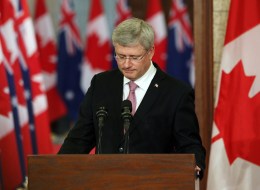
The group surveyed higher education and research unions in 12 countries including France, Argentina, Canada, Denmark, Italy, Portugal, Russia, Senegal, Serbia, Spain, the U.K. and the U.S.
Tuesday, September 22, 2015
Vanishing Canada: Why we’re all losers in Ottawa’s war on data
 When told that his small Prairie town had, in profound ways, fallen off the statistical map of Canada, Walter Streelasky, mayor of Melville, Sask., is incredulous. Streelasky had no idea Melville had been rendered a “statistical ghost town” after the mandatory long-form census was cut in 2010, and fewer than 50 per cent of the one third of Melville’s 4,500 residents who got the voluntary National Household Survey that replaced it in 2011 completed the form. Melville still exists—but as a shadow. We know how many people live there, but nothing about them—where they work, their education levels, whether they’re married, single or divorced, how many are immigrants, how many are unemployed, how many live in poverty. Melville’s numbers, then, aren’t factored into Canadian employment numbers or divorce rates or poverty rates. According to Sask Trends Monitor, the high non-response rate in the province resulted in “no socioeconomic statistics about the populations in about one-half of Saskatchewan communities.” Nationally, we’re missing similar data on 20 per cent of StatsCan’s 4,556 “census subdivisions,” making a fifth of Canada’s recognized communities statistical dead zones.
Tuesday, September 15, 2015
It's Time for Action on Canada's Muzzled Scientists
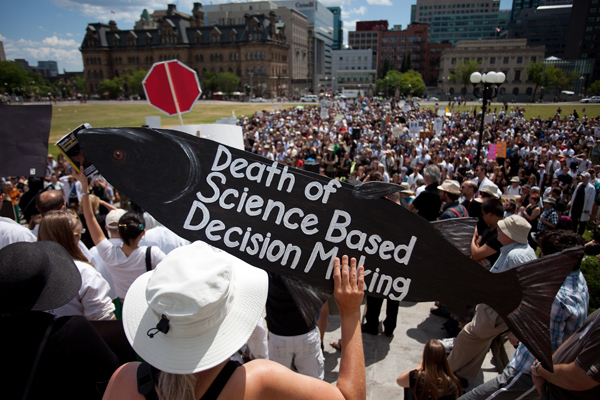
There's evidence that scientists are being silenced, and that the government has been misleading the public and Parliament about it. The damage to the public interest is extensive and ongoing.
Sunday, September 13, 2015
Canada’s science performance, down the memory hole

I have written about the Science, Technology and Innovation Council every two years since it produced its first major report, in May 2009. STIC, as it’s known, is not some fringe group of pinko malcontents trying to stir up trouble and turn the people against their right and proper governing party. It was conceived by the Harper government (in 2007), appointed by the Harper government (in bits ever since), and it consists, in part, of senior officials who work with the Harper government every day. Its current membership include: the presidents of three universities and the Institute for Quantum Computing; the federal deputy ministers of health and industry; and a bunch of CEOs in tech and energy.
Friday, August 28, 2015
Cuts to MD/PhD funding greeted with 'horror' by medical scientists

The Canadian Institutes of Health Research is the federal government's major health science research organization. Its MD/PhD program was launched in the 1980s out of concern over the lack of specialists who could move easily between the lab and hospital.
Another federal scientist fired in Harper's ongoing war on science
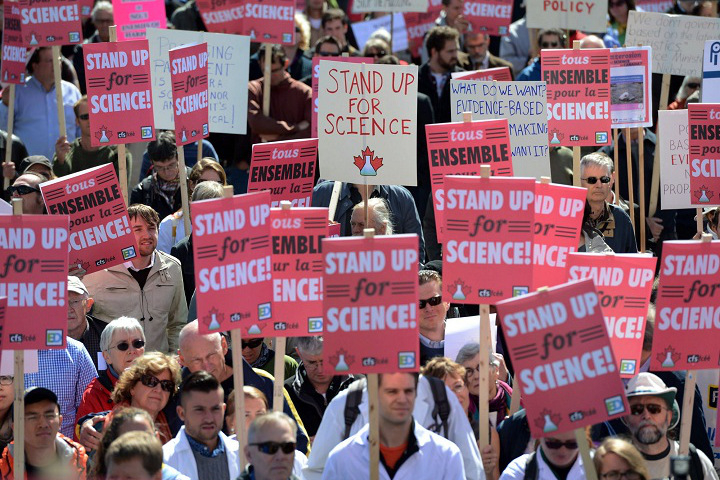
This government has used a culture of fear— achieved by de-funding, and the strategic dismissal of key leaders— as a means to suppress the flow of information from federal scientists. This ‘muzzling’ of researchers has been noticed in Canada and indeed around the world.
Tuesday, August 04, 2015
Thursday, February 05, 2015
Scott Walker Objects to ‘the Search for Truth’

Americans have returned to the question of whether the Republican Party has launched a “war on science”—as 2016 presidential prospects Chris Christie and Rand Paul have abandoned public-health imperatives in order to feed skepticism about whether children should be vaccinated against infectious diseases.
But Wisconsin Governor Scott Walker has trumped his fellow 2016 contenders.
Walker is launching a war on the truth.
Literally.
Monday, December 29, 2014
Stephen Harper government confuses science for mere opinion

In March 2013, then-Minister of Natural Resources Joe Oliver advanced the view that U.S. President Barack Obama is — on the Keystone XL issue, at least — “driven by facts,” adding “and that’s what drives us as well.”
He reiterated this assertion several months later in response to a blistering New York Times editorial that accused the Harper government of muzzling government scientists in an “attempt to guarantee public ignorance.” Americans, said Oliver, are entitled to their opinions but he would find it “refreshing if they confined themselves to the facts and science.”
Wednesday, November 26, 2014
House Passes Bill That Makes It Harder For Scientists To Advise The EPA

The House voted 229-191 to pass H.R. 1422, which would change the rules for appointing members to the Science Advisory Board (SAB), a group that gives scientific advice to the EPA Administrator. Also called the Science Advisory Board Reform Act, the bill would make it easier for scientists with financial ties to corporations to serve on the SAB, prohibit independent scientists from talking about their own research on the board, and make it more difficult for scientists who have applied for grants from the EPA to join the board.
Saturday, November 22, 2014
G20: Australians bury heads in sand to mock government climate stance
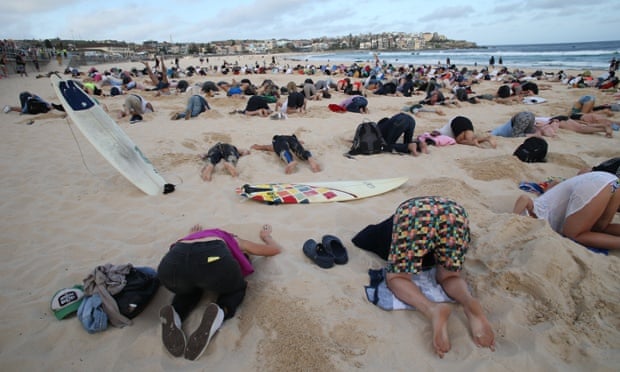
Prime minister Tony Abbott’s perceived failure to address climate change is all the more galling in the wake of an agreement between the United States and China on Wednesday to limit their carbon emissions, they said.
Thursday, October 30, 2014
New report documents federal clampdown on scientists' freedom of expression

How has the Harper government reacted? A new report, Can Scientists Speak, finds that federal media policies remain far more restrictive than those in the United States, and gives low to failing grades to nearly all 16 departments that employ scientists.
Thursday, October 23, 2014
Foreign scientists call on Stephen Harper to restore science funding, freedom

The call was made in an open letter drafted by the Cambridge, Mass.-based Union of Concerned Scientists, a group that represents U.S. scientists and uses science to advocate for environmental sustainability.
Thursday, October 16, 2014
How Did We Become a Society Suspicious of Science?

Wednesday, October 15, 2014
Scientists rail against imposed ignorance

They formed a collective called Scientists for the Right to Know.
They compiled a list of all the public agencies that have been eliminated, all the science and knowledge-based programs that have been discarded and all the strictures that have been placed on public officials. They created a website. They urged their academic peers to speak out.
Eye-opening research stopped in its tracks

It took Tony Clement five minutes — if that — to destroy Hulchanski’s mapping device.
“My research has been turned into a historical project,” the pioneering urban planner said disconsolately.
Subscribe to:
Posts (Atom)