Democracy Gone Astray

Democracy, being a human construct, needs to be thought of as directionality rather than an object. As such, to understand it requires not so much a description of existing structures and/or other related phenomena but a declaration of intentionality.
This blog aims at creating labeled lists of published infringements of such intentionality, of points in time where democracy strays from its intended directionality. In addition to outright infringements, this blog also collects important contemporary information and/or discussions that impact our socio-political landscape.

All the posts here were published in the electronic media – main-stream as well as fringe, and maintain links to the original texts.

[NOTE: Due to changes I haven't caught on time in the blogging software, all of the 'Original Article' links were nullified between September 11, 2012 and December 11, 2012. My apologies.]

Friday, October 28, 2011

Is Tory penchant for capping Commons debate efficient – or arrogant?


For the fifth time since they took office as a majority government in May, the Conservatives have limited debate on a key piece of legislation.

This week it was the dismantling of the gun registry. Before that it was the bill to end of the wheat board’s monopoly, the omnibus crime bill and two budget bills.

Prime Minister Stephen Harper is determined to push these items – some of which have been on his agenda for a very long time – through Parliament with as little opposition input as possible.

But the tactic has New Democrats crying foul.

“This will be the fifth time in 38 days of sitting that time allocation has been imposed,” Opposition House Leader Joe Comartin said Thursday when it became apparent that debate on the gun registry legislation would also be cut short.

"Blood on the Tracks": Brian Willson’s Memoir of Transformation from Vietnam Vet to Radical Pacifist

Today we spend the hour with a man who put his life on the line twice: once when he served in the Vietnam War and again when he came back. On September 1, 1987, Brian Willson took part in a nonviolent political action outside the Concord Naval Weapons Station in California. He sat down on the train tracks along with two other veterans to try to stop a U.S. government munitions train sending weapons to Central America during the time of the Contra wars. The train didn’t stop. Willson suffered 19 broken bones, a fractured skull and lost both of his legs. "Before, I had spent many months in Nicaragua in the war zones, and I had been to El Salvador talking to guerrillas and talking to human rights workers, understanding the incredible extent of murders that were going on and maimings and displacements, because of fear of being murdered," Willson said. He decided, "I have to at least escalate my own nonviolent occupation, if you will, of the tracks." In retrospect, Willson added, "I regret that I lost my legs, but I don’t regret that I was there. I did what I said I was going to do... Following orders, I discovered, is not what I’m about." Today, he is traveling the country visiting solidarity protests with Occupy Wall Street, where some of his fellow protesters are also veterans. He’s also been talking about his new memoir, "Blood on the Tracks: The Life and Times of S. Brian Willson." On the West Coast, he completed much of the tour on his handcycle.

Video
Source: Democracy Now! 

E. B. White on the Bonus Army

Both Frank Rich, in New York magazine, and Brent Cox, at the Awl, this week use the Bonus Army—an encampment, in 1932, of thousands of veterans of the First World War and their supporters in Washington—as a way of offering historical perspective on the Occupy Wall Street movement. The Bonus Army was big news in those waning days of the Hoover Administration and, in the summer of 1932, E. B. White devoted three Comment columns to the protest and the economic woes it highlighted. While deeply sympathetic to the plight of the jobless in the Great Depression (see this Comment from earlier in the year), White was largely dismissive of the Bonus Army.

The protests had begun with a simple demand: the early payment of a “bonus” due to veterans in 1945, to help them through the Depression. But that message was mixed with more general calls for jobs and even revolution. In the first of his columns, published in the issue of June 25, 1932, White, like many of Occupy Wall Street’s critics, took the protesters to task for their lack of focus:
In a democracy, there are a thousand, ten thousand groups…. Each has its own particular sorrow and its grievance; there exists no common tyranny against which to rebel, not even the tyranny of hard times. If you mixed bonus marchers with Kentucky miners, they would probably spend the rest of their lives arguing about what to rebel against.

Meet the 0.01 Percent: War Profiteers

There's the top 1% of wealthy Americans (bankers, oil tycoons, hedge fund managers) and there's the top 0.01% of wealthy Americans: the military contractor CEOs.

If you've been following the War Costs campaign, you already know that these corporations are bad bosses, bad job creators and bad stewards of taxpayer dollars. What you may not know is that the huge amount of money these companies' CEOs make off of war and your tax dollars places them squarely at the top of the gang of corrupt superrich choking our democracy. These CEOs want you to believe the massive war budget is about security -- it's not. The lobbying they're doing to keep the war budget intact at the expense of the social safety net is purely about their greed.

In many areas, including yearly CEO salary and in dollars spent corrupting Congress, these companies are far greater offenders than even the big banks like JP Morgan Chase or Bank of America.

Hispanic Kids Being Bullied In Alabama Immigration Law's Wake

BIRMINGHAM, Ala. -- It was just another schoolyard basketball game until a group of Hispanic seventh-graders defeated a group of boys from Alabama.

The reaction was immediate, according to the Mexican mother of one of the winners, and rooted in the state's new law on illegal immigration.

"They told them, `You shouldn't be winning. You should go back to Mexico,'" said the woman, who spoke through a translator last week and didn't want her name used. She and her son are in the country illegally.

Spanish-speaking parents say their children are facing more bullying and taunts at school since Alabama's tough crackdown on illegal immigration took effect last month. Many blame the name-calling on fallout from the law, which has been widely covered in the news, discussed in some classrooms and debated around dinner tables.

Justice Department officials are monitoring for bullying incidents linked to the law.

"We're hearing a number of reports about increases in bullying that we're studying," the head of the agency's civil rights division, Thomas Perez, said during a stop in Birmingham.

New Social Justice Index Places U.S. Near Bottom

WASHINGTON -- A central concern for those in the Occupy movement -- that the economic system in the U.S. is rigged in favor of the well-off -- has been corroborated by a major new survey of developed nations.

When it comes to social justice -- defined here as the ability each individual has to participate in the market society, regardless of their social status -- the United States ranks near the bottom of 31 developed countries, the Thursday report from Bertelsmann Foundation found.

It's one thing if you live in a market economy where everyone has the same shot at success. It's quite another if fortune favors the fortunate. And the new survey found that when it comes to "equal opportunities for self-realization," the U.S. ranks 27 out of 31 Organisation for Economic Co-operation and Development member states, well behind not just Northern European countries like Norway and Denmark, but even countries like Hungary, Poland, Italy and France. The only countries whose citizens fare even worse are Greece, Chile, Mexico and Turkey.

Herman Cain's Distrust Of Minimum Wage Goes Back To Restaurant Days

WASHINGTON -- Questioning America's minimum wage has somehow become a rite of passage in the Republican presidential primary.

Michele Bachmann has said she wouldn’t rule out lowering it. Ron Paul has predictably said it should be eliminated entirely. And Rick Perry, in his book "Fed Up!: Our Fight to Save America from Washington", has rued the role the commerce clause played in "creating national minimum-wage laws" and "establishing national labor laws."

But when it comes to battling our $7.25-an-hour wage floor, these contenders have neither the vision nor the resume of current frontrunner Herman Cain.

In his plan for economic "Opportunity Zones," Cain offers a slate of proposals aimed at revitalizing depressed pockets of the country, including zero capital gains and payroll taxes within qualifying areas. Although it doesn’t say so explicitly, the Cain campaign's primer on opportunity zones also suggests the possibility of rolling back minimum-wage laws in impoverished areas.

"Minimum wage laws prevent many unskilled and inexperienced workers (i.e. teens) from getting their first job and prices them out of the market," the plan says, listing a number of potential "solutions" to urban poverty.

Scott Walker Developing Plan To Allow Guns In Wisconsin State Capitol

The administration of Republican Gov. Scott Walker is developing a plan to allow guns in most parts of the Wisconsin State Capitol, reports the Milwaukee Journal-Sentinel. Under the plan, the state Supreme Court hearing room would not allow guns.

Walker signed a bill allowing the public to carry concealed weapons, provided they pass a four-hour training course and a background check. That law takes effect Nov. 1.

During the protests over a bill curtailing most collective bargaining rules last February, the administration installed metal detectors at the Capitol but removed them in June.

Florida recently allowed concealed carry permit holders to carry weapons into more parts of the Capitol.

Kentucky, New Hampshire, New Mexico, Utah, Minnesota, Idaho, Oregon, Washington, Texas and Virginia all allow guns in state Capitols with varying restrictions ranging from nothing to only allowing guns with permission from state police.

Origin
Source: Huff 

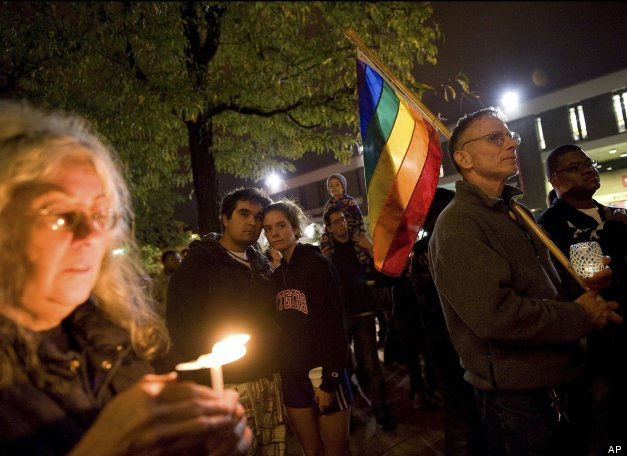
Attack On Gay Student By Bully At Union-Scioto High School In Chillicothe, Ohio, Caught On Video

A shocking video of a gay student being beaten at Union-Scioto High School in Chillicothe, Ohio, has surfaced reports Channel 6 WSYX news.

In the clip, which was filmed on a cell phone and then posted to Facebook, the attacker, who has not been named, can be seen waiting for the gay student, who wishes to remain anonymous, in a classroom.

Once the student arrives, the bully begins severely beating "the holy living crap out of him," says his mother.

Even though the boy tried to get away and asked "Why are you doing this?" the attack continued.

WSYX reports the student received a possible concussion and a chipped tooth.

The student also says that the perpetrator wrote "Check out the definition of a faggot" on his Facebook page two days earlier.

Long-Gun Registry: Quebec Says It Will Fight Harper Government On Destroying Data

QUEBEC - The Harper government's plan to not only kill the long-gun registry but subsequently bury its data has run into resistance in Quebec, which wants to bring the controversial program back from the dead.

The provincial government says it intends to keep using the gun registry on its territory and will fiercely oppose plans to destroy the data.

Speaking at a news conference in Quebec City, Public Security Minister Robert Dutil refused Wednesday to rule out legal action among his options.

A spokesman later explained that the province's Plan A is to maintain a repectful dialogue with Ottawa and negotiate a mechanism to save the records. If that fails, Plan B options will be weighed.

Quebec had already announced months ago it wanted to keep using some kind of long-gun registry if the Harper government killed the federal version, as expected.

But this week Ottawa made it clear that, in addition to destroying the registry, it would also eliminate the data compiled over the past decade.