Democracy Gone Astray

Democracy, being a human construct, needs to be thought of as directionality rather than an object. As such, to understand it requires not so much a description of existing structures and/or other related phenomena but a declaration of intentionality.
This blog aims at creating labeled lists of published infringements of such intentionality, of points in time where democracy strays from its intended directionality. In addition to outright infringements, this blog also collects important contemporary information and/or discussions that impact our socio-political landscape.

All the posts here were published in the electronic media – main-stream as well as fringe, and maintain links to the original texts.

[NOTE: Due to changes I haven't caught on time in the blogging software, all of the 'Original Article' links were nullified between September 11, 2012 and December 11, 2012. My apologies.]

Friday, October 28, 2011

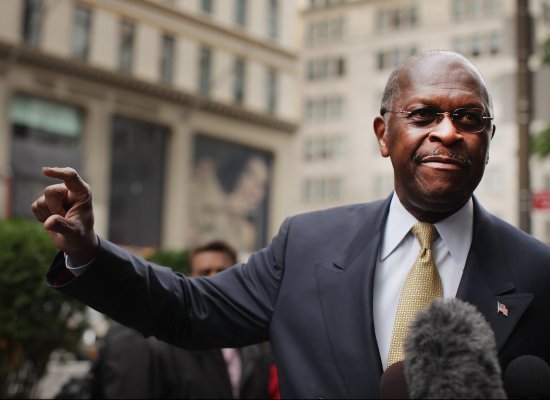
Herman Cain: Occupy Wall Street Protesters Should 'Go Home And Get A Job And A Life'

Republican presidential hopeful Herman Cain shot down the efforts of the Occupy Wall Street protesters Thursday, telling them to "go home and get a job and a life" while speaking to a crowd in Arkansas.

The former CEO of Godfather's Pizza made the comments in response to more than a dozen Occupy protesters who were gathered outside the event, according to the Tolbert Report. "Nobody knows what their cause is," Cain said before telling the activists to go home.

Cain also had harsh words for the left in general during the campaign stop, saying "the American dream has been hijacked" by liberals, "but we can take it back."

Can Newt Be the First Openly Mean President?

We are officially in the midst of a Newt Gingrich boom.

You didn't notice? ABC News, pointing out that the former House speaker has leaped to third place in the GOP 2012 contest with 10 percent support in a recent poll, reports, "For Newt Gingrich, the tides seem to have turned." The Washington Post's political über-junkie Chris Cillizza writes, "Don't call it a comeback! Actually, do. Sort of." He notes that a series of decent debate performances have vaulted Gingrich, whose campaign has been marred by profound disorganization and embarrassing revelations about Tiffany's expense accounts, into the tier between top-tier and second-tier, behind Herman Cain and Mitt Romney. So with the Newt rehab underway, it may be an opportune time to ask, is Gingrich too mean to be president?

Gingrich is by far the nastiest of the pack. Last spring, Tim Murphy and I posted a compendium of the highlights—or lowlights—of his three-decades-long career of rhetorical bomb-throwing. From the moment he was first elected to Congress in 1978, Gingrich has made mudslinging a specialty. He has routinely compared opponents to Nazis or to Nazi appeasers. (It can be confusing.) He has counseled fellow Republicans to accuse Democrats of treason. Last year, he derided President Obama for being "fundamentally out of touch with how the world works" and asked, "What if [Obama] is so outside our comprehension that only if you understand Kenyan, anti-colonial behavior, can you begin to piece together [his actions]? That is the most accurate, predictive model for his behavior."
NYPD Sergeants Union Blasts Protesters In Oakland For Violence

NEW YORK -- A union representing 5,000 New York City Police Department sergeants blasted Occupy Wall Street protesters on Thursday and threatened to sue them should they injure police.

"New York's police officers are working around the clock as the already overburdened economy in New York is being drained by 'occupiers' who intentionally and maliciously instigate needless and violent confrontations with the police," said Ed Mullins, president of the Sergeants Benevolent Association. Although sergeants are higher in rank than patrol officers, they do not wear the white shirts of some of the more senior officers.

Protesters have at times played confrontational cat-and-mouse games with the police, but incidents of serious violence directed against the NYPD by protesters in New York have been extremely rare.

What We Didn't Know About The War In Afghanistan

It sometimes feels as if our distant war in Afghanistan never really happened, so rarely is it analyzed or discussed any more.

Perhaps we all feel it's over and done with. But wars never let you get away that easily. One can only hide for so long from history before its inconvenient facts seek you out and demand answers.

Such is the case with "Lessons learned? What Canada should learn from Afghanistan," a 54-page study for the Canadian Defence and Foreign Affairs Institute and a powerful examination of our stunningly incoherent approach to that war.

The writers are two of our most respected military historians, professor emeritus Jack Granatstein and David Bercuson, of the University of Calgary, who also happen to be two well-known supporters of the war.

Ottawa looks at rewriting rules on charitable giving

Ottawa is conducting a sweeping overhaul of the way it finances charities and non-profit organizations, pledging a new era of accountability in which businesses and citizens shoulder more of the cost of giving.

The government’s lead minister for the changes said financing will come with more strings attached in an effort to ensure that organizations deliver promised social gains.

While the first steps will be small, the government’s ultimate goal is a shift in public expectations as to the role of government in assisting social causes.

The plan is inspired by British Prime Minister David Cameron’s Big Society experiment, in which social responsibilities that traditionally fell to the state are put in the hands of the citizenry and private sector.

What Brazil knows that we don’t

This week we are wondering whether the government of Canada thinks it’s more important to talk or to act.

Every now and then, Stephen Harper’s government phones up some experts and asks them to lead a panel and come up with smart advice. Then it ignores the advice. In 2008 it asked a businessman named Red Wilson for advice on making Canada more competitive. Wilson offered 65 recommendations. Most were never implemented. This fall there are new reports, from businessman Tom Jenkins on corporate R&D, and from career soldier Andrew Leslie on the structure of the military. We’ll see whether they do better.

Meanwhile, every week brings a new panel. In October, Ed Fast, the trade minister, was in China announcing a panel to come up with advice on “an international education strategy.”

The “goal” of such a strategy, the news release’s headline said, would be “Stronger Ties with World’s Best and Brightest in Priority Markets.” And how important would the strategy be? Glad you asked. It would be “critical to Canada’s continued economic growth and prosperity,” Fast said. It’s a good panel, as these panels always are. Its chairman is Amit Chakma, who has been making waves as the president of my alma mater, the University of Western Ontario. It’s supposed to report early in the new year.

At which point the horse will already have well and truly left the barn.

Feds want to destroy long-gun registry records to appease ‘tinfoil hat’ elements of gun-owning community, says Champ

PARLIAMENT HILL—Prime Minister Stephen Harper’s Conservative government is set to destroy massive records on owners of rifles and shotguns to appease “tin-foil hat” elements of the gun-owning community, says a prominent human rights lawyer.

Ottawa lawyer Paul Champ, who represented a Parliament Hill journalist in a long court battle getting access to government records, said the government, which plans to destroy the records after a bill terminating the long-gun registry clears Parliament, told The Hill Times on Thursday the government is likely trying to “pander” to rifle and shotgun owners who fear a successive government may try to use the data base, containing records on seven million firearms, to seize the guns.

Mr. Champ said the claim by Public Safety Minister Vic Toews (Provencher, Man.) that the aim is to prevent another government from reinstating the registry is not believable, since by then, with 2015 the earliest possible time a different government could be elected, the information would be out of date and unreliable.

Any new registry would have to be started essentially from the ground up.

Michael Den Tandt: F-35 project is ‘slowly unravelling’

OTTAWA — The Conservative government’s controversial F-35 jet fighter project, plagued by delays, cost overruns and now economic turmoil in Europe, is at growing risk of being sharply curtailed or shelved — the defence minister’s protestations notwithstanding.

“It just seems like it’s slowly unravelling,” said an industry insider who specializes in aircraft procurement. “It’s a mess.”

Peter MacKay has doggedly championed the Royal Canadian Air Force plan to purchase 65 “fifth-generation” Lockheed Martin Lightning stealth fighters to replace Canada’s aging fleet of CF-18s. Last week MacKay sought, with only limited success, to deflect reports that the first batch of planes built by Lockheed will be incapable of communicating in Canada’s far North.

This minister has a knack for projecting blithe confidence. But in this instance he is increasingly offside with other members of the cabinet and with the Prime Minister’s Office, sources familiar with the situation say.

Kevin Libin: What the West wants next

Spend enough time driving around Alberta and you might still spot, on the very occasional older model vehicle, the yellow, Reform-era bumper sticker: “No Kyoto, no wheat board, no gun registry.” Those were radical enough ideas back in the mid-’90s that angry Westerners felt it important to brandish them rebelliously on their pickups and minivans.

They might as well scrape them off now: Canada’s obligations under the Kyoto accord have been tossed aside; the Conservatives’ bill to deregulate the wheat board is en route to a third reading in the House; and the government tabled a bill to kill the gun registry Wednesday.

Prime Minister Stephen Harper came to Ottawa with a checklist of Western grievances he had committed to relieving. At the time it seemed like a long one. Turns out it wasn’t: After little more than five years in power, what early priorities he hasn’t scuttled — such as the Reform party’s one-time tendencies toward social conservative policy and populist democratic reforms — he’s nearly finished. He’s adding Western seats (as well as Ontario) in the House of Commons, and has almost reached the limit on Senate reform — setting term limits, encouraging provincial elections — at least till someone next has the nerve to reopen the Constitution.

Canada may buy nuclear submarines

Harper government considers mothballing 4 British-made diesel subs


CBC News has learned the Harper government is considering buying nuclear submarines to replace its problem-plagued fleet of diesel-powered subs, all of which are currently awash in red ink and out of service for major repairs.
The four second-hand subs Jean Chrétien’s Liberal government bought from the British navy in 1998 for $750 million were portrayed at the time as the military bargain of the century.
Instead, they have spent almost all of their time in naval repair yards, submerging Canadian taxpayers in an ocean of bills now totalling more than $1 billion and counting.
One of the subs, HMCS Chicoutimi, has been in active service of the Royal Canadian Navy exactly two days in the 13 years since it was purchased from the Brits.
The Chicoutimi caught fire on its maiden voyage from the U.K. to Canada, killing one sailor and injuring a number of others.