Democracy Gone Astray

Democracy, being a human construct, needs to be thought of as directionality rather than an object. As such, to understand it requires not so much a description of existing structures and/or other related phenomena but a declaration of intentionality.
This blog aims at creating labeled lists of published infringements of such intentionality, of points in time where democracy strays from its intended directionality. In addition to outright infringements, this blog also collects important contemporary information and/or discussions that impact our socio-political landscape.

All the posts here were published in the electronic media – main-stream as well as fringe, and maintain links to the original texts.

[NOTE: Due to changes I haven't caught on time in the blogging software, all of the 'Original Article' links were nullified between September 11, 2012 and December 11, 2012. My apologies.]

Friday, March 09, 2012

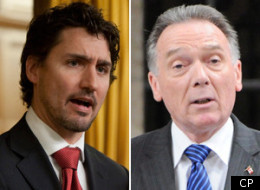
Justin Trudeau On Peter Kent: Calling Environment Minister A ‘Piece Of S**t' Was Ugly But It Worked

Justin Trudeau may have a famous last name, but much like Hillary Clinton he’s quickly making his first name the one that matters.

The MP's name recognition received a huge boost last December when Trudeau mirrored his father Pierre’s infamous “fuddle-duddle“ incident by referring to Environment Minister Peter Kent as a “piece of s***.”

The excremental epithet was launched during a contentious Question Period debate over Canada’s withdrawal from the Kyoto Protocol. Though he immediately apologized and says he’s still “not proud of having to use un-parliamentary language,” Trudeau told The Huffington Post Canada that in hindsight he’s happy his choice of words had the impact they did.

At the time, Kent said he understood the "Liberal rump is somewhat out of sorts as this government corrects one of the biggest blunders the previous Liberal government ever made," referring to Kyoto. He said he wasn't bothered by Trudeau's outburst, but did call for an apology.

Commons poised to cut jobs, but not as severely as first feared, says Comartin

The House of Commons is poised to unveil the results of its spending review — a review that will mean job cuts in the Parliamentary precinct, iPolitics has learned.

NDP House leader Joe Comartin, spokesman for the powerful Board of Internal Economy — which has been going through Parliament’s spending with a magnifying glass for months — says the strategic and operating review is almost done and could be complete as soon as next Monday. At the latest, it would be the week of March 26 when the House returns after a break.

While Comartin refused to reveal exactly what kinds of cuts the board is contemplating, he confirmed it will mean fewer jobs on Parliament Hill.

“It certainly is inevitable that we’re going to lose staff – there’s no question of that. At this point, we don’t have a grasp of the numbers because of attrition and vacancies that exist.”

How those job cuts are implemented and will be up to the House’s administration, he said.

On robocalls, reporters dig while pundits sit and snipe

It’s at times like these that I miss being part of a newsroom. I miss chasing an important story with the sometimes-exhilarating mixture of excitement, adrenalin and a whiff of angst experienced by investigative reporters.

The angst, of course, derives from being scooped by fellow investigative reporters who, while temperamentally colleagues, are also fierce competitors. That would have certainly been the case if I was still sitting at my ramshackle desk at The Globe and Mail and having to pick up a copy of this newspaper to read the fine work of reporters Glen McGregor and Stephen Maher as they broke open the robocall scandal now engulfing Ottawa.

Alas, since I long ago vacated the pressure-packed world of daily news as an investigative reporter, I have had to resign myself to being a spectator of sorts. Like millions of Canadians, I have read McGregor and Maher and a bevy of other talented and determined investigative reporters — in print and broadcast media — go about the hard, painstaking work of trying to unearth the truth about whether there was a concerted effort by the Conservative party or its agents to suppress the vote across the country during the last election.

Sweeping Tory budget plans are breathtaking in scope

In a sharp break from their first two mandates, the Harper Conservatives are preparing to unveil a budget that is revolutionary rather than evolutionary, one that will introduce sweeping structural changes in key areas of federal policy. Politically, from the government's standpoint, that won't happen a moment too soon — even if the budget provokes great controversy, which it most certainly will.

Whether in trade, immigration, retirement benefits, resource development, innovation or fiscal policy, Conservative insiders say, the years of plodding, minority-era "incrementalism" are over. Indeed, there's a sense within Conservative ranks that their moment of truth, a chance to distinguish themselves from the other parties in stark terms and establish a lasting legacy, has arrived.

"Everybody's going to be busy for a long time reporting about it," said one insider, speaking of the coming budget, to be handed down by Finance Minister Jim Flaherty on March 29.

The subtext: Unless the robocalls scandal mutates like a super flu into something as-yet-unseen — specifically, unless evidence emerges that the Conservative Party or its national campaign knew about or participated in electoral fraud, something the prime minister and campaign chair Guy Giorno have categorically denied — it may soon be knocked off front pages by more wrenching debates.

Mudslinging: Alberta’s latest growth industry

Behold: the first-ever extramural attack ad from an Alberta Conservative government. Don Braid says it’s the first, anyway, and if I didn’t know whether it was the first, he might be the person I’d ask.

Maybe it goes without saying, but the dearth of attack ads in recent Alberta politics is not special testimony to the politeness of those politics. It’s testimony to Alberta’s one-party nature. The Conservatives took over from Social Credit in 1971, in a youth-driven power shift: Peter Lougheed, in pushing aside a government that had delivered prosperity but was increasingly behind the times socially, was so civil and restrained and all-around decent about it that the whupped Socreds practically said “Please, sir, may I have another?” The federal Liberals and the radical ’70s NDP obligingly kept Lougheed in power for another decade and a half, and as Braid notes, the premier never so much as referred to the existence of other parties. Why would it have been in his interest to do so?

But even after Lougheed left the scene, the Tories didn’t turn to attack ads—not even in the 1993 election, when they were in a lot more trouble than they objectively seem to be in now. So why are Alison Redford and her team going nuclear in 2012, even if it’s only battlefield-nuclear? Certainly negative advertising is a more appropriate strategy, and a greater temptation, when you need to emphasize the distinctions between yourself and a rival party that’s culturally and ideologically similar to yours. But Conservative strategists might also be aware of gremlins hiding behind the very favourable top-line polling data. (These data have held steady, even in the face of fairly firm evidence of pervasive corruption and illegality on the part of PC MLAs.)

The Commons: No apologies

The Scene. Asking about a new report of political belligerence, Nycole Turmel eventually rounded on the Prime Minister.

“Mr. Speaker, the Prime Minister must take responsibility,” she ventured. “He created a culture in his party: victory at any cost is what matters.”

Mr. Harper was unmoved. Or at least undaunted. ”What I would say is this,” he said. “The Conservative party always accepts the verdict of the voters. We have accepted the verdict of the voters when we have won and also when we have lost. I would encourage the other parties to accept the verdict of voters as well.”

So there. As one of the Prime Minister’s backbenchers put it recently, this is all about “sore losers.” The public has passed its verdict. And the Conservatives have won a sufficient number of seats in this place to form a government. And that means, should they so choose, they can sit here for another three-and-a-half years. And there’s not much anyone can say to change that.

NDP expands Elections Canada motion to cover past votes

The NDP moved Thursday to tighten up a motion to give Elections Canada stronger investigative powers so they would apply to previous federal elections, including the 2011 vote at the centre of controversy over fraudulent robocalls and possible dirty tricks.

The party moved the amendment to change the way the motion was phrased so it would allow the chief electoral officer to use his power in investigations into previous elections rather than just elections in the future.

The vote on the non-binding motion and the amendment will happen Monday.

NDP MP David Christopherson says there will be "hell to pay" if the government doesn't bring in legislation to back up a motion to give Elections Canada more investigative power.

Christopherson said if the motion passes, Canadians will make sure the government has to follow through.

"If we get a positive motion today and in six months we don’t have legislation … I assure you there will be hell to pay," he said.

Public service faces ‘deliberate downsizing’ as Tories tackle deficit

A new report to Prime Minister Stephen Harper gives the clearest indication yet that public-service layoffs will be a big part of the government’s deficit cutting plans.

Federal ministers have been downplaying the impact of looming budget cuts in recent weeks, but a report released Thursday paints a different picture.

“One of the major tasks that senior leaders will face is the deliberate downsizing of the Public Service,” the Prime Minister’s Advisory Committee on the Public Service says.

The committee is co-chaired by former Privy Council clerk Paul Tellier and former Liberal and Conservative cabinet minister David Emerson.

The report’s language about cuts comes on the heels of recent revelations that Treasury Board – the central agency in charge of public service hiring – is creating a new Litigation Management Unit.

Keystone XL pipeline: U.S. Senate blocks bid to speed pipeline from Canada

WASHINGTON—U.S. Senate Democrats on Thursday defeated a Republican proposal to take quick action on the Keystone XL crude oil pipeline from Canada to Texas, in a vote that will give Republicans more ammunition to criticize President Barack Obama’s energy policies on the campaign trail.

TransCanada’s $7 billion project has been supported by some Democrats in the past, but Obama took the unusual step of calling some senators personally and asking them to vote against the proposal, drawing immediate fire from Republican leaders.

The measure needed 60 votes to pass, but fell four short.

Obama put the project on hold earlier this year pending further environmental review. Republicans argue the pipeline would create jobs and improve energy security at a time of surging gasoline prices. The project will take more than two years to build after winning all approvals.

“At a moment when millions are out of work, gas prices are skyrocketing and the Middle East is in turmoil, we’ve got a president who’s up making phone calls trying to block a pipeline here at home. It’s unbelievable,” said Senate Minority Leader Mitch McConnell.

Robocalls: RMG telemarketer fired over aggressive Conservative fundraising pitches

OTTAWA—Prime Minister Stephen Harper says the Conservative party’s telemarketing supplier, RMG, fired an employee for overly aggressive fundraising on the party’s behalf.

Harper told the Commons he was aware of “one case” where Responsive Marketing Group Inc. had fired an employee “before the election” and he added, “We maintain our standards at all times.”

But the revelation comes as an awkward admission at a time when the Conservative government fends off allegations of misleading robocalls, claiming their election calls to voters were beyond reproach.

According to a recording obtained by La Presse newspaper, an RMG employee who identified himself as Don Duke used aggressive pitches to solicit donations for the Conservatives.

The date of a series of recorded calls is not clear, but Duke says he is calling from “supporter services on behalf of the Harper government in Ottawa.”