Democracy Gone Astray

Democracy, being a human construct, needs to be thought of as directionality rather than an object. As such, to understand it requires not so much a description of existing structures and/or other related phenomena but a declaration of intentionality.
This blog aims at creating labeled lists of published infringements of such intentionality, of points in time where democracy strays from its intended directionality. In addition to outright infringements, this blog also collects important contemporary information and/or discussions that impact our socio-political landscape.

All the posts here were published in the electronic media – main-stream as well as fringe, and maintain links to the original texts.

[NOTE: Due to changes I haven't caught on time in the blogging software, all of the 'Original Article' links were nullified between September 11, 2012 and December 11, 2012. My apologies.]

Thursday, October 31, 2013

Canada, Aboriginal Tension Erupting Over Resource Development, Study Suggests

Canada has been singled out as the country with the most risk of conflict with aboriginal communities in a new study examining treatment of indigenous rights and resource development around the world.

“Canada is a developed country and it is having an implosion of the sort that we’ve only seen in the developing countries,” said Rebecca Adamson, president and co-founder of First Peoples’ Worldwide, the group that conducted the study.

“We’ve always seen this erupt when a government refuses to be clear in upholding indigenous land tenure.”

House Republicans Skip Obamacare Briefing They Furiously Demanded

For all their fury, most of the House Republicans who had demanded their own closed-door briefing from the administration on President Barack Obama's struggling health care rollout were no-shows on Wednesday.

Rep. John Fleming (R-La.) told reporters that "about 20 members" attended the House GOP briefing, at which senior Health and Human Services Department official Mike Hash laid out some of the issues facing the Healthcare.gov website.

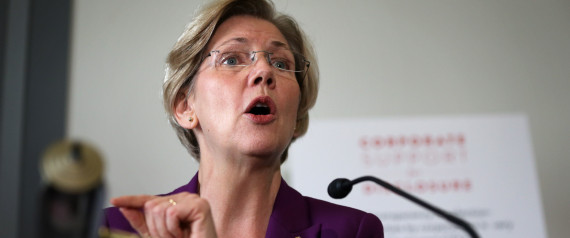
Elizabeth Warren: 'No Excuse' For Corporations To Keep Their Political Spending Secret

WASHINGTON -- Sens. Elizabeth Warren (D-Mass.) and Robert Menendez (D-N.J.) on Wednesday called for the Securities and Exchange Commission to finally adopt a rule requiring publicly traded corporations to disclose their political spending to their shareholders.

"This is foundational," said Warren at an event organized by the watchdog group Public Citizen. "There is no excuse. There is no reason, on the other side, for saying a corporation wants to be able to spend shareholders' money and not tell shareholders how that money is being spent."

Election Days, Opening Nights

Only two offices in American political life have a double function, one official and the other ceremonial, offering, and demanding, a second role that everyone knows about, but no one quite articulates. The Presidency is one: it’s both political and monarchical. He (or, soon, she) gets the top job in politics, and is also the embodiment of the state. Presidents who do both jobs passably well—Reagan and Kennedy, and Obama, too—get many a break from their constituents, and from the history books. We want a guy who looks the part. Those who never did—Nixon, Carter—get kicked around, perhaps unduly.

Immigrant mental health compounded by language and cultural barriers

For almost 25 years, since the onset of her schizophrenic symptoms, Kim Ngan Nguyen did not know why she heard voices and saw things that other people did not.

The 62-year-old Vietnamese immigrant says she had no idea what “schizophrenia” was when her psychiatrist in Toronto handed her the diagnosis in 1983, two years after she moved here with her husband.

She never spoke about her mental illness with her friends and family, not even to her husband when he passed away a decade ago.

Wednesday, October 30, 2013

The NSA Spied on Angela Merkel—and the Rest of Us, Too

Of all the spying activities conducted by the National Security Agency and disclosed by Edward Snowden, the one provoking the most alarm in Washington is the revelation that the agency monitored the communications of at least thirty-five world leaders, including Angela Merkel. Suddenly there is concern that the agency has overstepped its authority regarding foreign dignitaries—but not necessarily when it comes to American citizens.

After an outcry from Europe, the Obama administration indicated it may order the NSA to stop monitoring the heads of American allies. Senator Dianne Feinstein, the chair of the Senate Intelligence Committee and a prominent defender of domestic surveillance, said in a statement that Congress was not “satisfactorily informed” about the program. “With respect to NSA collection of intelligence on leaders of US allies…I am totally opposed,” she declared.

NSA Broke Into Yahoo, Google Data Centers: Report

WASHINGTON (AP) — The National Security Agency has secretly broken into the main communications links that connect Yahoo and Google data centers around the world, the Washington Post reported Wednesday, citing documents obtained from former NSA contractor Edward Snowden.

A secret accounting dated Jan. 9, 2013, indicates that NSA sends millions of records every day from Yahoo and Google internal networks to data warehouses at the agency's Fort Meade, Md., headquarters. In the last 30 days, field collectors had processed and sent back more than 180 million new records — ranging from "metadata," which would indicate who sent or received emails and when, to content such as text, audio and video, the Post reported Wednesday on its website.

A letter to Rona Ambrose, Canada’s "minister of disease"?

As a member of the federal government, you are currently titled Canada’s health minister. I question the accuracy of that nomenclature.

You have recently taken it upon yourself to void a decision by Health Canada, the public agency granted the task of supervising health practices in this country. The decision authorized a few physicians in Vancouver to prescribe heroin to a selected number of clients, patients who have failed other treatment attempts to keep their addictive habits manageable. The doctors did not seek such authorization because they wish to promote drug use but because clinical practice and scientific evidence have shown that the provision of this opiate is beneficial in some cases.

The Canada-Europe CETA: What's Behind the Curtain?

Is it a hard-fought win for Canada or a political decoy? So far, the Canada-EU trade agreement (or CETA) looks more the latter than the former.

I support the ideals of liberty and efficiency behind free trade. Yet the real question about the CETA, in a world of intense international competition, is whether the Harper government negotiated a good deal for Canada.

On this, the government's closed approach to the deal is a big problem. When the government announced the CETA on Oct. 18, it did not provide any text and, after much trumpeting of the deal, still has not done so. Thus, we are left to judge the deal by examining the circumstances of its negotiation. From this perspective, there is cause for concern.

Harper throws CETA party for CEOs, tables flimsy summary of Canada-EU deal

Yesterday in the House of Commons, Prime Minister Harper tabled a technical summary of the political deal Canada reached with the European Union on Friday, October 18. He invited a dozen or more CEOs to witness the spectacle from the bleachers, and they partied it up with Trade Minister Ed Fast in the afternoon (even though negotiations on key issues like investment and sustainable development continue in Brussels on November 25 and December 2).

The summary Harper tabled contains very little new information about the CETA trade-offs that was not already available on the government's Action Plan website, or that was not already reported in news stories this week. What it does contain confirms our fears about the EU deal -- that what little new access Canadian businesses will find in Europe is more than offset by the costs (financial and democratic) we will face if CETA is eventually ratified in its current form.