Democracy Gone Astray

Democracy, being a human construct, needs to be thought of as directionality rather than an object. As such, to understand it requires not so much a description of existing structures and/or other related phenomena but a declaration of intentionality.
This blog aims at creating labeled lists of published infringements of such intentionality, of points in time where democracy strays from its intended directionality. In addition to outright infringements, this blog also collects important contemporary information and/or discussions that impact our socio-political landscape.

All the posts here were published in the electronic media – main-stream as well as fringe, and maintain links to the original texts.

[NOTE: Due to changes I haven't caught on time in the blogging software, all of the 'Original Article' links were nullified between September 11, 2012 and December 11, 2012. My apologies.]

Thursday, November 20, 2014

The right-to-water struggle continues in El Salvador

The Blue Planet Project has supported the call for the right to water to be recognized in El Salvador.
Unfortunately, IPS reports, "On October 30, right-wing lawmakers blocked the single-chamber legislature from ratifying a previously approved reform to article 69 of the constitution, which granted the right to water and food the status of a human right, thus forcing the state to guarantee universal access."

Cameron warns Putin as Russian president lashes sanctions

Vladimir Putin has admitted for the first time that he is prepared for his country to face a “catastrophic” slump in oil prices, as David Cameron said Europe would have no choice but to step up sanctions if the Russian president did not abide by previous agreements to respect Ukraine’s independence.

Putin was speaking before a bilateral meeting with Cameron on the margins of the G20 summit in Brisbane. The meeting is likely to be a bruising affair, especially after the British prime minister likened Russia to Nazi Germany, saying Europe had learned lessons from history about how a big country could bully others. Sideline talks between EU leaders and Barack Obama over the Ukraine crisis have also been scheduled.

Senate Democrats Are About to Do Something Truly Stupid

In a cockeyed attempt to save one of their own, Senate Democrats are poised to do something truly stupid. Louisiana’s Mary Landrieu, after failing to win enough votes to avoid a runoff in her Senate race, is centering her prolonged bid for re-election on a bill to fast-track the Keystone XL pipeline. Democrats have long blocked such legislation in the Senate, but all of a sudden they’ve decided to bring it up for a vote, likely before Thanksgiving.

The decision is both hypocritical and irrational. Landrieu’s victory or loss will not alter the balance of the Senate. More importantly, there is no evidence to suggest that passing a pro-KXL bill will improve Landrieu’s chances in the runoff, where she faces Representative Bill Cassidy, a Republican who is just as pro-Keystone as she is. (He sponsored the House version of Landrieu’s bill, and the lower chamber is scheduled to vote Friday.) Landrieu’s entire re-election campaign centered on her being big oil’s best friend; voters know that already, and it wasn’t enough.

Are We Repeating Old Mistakes With the Oil Sands?

Canada's most contaminated site, the Yellowknife Giant Mine, has reached a milestone in its $1 billion taxpayer-funded remedial plan. The dangerous and badly contaminated roaster building, which created hundreds of thousands of tonnes of highly poisonous arsenic trioxide, (enough to kill every human in the world) has finally been demolished.

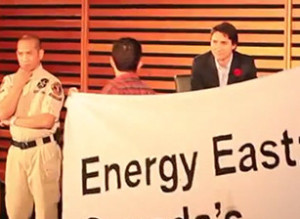
Trudeau Treats Protesters Very Differently Than Harper. He Talks To Them

Liberal Leader Justin Trudeau took a novel approach to dealing with climate protesters who interrupted an event over the weekend. He encouraged them to speak and listened to what they said.

Why the economy sucks, in one chart

The following is something I've prepared for the next issue of CUPE's Economy at Work, a popular economics quarterly publication I produce.
In his annual Economic and Fiscal Update (EFU), finance minister Joe Oliver told Canadians that while the federal government will finally record a surplus next year after seven years of deficits, we can't expect the economy to grow much faster than the slow growth we've experienced since the financial crisis, with economic growth expected to average just 2.4 per cent over the next four years.
Economic growth in this recovery is a third slower than in the recoveries of the '80s and '90s while job and wage growth has also been dismal. And despite all the spending cuts they've made, we also can't expect the federal government to have much extra money because the additional tax cuts they've promised are eating up a lot of the surplus.

Scott Walker: Denying Health Care To Low-Income People Helps Them ‘Live The American Dream’

Defending his fellow Republican governors’ decision to block Medicaid expansion in their states, Wisconsin Gov. Scott Walker (R) on Friday suggested that denying health coverage to additional low-income Americans helps more people “live the American Dream” because they won’t be “dependent on the American government.”

Walker has recently leveled some criticism at other GOP leaders for accepting Obamacare’s optional Medicaid expansion, saying they shouldn’t necessarily trust the government to come through with the federal funds to cover the policy. During an appearance on MSNBC’s Morning Joe on Friday, Walker was asked whether his position stemmed from an “ideological criticism,” and if he believes the handful of Republican governors implementing this provision of the health law are not “genuine conservatives.”

Dark side of Canadian mining activities overseas brought to light

Compared to the oil industry, Canada's mining industry isn't known for controversy.

In poorer parts of the world, however, the Canadian mining sector is seen in a different light.  Canada's reputation on this front is being scrutinized once again and the picture remains an ugly one.

In recent weeks, the Inter-American Commission on Human Rights (IACHR) held its 153rd hearings. The Commission heard of massive human rights abuses—including killings and sexual assaults of Indigenous protesters—at the hands of security forces in the employ of Canadian mining companies and their associates. These acts were in response to protests motivated by concerns over environmental degradation related to mining activities, which ultimately threaten the very survival of the communities in the regions affected by the mines.

Remembrance Day is about the past, not the present

Remembrance Days grow clearer in retrospect. They remember past wars after all, not wars happening now or about to happen. Those are contentious; they involve arguments and disagreements about whether they should proceed. Past wars are simply past. The remembrance focuses on those who suffered or died in them and didn't deserve to, which is the vast majority in all wars.

U.S.-China climate deal poses special challenge for G20-bound PM

Two things happened this week that may come to shape Stephen Harper's leadership, both at home and on the world stage, as he gets set to attend this weekend's G20 summit in Australia.

The first happened Wednesday when Finance Minister Joe Oliver confirmed that the federal budget is back in surplus for the first time since 2008, when Harper agreed to run the biggest budget deficit in Canadian history to try to stimulate the economy out of a global recession.