Democracy Gone Astray

Democracy, being a human construct, needs to be thought of as directionality rather than an object. As such, to understand it requires not so much a description of existing structures and/or other related phenomena but a declaration of intentionality.
This blog aims at creating labeled lists of published infringements of such intentionality, of points in time where democracy strays from its intended directionality. In addition to outright infringements, this blog also collects important contemporary information and/or discussions that impact our socio-political landscape.

All the posts here were published in the electronic media – main-stream as well as fringe, and maintain links to the original texts.

[NOTE: Due to changes I haven't caught on time in the blogging software, all of the 'Original Article' links were nullified between September 11, 2012 and December 11, 2012. My apologies.]

Showing posts with label BART. Show all posts

Tuesday, July 02, 2013

What's Behind the BART Strike?

Commuters were scrambling on Monday morning as the main transit system for one of the largest metropolitan regions in the US came to a halt because of a labor strike. Here's a closer look at what unionized workers are demanding and why you should care:

Who's on strike?

Workers for Bay Area Rapid Transit, more commonly known by its acronym BART. After contracts with the agency's two largest unions, Service Employees International Union Local 1021 and the Amalgamated Transit Union Local 1555, expired and renewal talks broke down, the unions announced they would strike. This morning, instead of reporting for work, BART employees picketed the rail system's stations. It's BART's first strike since a six-day protest in 1997.

Tuesday, August 30, 2011

BART Protests: Police Make Arrests During San Francisco's Third Week Of Demonstrations (PHOTOS, VIDEO)

SAN FRANCISCO -- The San Francisco transit commute went smoothly for the first Monday in two weeks as demonstrators - acknowledging that disruptive protests of the two previous Monday nights have angered commuters - stayed away from train platforms, where protests have been barred for safety reasons.

About 75 protesters gathered above the Bay Area Rapid Transit system's Civic Center station shortly after 5 p.m. and marched on the sidewalks down San Francisco's Market Street. The busy downtown corridor runs over the BART tracks and the protesters briefly gathered in front of three other BART stations to chant slogans and yell at police.

Two protesters were arrested in BART's Embarcadero station, outside the fare gates and a floor above the platform.

As demonstrators were taunting police and chanting slogans, one of the organizers went through the turnstiles with a megaphone and chanted an anti-police slogan. The scene turned chaotic as the dozens of police in riot gear pulled out their night sticks and pushed protesters, reporters and commuters away from the two arrestees.

Thursday, August 18, 2011

Authorities suppress protests against BART police in San Francisco

What does the police killing of a homeless man in San Francisco have to do with the Arab Spring uprisings from Tunisia to Syria? The attempt to suppress the protests that followed. In our digitally networked world, the ability to communicate is increasingly viewed as a basic right. Open communication fuels revolutions -- it can take down dictators. When governments fear the power of their people, they repress, intimidate and try to silence them, whether in Tahrir Square or downtown San Francisco.

Charles Blair Hill was shot and killed on the platform of the Bay Area Rapid Transit (BART) system's Civic Center platform on July 3, by BART police officer James Crowell. BART police reportedly responded to calls about a man drinking on the underground subway platform. According to police, Hill threw a vodka bottle at the two officers and then threatened them with a knife, at which point Crowell shot him. Hill was pronounced dead at the hospital.

Tuesday, August 16, 2011

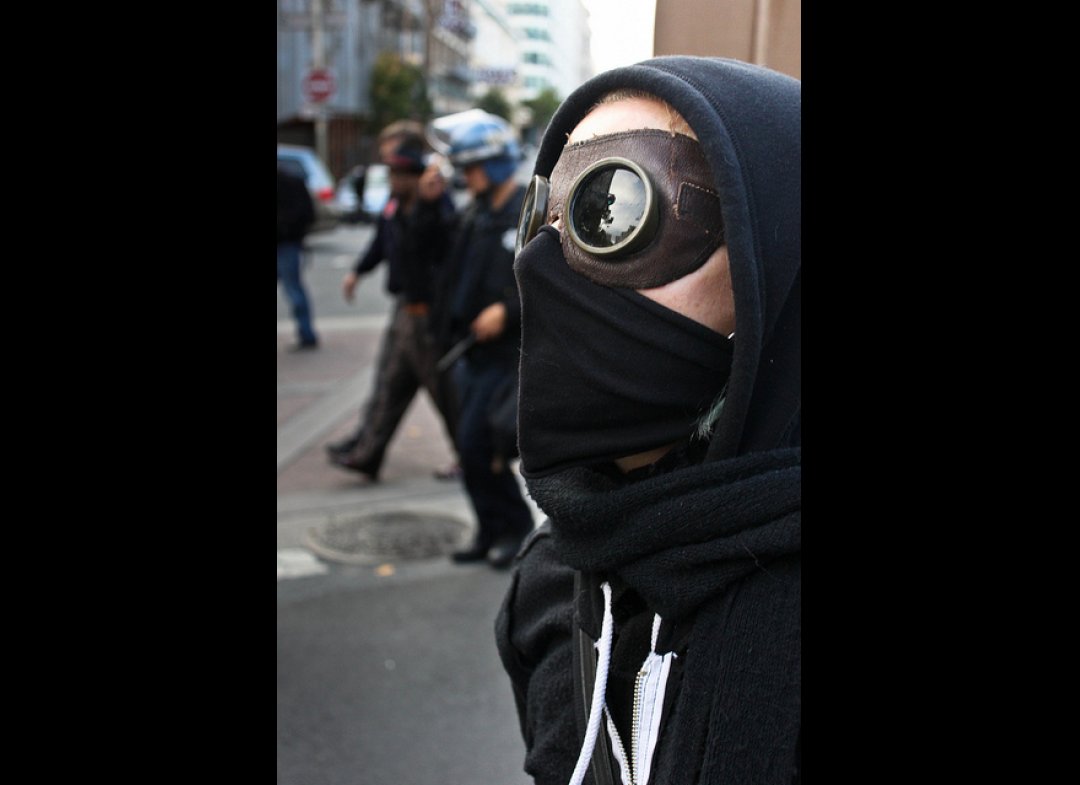
Disguised Member of Hacktivist Group "Anonymous" Defends Retaliatory Action Against BART

On Monday, officials with the Bay Area Rapid Transit (BART) were forced to close four train stations during the evening rush hour as free speech advocates attempted to disrupt the evening commute. The protest was called by the activist hacker group Anonymous in retaliation for BART’s decision to shut down cell phone and mobile-internet service at four stations last week in an effort to disrupt a protest over the shooting of a homeless man. As part of its self-described "OpBART" campaign, Anonymous hacked into the BART website, myBart.org, and leaked the names, phone numbers and passwords of train passengers. We’re joined by a disguised Anonymous member who took part in "OpBART," speaking under the pseudonym "X." "We gave them a little taste of their own medicine," X says. "We’re information activists just trying to make our world a bit freer and a little better," says X. On the question about the FBI investigation over the hack, X says, "I don’t want to get caught… I am literally running from coffeehouse to coffeehouse, from city to city, from state to state, to try to avoid this massive, multimillion-dollar manhunt that they’ve put out for Anonymous. And for what? What have we done, Amy? Point to one thing where we’ve hurt a single human being… BART...kills its innocent people… How dare they do this in the United States of America?"

Origin
Source: Democracy Now 

Bay Area Rapid Transit Accused of Censorship for Blocking Wireless Services to Foil Protests

The operators of the San Francisco area subway system are facing intense criticism for temporarily cutting off underground cell phone and mobile-internet service at four stations in an attempt to foil a protest. On Thursday, authorities with the Bay Area Rapid Transit (BART) removed power to underground cell phone towers at four stations to disrupt a protest against the recent death of Charles Hill, a homeless man who was shot dead on a train platform by a BART police officer in July. Police say Hill threw a knife at an officer. According to media reports, BART may be the first government agency in the United States to shutter mobile-internet and phone service in a bid to quash a demonstration. Some have compared the move to former Egyptian leader Hosni Mubarak’s blockage of internet access across Egypt in January during the popular uprising against his rule. The Federal Communications Commission says it will investigate BART’s decision. We go to San Fransisco to speak with Davey D, a hip-hop journalist and activist who has been covering the protests. He runs the popular website "Davey D’s Hip Hop Corner" at DaveyD.com and is co-host of Hard Knock Radio on KPFA in Berkeley. We’re also joined by Catherine Crump, an attorney with the American Civil Liberties Union’s Speech, Privacy & Technology Project.

Video
Source: Democracy Now! 

Saturday, August 13, 2011

San Francisco Transit Blocks Cellphones To Hinder Protest

SAN FRANCISCO -- Transit officials blocked cellphone reception in San Francisco train stations for three hours to disrupt planned demonstrations over a police shooting.

Officials with the Bay Area Rapid Transit system, better known as BART, said Friday that they turned off electricity to cellular towers in four stations from 4 p.m. to 7 p.m. Thursday. The move was made after BART learned that protesters planned to use mobile devices to coordinate a demonstration on train platforms.

The tactic drew comparisons to those used by the former president of Egypt to squelch protests demanding an end to his authoritarian rule. Authorities there cut Internet and cellphone services in the country for days earlier this year.