Democracy Gone Astray

Democracy, being a human construct, needs to be thought of as directionality rather than an object. As such, to understand it requires not so much a description of existing structures and/or other related phenomena but a declaration of intentionality.
This blog aims at creating labeled lists of published infringements of such intentionality, of points in time where democracy strays from its intended directionality. In addition to outright infringements, this blog also collects important contemporary information and/or discussions that impact our socio-political landscape.

All the posts here were published in the electronic media – main-stream as well as fringe, and maintain links to the original texts.

[NOTE: Due to changes I haven't caught on time in the blogging software, all of the 'Original Article' links were nullified between September 11, 2012 and December 11, 2012. My apologies.]

Showing posts with label Boeing. Show all posts

Friday, March 28, 2014

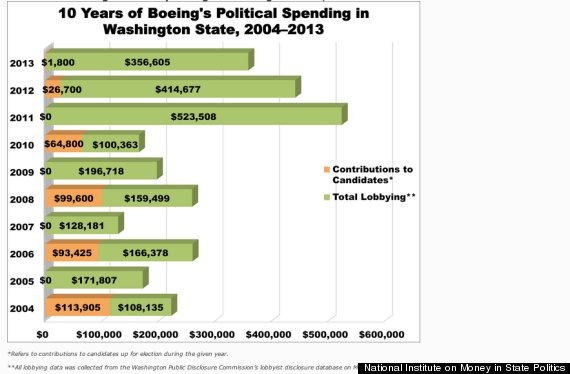
Boeing Got $7,250 In Tax Breaks For Every $1 It Spent Lobbying

lobbying graphic
That's the benefit Boeing Corp. will reap from a ramped-up lobbying push in Washington state that ended with a massive $8.7 billion tax subsidy, according to ananalysis of lobbying data released Thursday. The tax break came as part of a deal to keep production of a new jet, the 777X, in the Seattle area.

Tuesday, November 19, 2013

Biggest Tax Break In U.S. History May Not Be Enough For Boeing

Earlier this week, the legislature in Washington state agreed to give Boeing $8.7 billion in tax breaks through 2040 in an attempt to convince the company to locate production of a new jetliner fleet in the state. It's believed to be the largest state tax break for a company ever. But the huge concession still may not satisfy Boeing.

The company is now threatening to take production of the jetliner fleet elsewhere over a contract dispute with its machinist union. On Thursday, the union shot down a proposal from Boeing that would have replaced worker pensions with a contribution retirement savings plan and guaranteed raises of just 1 percent every other year, according to the Seattle Times. The New York Times reports that the proposed biannual 1 percent raise would have been in conjunction with some cost-of-living escalations.

Thursday, February 28, 2013

Boeing touts fighter jet to rival F-35 — at half the price

In a dogfight of defence contractors, the hunter can quickly become the hunted. It's happening now to the F-35.

The world's largest defence contractor, Lockheed Martin, is trying to convince wavering U.S. allies — including Canada — to stick with its high-tech, high-priced and unproven F-35 stealth fighter. But the F-35 is way behind schedule, way over budget and, now, it's grounded by a mysterious crack in a turbine fan.

Friday, September 16, 2011

NLRB Boeing Case: Bill To Weaken Labor Board Passed By House Republicans

WASHINGTON -- In their latest effort to aid the Boeing Company, House Republicans took the extraordinary step on Thursday of voting to strip the National Labor Relations Board (NLRB) of much of its power.

The bill, entitled the Protecting Jobs from Government Interference Act, would bar the federal labor board from ordering a company to close or relocate a workplace, even if that company has violated labor law. Thursday's House vote fell along party lines, with 238 Republicans for the bill and 186 Democrats against it.

The bill is designed expressly to thwart a controversial complaint brought by the NLRB against Boeing that has put the future of a South Carolina Boeing plant into limbo.

Although Republicans claim the law would save South Carolina jobs, Democrats and union leaders say it would gut the 77-year-old independent agency of its authority, while also letting Boeing off the hook for alleged misdeeds.

The NLRB's acting general counsel filed the complaint in April, alleging that the aerospace giant violated labor law when it established a production line for its 787 Dreamliner in South Carolina. The move was retaliation against Boeing's unionized workers in Washington state for having gone on strike in the past, the complaint alleged. If Boeing and the board don't settle the case, the company could feasibly be forced to close its South Carolina facility and bring the work to Washington.

Friday, June 17, 2011

In Labor Board Dispute With Boeing, Growing Controversy Clouds Facts

Just months after fights to limits labor rights in Wisconsin and other states grabbed national attention, another messy labor dispute is getting headlines.  

One of the nation’s largest manufacturers, Boeing, has been sued by the government for allegedly punishing union workers by shifting a proposed new plant to another state. Republicans and other critics have charged that the government is overstepping its authority and creating a dangerous precedent.
The dispute has taken over congressional hearings, prompted more than a dozen states to chime in on Boeing’s side, and has even become a talking point for Republican presidential candidates. Tim Pawlenty compared the case to “the Soviet Union circa 1970s or 1960s or ‘50s.”
Amid all the rhetoric, we’ve decided to step back and lay out the facts.

What the controversy’s about

The National Labor Relations Board has alleged that Boeing scrapped its plans for a new plant in
Washington state to punish union workers there for going on strike. The company opened up a nonunion plant in South Carolina last Friday. If the claims are true, Boeing broke federal labor law.
The complaint was originally brought by the machinists union in 2010. The NLRB investigated and ultimately decided that the allegations were well-founded, and it sued. Cases like this often settle before going to a judge. That hasn’t happened here. And this week, Boeing and the NLRB faced off in court for the first time.

The administrative hearing this week is a hearing on the facts. If the decision is appealed, it will go to the NLRB’s board, which serves as a quasi-judicial body and acts independently of the agency’s general counsel. (As the agency explains it, the general counsel functions as a prosecutor, and the board functions as a court.)

Though the issue hasn’t yet come before the board, Republican critics have worried that it will rule in favor of the union because it has a Democratic majority at the moment.

Why the law’s simple, but the facts in the case aren’t

Federal labor law—specifically, the National Labor Relations Act—protects workers from retaliation or threats of retaliation for exercising the right to form a union, bargain collectively, or go on strike.

“There’s nothing particularly extraordinary about this case as a matter of the legal principles at stake,” said Catherine Fisk, a University of California-Irvine law professor and former Justice Department attorney. Fisk has written extensively about labor law and the NLRB.

According to Fisk, the question is whether the labor board can prove that the dispute with the workers in Seattle was Boeing’s primary reason for moving its planned plant. Companies may legally shift work for reasons such as labor costs, but they may not do so out of retaliation against workers for past strikes or to prevent future strikes.

But at least two former NLRB chairmen have said that the case is unprecedented and have taken issue with the agency’s conclusion about Boeing’s motive.

Why establishing motive is tricky

In an interview last year with the Seattle Times, Boeing executive Jim Albaugh said the following about the decision to relocate: “The overriding factor was not the business climate, and it was not the wages we’re paying people today. It was that we can’t afford to have a work stoppage every three years.”

NLRB’s general counsel took that statement—and others—to mean that Boeing was trying to avoid the union, which had a history of strikes dating back to the 1970s.

However, the company has argued that Albaugh’s quote was taken out of context and have noted that his full statement went on to say more: “We can’t afford to continue the rate of escalation of wages as we have in the past. You know, those are the overriding factors. And my bias was to stay here but we could not get those two issues done despite the best efforts of the Union and the best efforts of the company.”

The Seattle Times had this take on Albaugh’s statements about the work in Seattle:

He repeatedly made clear that those two things—first, no strikes; second, lowered escalation of wages in the future—remain deal breakers for placing future work here.

Here’s the NLRB’s complaint against Boeing, filed in April [PDF]. Boeing has argued that it did not make the decision to open the plant in South Carolina out of retaliation against unionized employees. The company has also argued that the workers in Seattle weren’t adversely affected by the opening of the South Carolina factory because no jobs in Seattle were lost.

Full Article
Source: ProPublica