
Showing posts with label Bradley Manning. Show all posts
Showing posts with label Bradley Manning. Show all posts
Wednesday, January 21, 2015
No Chelsea morning for hypocritical world leaders in Paris
Thursday, August 22, 2013
News Outlets Continue To Refer To Chelsea Manning As 'He'
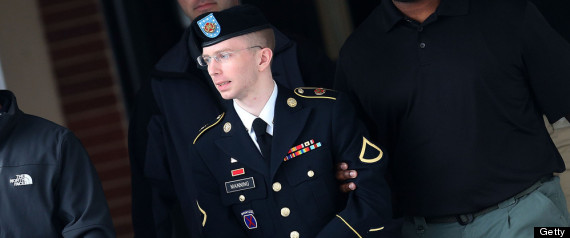
Manning made her announcement in a letter that was first read on the "Today" show. Despite her stated desire, the Associated Press and Reuters both steered clear of using "she" in their pieces on the story.
Daniel Ellsberg, Pentagon Papers Whistleblower, Sees Bradley Manning's Conviction As The Beginning Of Police State
The NSA surveillance of millions of emails and phone calls. The dogged pursuit of whistleblower Edward Snowden across the globe, regardless of the diplomatic fallout. And the sentencing of Bradley Manning to 35 years in prison for giving a cache of government files to the website WikiLeaks. Pentagon Papers whistleblower Daniel Ellsberg sees these events as signs that the United States is becoming a police state.
"We have not only the capability of a police state, but certain beginnings of it right now," Ellsberg told HuffPost Live Wednesday. "And I absolutely agree with Edward Snowden. It's worth a person's life, prospect of assassination, or life in prison or life in exile -- it's worth that to try to restore our liberties and make this a democratic country."
"We have not only the capability of a police state, but certain beginnings of it right now," Ellsberg told HuffPost Live Wednesday. "And I absolutely agree with Edward Snowden. It's worth a person's life, prospect of assassination, or life in prison or life in exile -- it's worth that to try to restore our liberties and make this a democratic country."
Bradley Manning To Barack Obama: I Did It 'Out Of Love For My Country'
FORT MEADE, Md. -- The text of U.S. Army Pfc. Bradley Manning's statement that will be sent to the president, as read by defense attorney David Coombs following Manning's sentencing Wednesday:
The decisions that I made in 2010 were made out of a concern for my country and the world that we live in. Since the tragic events of 9/11, our country has been at war. We've been at war with an enemy that chooses not to meet us on any traditional battlefield, and due to this fact we've had to alter our methods of combating the risks posed to us and our way of life.
The decisions that I made in 2010 were made out of a concern for my country and the world that we live in. Since the tragic events of 9/11, our country has been at war. We've been at war with an enemy that chooses not to meet us on any traditional battlefield, and due to this fact we've had to alter our methods of combating the risks posed to us and our way of life.
In Chelsea Manning, We Finally Have a Scapegoat for the Iraq War

The best way to cope with humiliating military disaster is to find a scapegoat. For the Germans after World War I, it was leftists and Jews who “stabbed the nation in the back”—the Dolchstoßlegende that set the global standard. In the resentful folklore that grows like kudzu around our Vietnam War, American defeat is blamed on the hippies and anti-American journalists who sabotaged a military effort that was on the verge of total victory. (More sophisticated revanchists season this pottage with imprecations against General Westmoreland’s leadership.)
8 Real Spies And Actual Bad Guys Who Got Shorter Sentences Than Bradley Manning
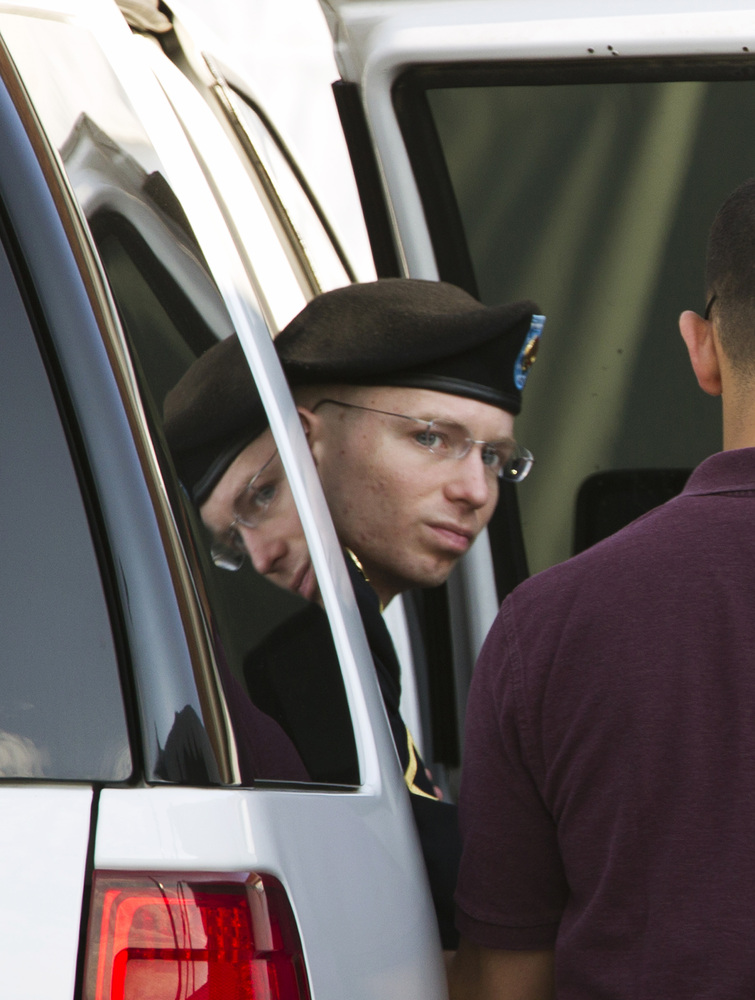 Bradley Manning received a 35-year prison sentence on Wednesday,
punishment for leaking troves of classified intelligence to the website
WikiLeaks in 2010. The former Army private first class faced a maximum
of 90 years in prison, and the prosecution was pushing aggressively for
at least 60 years, meaning the final outcome was less harsh than it
could have been.
Bradley Manning received a 35-year prison sentence on Wednesday,
punishment for leaking troves of classified intelligence to the website
WikiLeaks in 2010. The former Army private first class faced a maximum
of 90 years in prison, and the prosecution was pushing aggressively for
at least 60 years, meaning the final outcome was less harsh than it
could have been.But supporters of Manning -- who has maintained that his actions were driven by his desire to expose brutality and wrongdoing being carried out by America's military and diplomatic corps -- argued that he deserves to be pardoned for his part in the revelations. Anti-war activists and civil libertarians have also commended Manning for his part in the leaks, saying that he helped accelerate the drawing down of U.S. military engagements in Iraq and Afghanistan and provided important fodder for the Arab revolutions in 2010 and 2011.
History Will Pardon Manning, Even If Obama Doesn't

1. Make no mistake, the sentence is draconian.
Judge Denise Lind, an Army colonel, didn’t give Manning the full sixty years in prison that the prosecution wanted, but the whistle-blower still faces the same sort of prison term handed out to murderers and gangsters. Assuming he follows the rules, he will be eligible for parole after eight years (a third of the sentence minus three and a half years, for time served). Even if he is released then, he will have been in prison for well over a decade.
Bradley Manning Headed To Prison, While Those Who Authorized Torture Go Free

Manning was a 25-year-old Army private first class at the time of his arrest. He saw himself as an idealist acting to end the wars, and said in online chats with hacker Adrian Lamo that he was particularly concerned about the abuse of detainees in Iraq. No political or military higher-ups have ever been prosecuted for detainee abuse or torture in Iraq, Afghanistan or at Guantanamo Bay.
Tuesday, August 20, 2013
Bradley Manning Deserves 60-Year Sentence, Government Argues
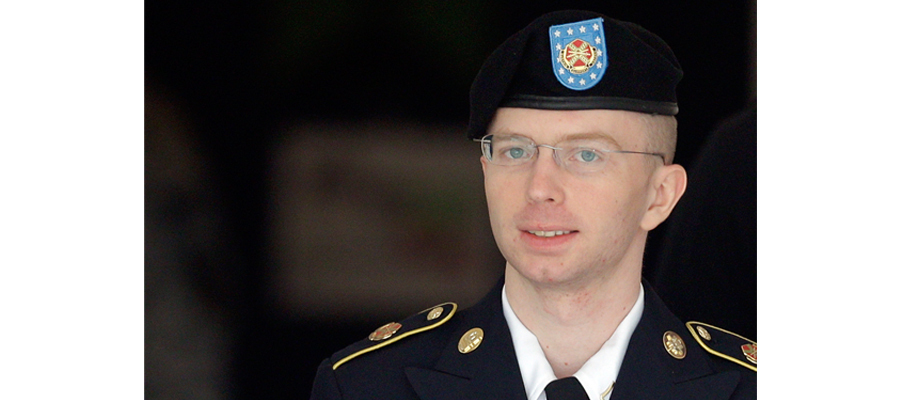
While acknowledging that Manning is young and pleaded guilty to some of the charges against him, Army prosecutor Capt. Joe Morrow said Manning "betrayed" the United States and "deserves to spend the majority of his remaining life in confinement."
Wednesday, August 14, 2013
Bradley Manning deserves the Nobel Peace Prize, not more hard time

The headquarters of the Nobel Committee is in downtown Oslo on a street named after Henrik Ibsen, whose play 'An Enemy of the People' has remained as current as dawn light falling on the Nobel building and then, hours later, on a Fort Meade courtroom where Bradley Manning's trial enters a new stage -- defence testimony in the sentencing phase.
Ibsen's play tells of mendacity and greed in high places: dangerous threats to public health. You might call the protagonist a whistleblower. He's a physician who can't pretend that he hasn't seen evidence; he rejects all the pleas and threats to stay quiet, to keep secret what the public has a right to know. He could be content to take an easy way, to let others suffer and die. But he refuses to just follow orders. He will save lives. There will be some dire consequences for him.
Friday, August 02, 2013
In Defense of Leakers: Snowden and Manning

Setting aside Snowden’s personal odyssey—he’s been holed up at Sheremetyevo Airport since June 23rd—the documents he released detailing the National Security Agency’s spying programs, domestic and global, have already had a transformative effect. For decades, Congress has adopted a hands-off and pusillanimous approach to the N.S.A., appropriating vast sums for its operations—its budget remains classified, but it’s reportedly about ten billion dollars a year—and not examining too closely how this money was spent. As the agency sought to expand its domestic surveillance programs in the aftermath of 9/11, Congress, by passing successive versions of the Patriot Act and other measures, actively enabled it to broaden its remit under the catch-all justification of countering terrorism.
Wednesday, July 31, 2013
"Bradley Manning Has Become a Martyr"–WikiLeaks’ Julian Assange on Guilty Verdict
The sentencing hearing for Army whistleblower Bradley Manning begins
today following his acquittal on the most serious charge he faced,
aiding the enemy, but conviction on 20 other counts. On Tuesday, Manning
was found guilty of violating the Espionage Act and other charges for
leaking hundreds of thousands of government documents to WikiLeaks. In
beating the "aiding the enemy" charge, Manning avoids an automatic life
sentence, but he still faces a maximum of 136 years in prison on the
remaining counts. In his first U.S. television interview since the
verdict, WikiLeaks founder Julian Assange discusses the Manning "show
trial," the plight of National Security Agency whistleblower Edward
Snowden, and the verdict’s impact on WikiLeaks. "Bradley Manning is now a
martyr," Assange says. "He didn’t choose to be a martyr. I don’t think
it’s a proper way for activists to behave to choose to be martyrs, but
these young men — allegedly in the case of Bradley Manning and clearly
in the case of Edward Snowden — have risked their freedom, risked their
lives, for all of us. That makes them heroes." According to numerous
press reports, the conviction of Manning makes it increasingly likely
that the U.S. will prosecute Assange as a co-conspirator. During the
trial, military prosecutors portrayed Assange as an "information
anarchist" who encouraged Manning to leak hundreds of thousands of
classified military and diplomatic documents.
Video
Source: democracynow.org
Author: --
Video
Source: democracynow.org
Author: --
The Trials of Bradley Manning

Manning had already pleaded guilty to ten of the lesser charges against him—for instance, unauthorized possession and improper storage of classified material, which together carry a maximum twenty-year term. But this was not enough for the prosecution: it pressed on with a dozen more serious offenses, including the potential capital crime of aiding the enemy as well as charges stemming from the Espionage Act of 1917, which Richard Nixon retooled as a weapon against domestic leakers in his vendetta against Daniel Ellsberg. (Such a use of the statute has never been decided on the legal merits until this case.) Judge Denise Lind announced a verdict that splits the difference, acquitting the soldier of aiding the enemy but convicting him on the Espionage Act charges. Private Manning could still face a prison term of more than 130 years (the sentence will be determined in a separate proceeding). The consequences for American journalism are grave, as the government now has even greater incentive to prosecute as a spy any confidential source who passes classified information to the press, criminalizing what has long been a vital (and tacitly accepted) conduit of essential public information. Such collateral damage to the Fourth Estate will not be mourned by a government that has become aggressively intolerant of leaks, whistleblowers and, it often seems, a well-informed citizenry.
Bradley Manning verdict: Punishing the whistleblower while the war criminals go free

Though some found solace in the fact that the 25-year-old U.S. Army whistleblower was found "not guilty" on the "most outrageous" charge of "aiding the enemy," voices across the progressive community were expressing mixtures of outrage and sadness after Judge Col. Denise Lind found Manning guilty on 19 other counts that could lead to a sentence of more than 100 years in prison.
The Center for Constitutional Rights put out a statement, which read in part:
While the "aiding the enemy" charges (on which Manning was rightly acquitted) received the most attention from the mainstream media, the Espionage Act itself is a discredited relic of the WWI era, created as a tool to suppress political dissent and antiwar activism, and it is outrageous that the government chose to invoke it in the first place against Manning. Government employees who blow the whistle on war crimes, other abuses and government incompetence should be protected under the First Amendment.
Monday, July 29, 2013
Bradley Manning Awaits Verdict After Trial Ends with Prosecution "Smears" & Harsh Gov’t Secrecy
Closing arguments have wrapped in the nearly two-month military trial of
Army Private Bradley Manning. The presiding judge, Col. Denise Lind, is
now deliberating on 21 charges, including "aiding the enemy." Manning
faces up to life in prison for leaking more than 700,000 documents to
WikiLeaks and other news sources, the largest leak of classified
information in U.S. history. Over the weekend, protesters in dozens of
cities around the world held rallies to mark an international day of
action calling for Manning’s release. We get an update from outside the
courtroom with independent journalist Alexa O’Brien, who has been in the
courtroom daily since the trial began. "We had armed guards roaming the
aisles, actually standing behind reporters, peering into our computers,
coming every five minutes behind us," O’Brien says of how journalists
were treated last week. "It was quite shocking behavior." We’re also
joined by Michael Ratner, president emeritus of the Center for
Constitutional Rights and a lawyer for WikiLeaks founder Julian Assange,
who observed the trial’s closing arguments. "The government’s theory is
what really is awful here: You can 'aid the enemy' by putting
information up on the Internet, intelligence that doesn’t have to be
classified," Ratner says. "Because the enemy reads the Internet, you can
be accused of aiding the enemy."
Video
Source: democracynow.org
Author: --
Video
Source: democracynow.org
Author: --
Tuesday, July 09, 2013
Bradley Manning Aided The Enemy Because He Knew Al Qaeda Uses The Internet, Prosecutors Charge
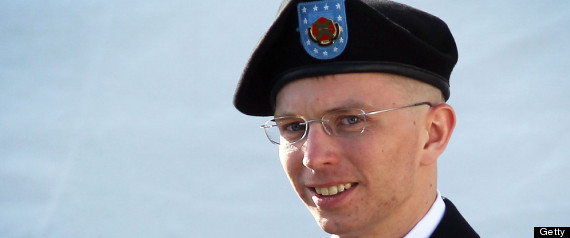
When the government brought the charge against Manning in May 2011, the move aroused a firestorm of criticism over fears a dangerous precedent could be set. Manning is being tried in a military court martial, but some have argued that the rarely used aiding the enemy charge might also be applied against civilians. Press freedom advocates claim the charge could be used to give a severe sentence to anyone who uploads sensitive information on the Internet -- by the government's own admission, it would have made no difference if Manning had given his 700,000 files to The New York Times instead of WikiLeaks.
Monday, June 17, 2013
In praise of Bradley Manning and Edward Snowden

They weren’t motivated to release secret material by any ideology or mentor. Their motives were naive, moral and direct. In Manning’s statement at his court martial, he said he came in contact with material on the Iran and Afghanistan wars showing how counterproductive they were and thought Americans should have it to think about, too. “For me it’s all a big mess, and I am left wondering what these things mean . . . I hoped that the public would be as alarmed as me . . . to know that not everyone in Iraq and Afghanistan are targets that needed to be neutralized, but rather people who were struggling to live . . . As I hoped, others were just as troubled — if not more. . .”
Wednesday, June 12, 2013
Bradley Manning vs. SEAL Team 6

Tuesday, June 11, 2013
The Judicial Lynching of Bradley Manning

Monday, June 10, 2013
As Bradley Manning Trial Begins, Press Predictably Misses the Point
 Well, the Bradley Manning trial has begun, and for the most part, the government couldn't have scripted the headlines any better.
In the now-defunct Starz series Boss, there's a reporter character named "Sam Miller" played by actor Troy Garity who complains about lazy reporters who just blindly eat whatever storylines are fed to them by people in power. He called those sorts of stories Chumpbait. If the story is too easy, if you're doing a piece on a sensitive topic and factoids are not only reaching you freely, but publishing them is somehow not meeting much opposition from people up on high, then you're probably eating Chumpbait.
There's an obvious Chumpbait angle in the Bradley Manning story, and most of the mainstream press reports went with it. You can usually tell if you're running a Chumpbait piece if you find yourself writing the same article as 10,000 other hacks.
Subscribe to:
Posts (Atom)