Democracy Gone Astray

Democracy, being a human construct, needs to be thought of as directionality rather than an object. As such, to understand it requires not so much a description of existing structures and/or other related phenomena but a declaration of intentionality.
This blog aims at creating labeled lists of published infringements of such intentionality, of points in time where democracy strays from its intended directionality. In addition to outright infringements, this blog also collects important contemporary information and/or discussions that impact our socio-political landscape.

All the posts here were published in the electronic media – main-stream as well as fringe, and maintain links to the original texts.

[NOTE: Due to changes I haven't caught on time in the blogging software, all of the 'Original Article' links were nullified between September 11, 2012 and December 11, 2012. My apologies.]

Showing posts with label Cyber War. Show all posts

Monday, September 25, 2023

Israel ‘creating task force’ to manage response to Pegasus project

Israel’s government is reportedly setting up a task force to manage the fallout from Pegasus project revelations about the use of spying tools sold to authoritarian governments by the Israeli surveillance firm NSO Group.

A team including representatives from the defence ministry, ministry of justice, foreign ministry, military intelligence and the Mossad, the national intelligence agency, is poised to conduct an investigation into whether “policy changes” are needed regarding sensitive cyber exports, several Israeli media outlets reported on Tuesday night, quoting unnamed officials.

Saturday, September 16, 2023

Russia cyber-plots: US, UK and Netherlands allege hacking


Russian spies have been accused of involvement in a series of cyber-plots across the globe, leading the US to level charges against seven agents.

The US justice department said targets included the global chemical weapons watchdog, anti-doping agencies and a US nuclear company.

The allegations are part of an organised push-back against alleged Russian cyber-attacks around the world.

Russia earlier dismissed the allegations as "Western spy mania".

Friday, June 25, 2021

Even More Evidence That Russia Is Still Meddling in U.S. Politics


WASHINGTON — Hackers affiliated with the Russian government have expanded their targets to include the U.S. Senate as well as two American think tanks critical of Russia. The discovery comes from a new report by Microsoft, which says it helped detect this new wave of hacking and is going public for the first time about its efforts to block future cyberattacks.

The two think tanks in question are the Hudson Institute, a hawkish organization that works on anti-corruption reforms in Russia, and the International Republican Institute, whose board of directors includes six GOP senators and many other right-leaning foreign-policy types who have spoken in favor of Russian sanctions and other punitive measures against the country.

Thursday, July 26, 2018

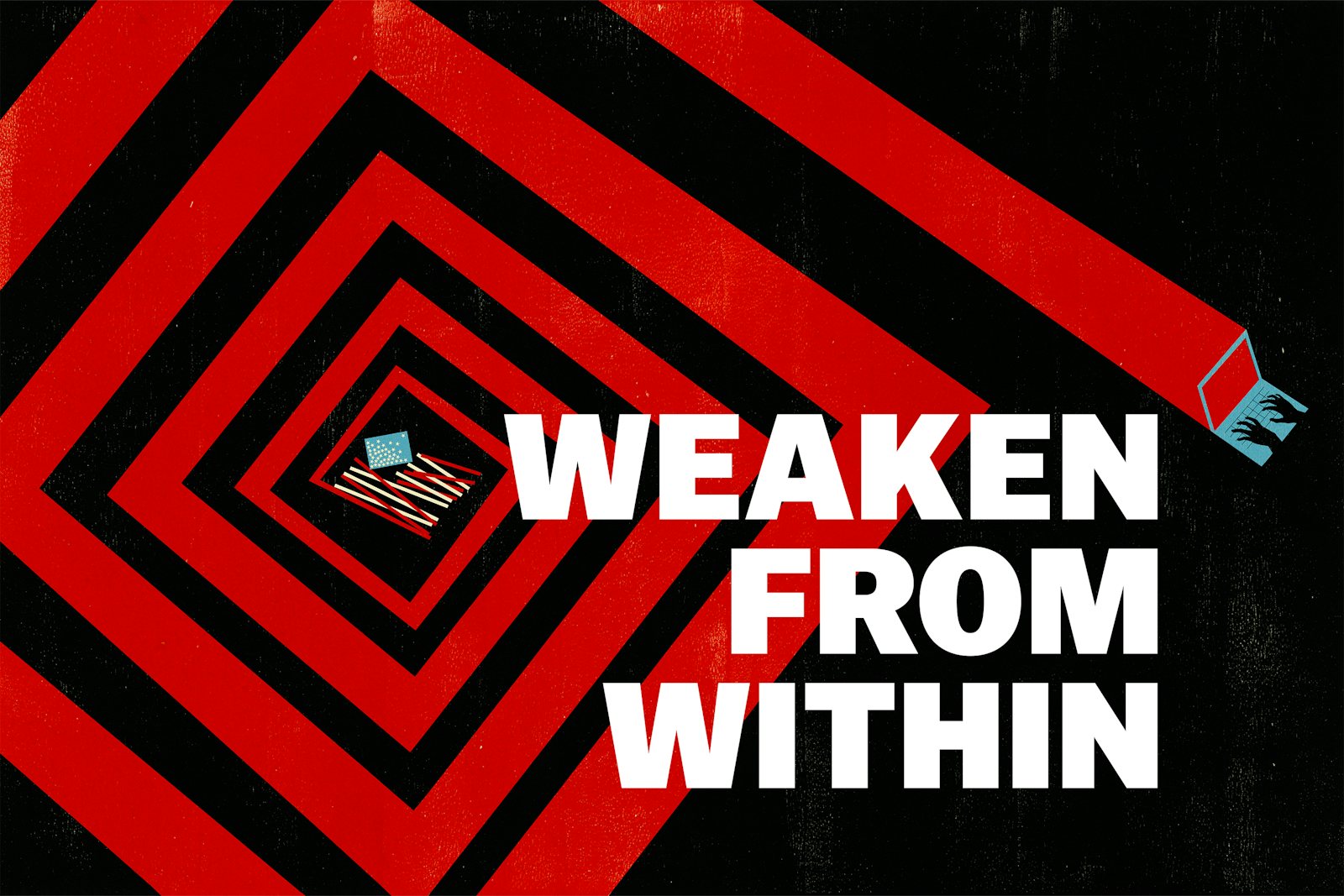
Weaken from Within

Let us review, if only in brief, some of the facts as they are presently understood. Two years ago, a shadowy company based in Russia called the Internet Research Agency began buying Facebook ads in bulk. An estimated 11.4 million people across the United States saw these ads, both before and after the U.S. presidential election. Many millions more read the messages and conspiracy theories circulated by hordes of angry bots, hecklers, and trolls on social media, obscure blogs, and web sites. These messages were largely in the service of advancing the political aims of Donald Trump. We do not—cannot—know precisely how much they affected the choices of voters, but we can state that these exertions were deliberate and systematized, part of a sprawling effort that many now believe could only have been orchestrated by one country: Russia.

Tuesday, June 20, 2017

Russia’s cyberwar against America isn’t over — and the real target is democracy

Conventional wisdom inside the Beltway is understandably hesitant to embrace these terms, but it should be obvious to anyone following along that Russia declared war on the United States last year, and it’s a war that continues to be waged today.

Unlike hot proxy wars of the past in faraway places like Vietnam or Afghanistan, and certainly unlike the Cold War in which the Soviet Union and the United States aimed thousands of weapons of mass destruction at each other’s population centers and other strategic targets but never fired a shot, this is perhaps the first time in modern history that Russia has directly attacked the United States — on American soil no less and precision aimed at what matters most: the very integrity of our democratic process.

Friday, December 30, 2016

The Key to Putin’s Cyber Power

Michael McFaul, Barack Obama’s ambassador to Russia from 2012 to 2014, has a blunt assessment of the actions that his former boss took against the Russian government this week. The sanctions on Russian intelligence officers and organizations, along with the expulsion of Russian intelligence officials and closing of Russian compounds in the United States, is “not going to change” Russian President Vladimir Putin’s behavior, he told me shortly after the measures were announced. Obama’s retaliation—at least the retaliation that the U.S. government has made public—isn’t sufficient to deter the Kremlin from interfering in future U.S. elections, he said.

Tuesday, December 27, 2016

The Perfect Weapon: How Russian Cyberpower Invaded the U.S.

WASHINGTON — When Special Agent Adrian Hawkins of the Federal Bureau of Investigation called the Democratic National Committee in September 2015 to pass along some troubling news about its computer network, he was transferred, naturally, to the help desk.

His message was brief, if alarming. At least one computer system belonging to the D.N.C. had been compromised by hackers federal investigators had named “the Dukes,” a cyberespionage team linked to the Russian government.

Wednesday, July 03, 2013

How Do the Laws of War Apply to Cyberspace?

As the concept of online warfare advances, the international community is scrambling to lay out rules to regulate this potentially devastating new kind of conflict. Last week, the International Committee of the Red Cross released its first ever position paper on the subject, stating that "there is no question" that laws of war apply to cyberspace – but what that actually means remains unclear. The Red Cross paper comes on the heels of the first major international attempt to offer a solution: a nonbinding NATO-backed report called the Tallinn Manual. At the same time, a recently leaked U.S. policy directive suggests that our government is already writing its own rules for cyber-war – and some say the administration's reasoning raises many of the same concerns that surround other kinds of 21st-century American war.

Thursday, June 13, 2013

Edward Snowden Tells South China Morning Post: U.S. Has Been Hacking Hong Kong And China Since 2009

The South China Morning Post published another article early Thursday morning local time about its exclusive interview with Edward Snowden, the person responsible for leaking top-secret information about the National Security Agency's secret surveillance programs. The Post reported that Snowden said that the U.S. government "had been hacking into computers in Hong Kong and [in China] for years."

Snowden spoke with the Post's Lana Lam from an undisclosed location. He said that the U.S. was "bullying" Hong Kong to extradite him and that he has been in constant fear for his safety. "I will never feel safe," he said. "Things are very difficult for me in all terms, but speaking truth to power is never without risk."

Sunday, June 09, 2013

Obama Cyber Memo Is Just The Latest Sign That The U.S. Is Preparing For Cyberwar

A top-secret presidential memo published Friday marked the latest sign that the Obama administration is ready to go on the offensive in a potential cyberwar.

On Friday, the Guardian published a secret presidential directive calling on national security and intelligence officials to create a list of potential foreign targets for U.S. cyber attacks. The 18-page document, known as Presidential Policy Directive 20, aims "to put in place tools and a framework to enable government to make decisions" on cyber actions, a senior administration official told the Guardian.