Democracy Gone Astray

Democracy, being a human construct, needs to be thought of as directionality rather than an object. As such, to understand it requires not so much a description of existing structures and/or other related phenomena but a declaration of intentionality.
This blog aims at creating labeled lists of published infringements of such intentionality, of points in time where democracy strays from its intended directionality. In addition to outright infringements, this blog also collects important contemporary information and/or discussions that impact our socio-political landscape.

All the posts here were published in the electronic media – main-stream as well as fringe, and maintain links to the original texts.

[NOTE: Due to changes I haven't caught on time in the blogging software, all of the 'Original Article' links were nullified between September 11, 2012 and December 11, 2012. My apologies.]

Showing posts with label Emails. Show all posts

Thursday, July 26, 2018

Bombshell report reveals Russians altered at least some of leaked Podesta emails

A bombshell new investigation by the Associated Press reveals that Russian hackers altered at least some of the documents they leaked from prominent Democrats last year — although the extent of the alterations is still an open question.

Specifically, one source tells the AP that notorious Russian hacker Guccifer 2.0 airbrushed the word “CONFIDENTIAL” on top of a document that did not have that label in order to make it more immediately appealing to reporters. It is not known at this time whether Guccifer also altered the content of the Podesta emails to make them appear more scandalous than they really were.

Tuesday, May 31, 2016

Secret Text in Senate Bill Would Give FBI Warrantless Access to Email Records

A provision snuck into the still-secret text of the Senate’s annual intelligence authorization would give the FBI the ability to demand individuals’ email data and possibly web-surfing history from their service providers without a warrant and in complete secrecy.

If passed, the change would expand the reach of the FBI’s already highly controversial national security letters. The FBI is currently allowed to get certain types of information with NSLs — most commonly, information about the name, address, and call data associated with a phone number or details about a bank account.

Wednesday, April 06, 2016

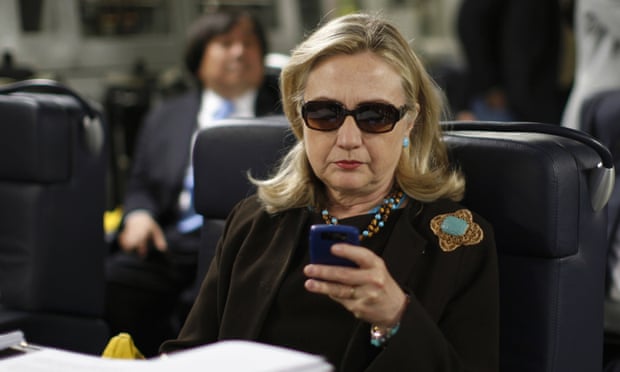
Hillary Clinton: US State Department halts review of emails at FBI request

The US State Department has suspended plans for an internal review of whether classified information was properly handled in former Secretary of State Hillary Clinton’s emails at the request of the FBI, a spokeswoman said on Friday.

Clinton, the front-runner in the race for the Democratic party nomination in the 8 November presidential election, has apologised for using a private email server for official business while in office from 2009 to 2013 and said she did nothing wrong. The Federal Bureau of Investigation is investigating the arrangement.
On 29 January, the State Department said 22 emails sent or received by Clinton had been upgraded to top secret at the request US intelligence agencies and would not be made public as part of the release of thousands of Clinton’s emails. It said none of the emails was marked classified when sent.

At the time, the department also said it would conduct an internal review on whether the information in the emails was classified at the time it passed through Clinton’s private clintonemail.com account run on a server in her New York home.

The State Department consulted the FBI about this in February, and in March the law enforcement agency asked the State Department to halt its inquiry.

“The FBI communicated to us that we should follow our standard practice, which is to put our internal review on hold while there is an ongoing law enforcement investigation ,” State Department spokeswoman Elizabeth Trudeau told reporters.

“The internal review is on hold, pending completion of the FBI’s work,” she added.” We’ll reassess next steps after the FBI’s work is complete.”

An official who spoke on condition of anonymity said the State Department had really only done “administrative work” on its review but had held off while waiting for a response from the FBI.

“It took a little bit of time for the FBI to respond to our request for advice and in the interim we did not pursue the review out of prudence,” said the official, who declined further comment on the review.

The government forbids handling of classified information, which may or may not be marked that way, outside secure government-controlled channels, and sometimes prosecutes people who remove it from such channels. The government classifies information as top secret if it deems a leak could cause “exceptionally grave damage” to national security.

Two judges have allowed a group suing for Clinton’s records to seek sworn testimony from officials. On Tuesday, one judge said there was “evidence of government wrongdoing and bad faith” over the arrangement.

Original Article
Source: theguardian.com/
Author: Reuters

Tuesday, March 15, 2016

Former BC Gov't Official Charged in Connection to Triple Delete Scandal

A British Columbia government aide who lost his job for inappropriately deleting emails has been charged for lying while under oath.

George Gretes was a ministerial assistant to Todd Stone in the Ministry of Transportation and Infrastructure.

"He is charged with two counts of willfully making false statements to mislead, or attempt to mislead, the Information and Privacy Commissioner (or another person), in performance of the duties, powers and functions of the Commissioner," said a March 11 statement from the province's Criminal Justice Branch.

Monday, February 15, 2016

Former Obama intel official: Hillary Clinton should drop out

Washington (CNN)President Barack Obama's former top military intelligence official said Hillary Clinton should pull out of the presidential race while the FBI investigate her use of a private email server for official government communication while secretary of state.

Lt. Gen. Michael Flynn, the retired chief of the Defense Intelligence Agency, made the call in an interview with Jake Tapper on "The Lead."

Friday, February 12, 2016

Judge Handling Clinton Email Case Fumes Over State Department Delays

A federal judge on Tuesday grilled a State Department lawyer who had been summoned to explain why his office missed a deadline to produce 7,000 pages of emails in the ongoing controversy over Hillary Clinton's use of a private email server.

U.S. District Judge Rudolph Contreras said that the federal government "has put me between a rock and a hard place."

Saturday, January 30, 2016

22 Clinton Emails Deemed ‘Top Secret’ by State Department

Confirming that former Secretary of State Hillary Clinton’s private computer server held highly classified material, the U.S. government Friday censored 22 emails.

The seven email chains from the Democratic presidential front-runner will be withheld from the public because information in them has been deemed “top secret,” announced John Kirby, State Department spokesman. However, “These documents were not marked classified at the time that they were sent,” he said, having been upgraded at the request of intelligence agencies.

Government Finds 'Top Secret' Information In Hillary Clinton's Emails

WASHINGTON (AP) — The Obama administration confirmed for the first time Friday that Hillary Clinton's home server contained closely guarded government secrets, censoring 22 emails that contained material requiring one of the highest levels of classification. The revelation comes three days before Clinton competes in the Iowa presidential caucuses.

State Department officials also said the agency's Diplomatic Security and Intelligence and Research bureaus are investigating if any of the information was classified at the time of transmission, going to the heart of Clinton's defense of her email practices.

Tuesday, November 17, 2015

Why isn't Christy Clark facing the fight of her life over triple-deletes?

Premier Christy Clark should be facing the fight of her life. Just one week ago, it was reported that the BC Liberal government routinely disposes of all written records relating to government decisions.

When a local resident from Delta submitted a request for background information on how the government made the $3 billion decision to replace the Massey Tunnel, the government stated that there was simply no written information to be found.

Wednesday, October 28, 2015

BC Government Put Itself Above the Law with Email Deletions

The information and privacy commissioner's report condemning the BC Liberal government isn't really about openness or freedom of information.

It's much bigger. Commissioner Elizabeth Denham's report is really about corruption and a fundamental threat to democracy.

The state has immense power, and politicians and their operatives are motivated to wield that power to protect their own interests.

Saturday, October 24, 2015

Info Commissioner Slams BC Gov't for Email Deletions, Asks RCMP to Probe

The Information and Privacy Commissioner has slammed the British Columbia government for deleting too many emails and has asked the RCMP to investigate whether a former ministerial assistant lied under oath.

"I am deeply disappointed by the practices our investigation uncovered," Elizabeth Denham wrote in a report released today, Access Denied: Record Retention and Disposal Practices of the Government of British Columbia.

Saturday, July 25, 2015

Newly Released Emails Reveal the Hillary You (Still) Don’t Know

With the release of the first batch of the thousands of emails that Hillary Clinton turned over to the State Department, what has America learned about the former secretary of state and current presidential candidate?

Nothing sufficiently voyeuristic to titillate journalists ever on the hunt for Clinton “scandals”—but just a few things that voters might be learning for the first time, if all they know about her is what the mainstream media always tells them.

Sunday, June 28, 2015

Key emails in Prime Minister's Office at risk of deletion, report finds

Emails in the Prime Minister's Office are at risk of disappearing forever, and need to be better monitored to prevent staff from improperly deleting them.

That's the conclusion of a 16-month probe by Canada's information commissioner, triggered by the temporary disappearance of emails crucial to the RCMP's criminal investigation of Senator Mike Duffy over inappropriate expenses and housing allowance claims.

Friday, March 13, 2015

Does It Matter That Hillary Clinton Deleted Her E-Mails?

One of the big headlines to come out of Hillary Clinton’s press conference on Tuesday is that she deleted roughly half of the 60,000 e-mails she sent and received on her now-infamous private e-mail server while secretary of state. “At the end, I chose not to keep my private personal email,” Clinton said, revealing a theretofore unknown fact. “No one wants their personal emails made public, and I think most people understand that and respect that privacy.”

To be clear up front—Clinton didn’t break any laws or regulations by deleting this information. Federal officials are not obligated to preserve private communications.

Tuesday, March 03, 2015

Hillary Clinton Used Personal Email Account at State Dept., Possibly Breaking Rules

WASHINGTON — Hillary Rodham Clinton exclusively used a personal email account to conduct government business as secretary of state, State Department officials said, and may have violated federal requirements that officials’ correspondence be retained as part of the agency’s record.

Mrs. Clinton did not have a government email address during her four-year tenure at the State Department. Her aides took no actions to have her personal emails preserved on department servers at the time, as required by the Federal Records Act.

Thursday, February 12, 2015

Government wonders: What’s in your old emails?

WASHINGTON — If you’ve been remiss in cleaning out your email in-box, here’s some incentive: The federal government can read any emails that are more than six months old without a warrant.

Little known to most Americans, ambiguous language in a communications law passed in 1986 extends Fourth Amendment protections against unreasonable search and seizure only to electronic communications sent or received fewer than 180 days ago.

The language, known as the “180-day rule,” allows government officials to treat any emails, text messages or documents stored on remote servers – popularly known as the cloud – as “abandoned” and therefore accessible using administrative subpoena power, a tactic that critics say circumvents due process.

Friday, November 28, 2014

National Archives: Ok, So Maybe Letting The CIA Destroy Emails Wasn't A Great Idea

WASHINGTON -- The National Archives told lawmakers Friday that it is reconsidering its tentative approval of a new CIA records-keeping strategy that would have allowed the agency to destroy the emails of non-senior personnel, according to a letter obtained by The Huffington Post on Friday.

The National Archives’ backtrack comes after blowback from the agency’s top Senate overseers on the upper chamber’s Intelligence Committee, who wrote letters to the office this week blasting its green light to the proposal and its reliance on the CIA’s good faith.

Friday, November 07, 2014

Missing: 3 million News International emails

Three million emails at News International are missing after Rebekah Brooks changed the company’s email deletion policy, a jury heard.

Brooks ordered the change in June 2010, which resulted in a large quantity of emails being deleted, including those “covering her entire period as editor of the Sun”, Kingston crown court was told.

The issue of missing emails emerged as the prosecution completed its case in the trial of six Sun and former Sun journalists accused of making corrupt payments to public officials. All six deny the charges.

Thursday, September 25, 2014

Gov. Susana Martinez's Emails Have Mysteriously Disappeared

One of the central themes in my April cover story about New Mexico Gov. Susana Martinez, a rising star in the Republican Party touted as a potential vice presidential candidate, was the paranoia displayed by Martinez's 2010 gubernatorial campaign. Here's one of the juiciest nuggets illustrating this behavior:
Martinez's [2010] crew saw enemies everywhere. A former staffer recalls the campaign on multiple occasions sending the license plate numbers of cars believed to be used by opposition trackers to an investigator in Martinez's DA office who had access to law enforcement databases. In one instance, a campaign aide took a photo of a license plate on a car with an anti-Martinez bumper sticker and emailed it to the investigator. "Cool I will see who it belongs to!!" the investigator replied.

Wednesday, September 24, 2014

BC Gov't Slow to Respond to Info Requests, Routinely Deletes Email

Over the past two years, the British Columbia government has become significantly worse at responding to information requests on time, and some people in Premier Christy Clark's office routinely delete their email, according to a report published today by the province's Information and Privacy Commissioner Elizabeth Denham.

"I'm discouraged by what I found, not surprised," Denham said in an interview. "I do think the public should be concerned about this report... A lack of timeliness erodes the public's right to know."

By law, public bodies have 30 business days to respond to requests.