Democracy Gone Astray

Democracy, being a human construct, needs to be thought of as directionality rather than an object. As such, to understand it requires not so much a description of existing structures and/or other related phenomena but a declaration of intentionality.
This blog aims at creating labeled lists of published infringements of such intentionality, of points in time where democracy strays from its intended directionality. In addition to outright infringements, this blog also collects important contemporary information and/or discussions that impact our socio-political landscape.

All the posts here were published in the electronic media – main-stream as well as fringe, and maintain links to the original texts.

[NOTE: Due to changes I haven't caught on time in the blogging software, all of the 'Original Article' links were nullified between September 11, 2012 and December 11, 2012. My apologies.]

Showing posts with label Health Insurance. Show all posts

Monday, September 18, 2023

Is employer-sponsored insurance really a good deal for workers?

Jessica Salfia knew the pay wasn’t going to be great when she became a teacher in Martinsburg, West Virginia, but she did have really good health coverage. She felt like she could go to see any doctor she wanted. The copay for an emergency room visit was just $15. She had three kids over the years, and health care was one thing Salfia didn’t feel like she had to worry about.

“The one thing about being a public schoolteacher was you knew that was taken care of,” Salfia, a teacher of 16 years, tells me. “But in the last four to six years, it’s been death by a thousand cuts.”

Tuesday, March 07, 2017

Leaked report suggests millions could lose coverage under GOP health proposal

Republican replacement plans for Obamacare would lead to significant declines in the number of Americans with health insurance coverage, according to an analysis presented Saturday at the National Governors Association and obtained by Vox.

The analysis was conducted by the health research firm Avalere Health and the consulting firm McKinsey and Company.


Thursday, February 23, 2017

Republicans are playing with the future of the entire health insurance industry

Since President Obama first signed the Affordable Care Act into law, Republicans have been itching to dismantle it. And come January 20 — the day Trump takes the oath of office and Republicans have a majority in the House and the Senate — they will actually have the capacity to do so.

In other to expedite the process, Senate Republicans have one strategy in mind: repeal and delay. They want to repeal Obamacare quickly and give themselves a two to three year grace period to create an alternative policy.

Wednesday, November 26, 2014

Dear New York City's Uninsured: Screw You, Love Governor Cuomo

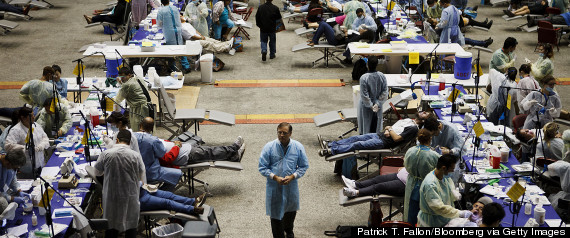
On the morning of November 28, the day after Thanksgiving, while Americans across the country line up for Black Friday deals, a queue of a different kind was scheduled to form in New York City. At 5 a.m., the doors of Manhattan's massive Javits Center were to open, not for a tech expo or sneaker convention but to provide free health care to thousands of uninsured patients, courtesy of the organization Remote Area Medical.

RAM was founded in 1985 to bring health care to the developing world, but its leadership realized just a few years into its existence that a lack of access has made large swaths of our country as "remote" as Haiti or Guyana in terms of the needs of the American people. Because of this, they now do over 80 percent of their work in the U.S., creating three-to-five-day pop-up clinics that offer medical, dental, and vision services at no cost to the patient.

Saturday, October 11, 2014

Walmart Is Cutting Health Insurance for 30,000 Part-Time Employees, but That’s Not All


Despite the fact that members of the Walton family, which founded Walmart, are consistently at the top of the list of the richest individuals in America, and even though some of Walmart’s workers are being paid such low wages that employees at one of its stores actually started a food drive for co-workers in need last year, the retail giant has decided it has to cut corners. The United States’ largest private employer, The Wall Street Journal reports, will raise health insurance premiums for its workers and stop providing coverage for thousands of its employees working less than 30 hours a week in an effort to “contain costs in the wake of the federal health-care law.”

Thursday, October 09, 2014

Health Insurers Are Spending Millions to Defeat California’s Proposition 45

From the start, even fans recognized that one of Obamacare’s great weaknesses was its failure to regulate insurance rates. Washington orders you to buy insurance, but can’t police how insurance companies raise your rates, a decision that made the Affordable Care Act a big moneymaker for the insurance industry.

Now, determined to preserve and increase profits, the industry is waging a fierce and expensive battle against a ballot initiative in California that would regulate insurance premiums. The vote in November has national significance. California, according to the Insurance Journal, is the largest insurance market in the country and what happens there politically and economically can be felt elsewhere in the country. Certainly, the fate of the measure, Proposition 45, is likely to have a great impact on consumer advocates’ efforts to improve Obamacare.

Tuesday, April 29, 2014

GOP Lawmakers Fought To Keep These People Uninsured. Now They Have To Rely On Hope.

WASHINGTON -- Eight million Americans are insured through the Affordable Care Act's exchanges, President Barack Obama announced Thursday. Wendy TwarDokus wishes she were one of them.

The 60-year-old former traveling hospice nurse describes her health as generally "average," but she has a few complaints, including a prolapsed bladder. It sometimes protrudes outside her body when she picks up something heavy -- like the saddles she used to lift when she rode horses. She can't afford the surgery to treat it.

Saturday, October 26, 2013

Ted Cruz Gets His Health Insurance Through Goldman Sachs, His Wife Confirms

The wife of Sen. Ted Cruz (R-Texas) confirmed in an interview with The New York Times what the tea party star's opponents have insinuated gleefully for weeks: The most vocal opponent of Obamacare enjoys a high-priced health plan through investment bank Goldman Sachs.

"Ted is on my health care plan," Heidi Nelson Cruz, who has worked in the firm's management division for eight years, told the paper in a story published Wednesday.

Monday, May 27, 2013

Private drug plans ‘not sustainable’ in current form, insurance exec says

OTTAWA — Private drug plans that provide coverage to 19 million Canadians are not sustainable in their current form, according to an executive at Great West Life Assurance, one of Canada’s largest insurance companies.

Barbara Martinez made the blunt comment during a panel discussion Saturday at an Ottawa conference on universal pharmacare sponsored by Carleton University and the Canadian Health Coalition.

Friday, April 26, 2013

Health Insurance Market Left Out 55 Million Americans In 2012, Survey Says

More than 40 percent of U.S. residents went without health insurance or had coverage that didn't protect them against high medical costs last year, survey results released Friday reveal.

Thirty percent of people in the U.S., or 55 million, were uninsured for at least part of the year prior to the survey, which was conducted from April to August 2012 for the Commonwealth Fund, a New York-based research organization. Another 30 million people, or 16 percent of the population, were "underinsured," meaning their health plans offered too little coverage and exposed them to high out-of-pocket costs, the survey found.

Friday, April 05, 2013

Aetna Seeks To Avoid Obamacare Rules Next Year

WASHINGTON -- One of the largest health insurance companies in the United States is advising insurance brokers on how to evade new mandates and benefits set to take effect next year under President Barack Obama's health care reform law.

In an email sent to brokers, the insurance giant Aetna explains how they can renew customers' current health plans before Jan. 1, a strategy the Los Angeles Times reported this week is under consideration at other big health insurance companies.

Friday, March 22, 2013

Health Insurance Premium Increases Vowed By Companies For 2014

Big health insurance companies are predicting huge premium increases next year for small employers and people who buy coverage on their own, citing rising health care costs and new mandates from President Barack Obama's health care reform law.

The Wall Street Journal reports companies including UnitedHealth Group, Aetna and Blue Cross & Blue Shield of North Carolina say health insurance premiums could rise from 25 percent to 116 percent for some people. Part of these cost increases are due to Obamacare's requirements that health insurance companies provide better benefits including maternity care and prescription drugs, accept any customer regardless of pre-existing conditions, and not charge older people more than three times what younger people pay.

Thursday, March 21, 2013

Uninsured Americans 2012: More Than 45 Million Lacked Health Insurance Last Year, CDC Reports

More than 45 million U.S. residents didn't have health insurance during the first nine months of last year, according to survey findings released Thursday by the Centers for Disease Control and Prevention. Even more people, 57.5 million, were uninsured for at least part of the 12 months before being polled.

Tuesday, August 07, 2012

Medical insurance needs rethink

A recent guest editorial (We tinker with the Canada Health Act at our peril, July 24) relies on ill-founded arguments in suggesting that the nearly 30-year-old Canada Health Act should remain unchanged.

Perhaps the most troublesome and outdated aspect of the act is the fiscal punishment it allows the federal government to mete out if patients con-tribute to the cost of their own medical care. In order to comply with the Canada Health Act, the B.C. Medical Services Plan (MSP) prohibits such payments for some (not all) medical care. MSP does so because other-wise the federal government can claw back its fiscal transfers to B.C. under the Canada Health Act, to punish the province if patients pay directly (instead of indirectly, through their taxes) even a small part of the cost of their own care.

Wednesday, July 11, 2012

GOP to the uninsured: Drop dead

The House is voting (again) Wednesday to repeal the Affordable Care Act.

Meanwhile, six Republican governors (so far) say they won’t go along with the law’s planned Medicaid expansion for 4 million uninsured people in their states, even though the feds would pick up nearly all the tab.

See the pattern here?

The Republican message to uninsured Americans in the wake of the Supreme Court’s recent ruling couldn’t be clearer: You’re on your own.

Thursday, June 28, 2012

Supreme Court Upholds Mandate, Mixed Ruling on Medicaid Expansion

UPDATE: The entire ACA has been upheld by the Supreme Court, with Chief Justice Roberts joining the majority. According to SCOTUSblog, "the entire ACA is upheld, with the exception that the federal government's power to terminate states' Medicaid funds is narrowly read." The court decided 5-4, with Kennedy dissenting and Roberts essentially saving the ACA, going against party lines. 

The Nation's David Cole parses the decision:

"The law has long been that congress can enact a tax for any purpose to further the general welfare. Unlike its regulatory powers, congress can point to a specific power that they have for the ACA -- the power to tax. Becasue the only consequence is that a person who doesn't get insurance will be taxed, there's no restriction on what congress can do. The court upholds the mandate as an exercise of the taxing power."

Thursday, March 22, 2012

Health Insurance Premium Hikes Called 'Excessive' by Federal Regulators

Health insurance premium hikes in nine states as high as 24 percent are "excessive" and should be blocked, the federal Department of Health and Human Services said Thursday. The agency will have to depend on states to take action, however, because the federal government lacks the authority.

The health care reform law enacted in 2010 requires health insurance companies to present premium hikes of 10 percent or more for federal review. Since the law took effect, the Department of Health and Human Services has reviewed and made public more than 180 rate-review proposals for health plans that cover 1.3 million individuals and small-business employees.

Big annual health insurance premiums became a heated issue during the congressional debate over health care reform in February 2010, just one month before the legislation passed, when a California subsidiary of the insurance giant WellPoint sought to raise rates on its 800,000 customers by as much as 39 percent. At the time, President Barack Obama said he was "very disturbed" by what WellPoint's Anthem Blue Cross proposed.

Friday, March 09, 2012

Travel insurance loophole devastates B.C. couple

The travel health insurance that millions of Canadians buy may offer no protection at all if they answer a single question incorrectly — no matter how innocent the error — on a medical questionnaire full of convoluted language, confusing clauses and tricky definitions, the CBC's Marketplace has learned.

For some people, the result can be financial ruin when their claims are denied.

That’s what happened to Bill Jennings, 67, and his wife Tracy, 48, of Gold River, B.C., who bought travel insurance from Manulife before leaving on a trip to Fort Walton, Fla., in December 2010.

They filled out the application, including the medical questionnaire, online and thought they were covered in case of illness during their trip.

In Florida, Bill had chest pains and numbness in his arm. He discovered he had suffered a heart attack and needed emergency surgery to remove five blockages in his heart.

Wednesday, September 28, 2011

Surveys: Health insurance costs shifted to workers, even as premiums surge

Premiums for employer-sponsored health insurance continued to escalate this year even as the share of workers getting less generous coverage reached a new high, according to survey data released Tuesday.

In 2011, for the first time, half of workers at small firms with individual policies faced annual deductibles of $1,000 or more. In 2006, that figure was 16 percent. At large firms, the share has grown from 6 percent to 22 percent over the same five years.

At the same time, the survey by the Kaiser Family Foundation found that premiums for family plans rose 9 percent in 2011, after several years of slower annual growth. A similar recent survey by the consulting firm Mercer found that yearly premium increases have been hovering around the 6 percent mark and will grow by slightly less in 2012.

Both sources point to the same fundamental long-term shift: Faced with continually climbing premiums, a record share of employers have moved to plans that require workers to pay more out of pocket.

Why is a $1,575-a-month drug approved and a $7 one isn’t?

Wet age-related macular degeneration is the leading cause of vision loss in people 65 and over – the age at which all Canadians can benefit from public drug plans.

There are two treatments for wet AMD: ranibizumab (brand name Lucentis) and bevacizumab (Avastin). Both drugs are biologics that inhibit blood-vessel growth and leakage into eyes that causes vision loss. They were both developed by Genentech, which is now a subsidiary of Roche.

Treatment of wet AMD with Lucentis costs $1,575 a month for a recommended period of about two years; Avastin costs roughly $7 a month with about the same treatment period.

The Common Drug Review, the national agency that determines if drugs are cost-effective and warrant being included on provincial drug formularies, has given its blessing to Lucentis. All publicly funded health plans have followed that recommendation, but British Columbia and Nova Scotia also allow for Avastin to be reimbursed.

That means Lucentis must be the clearly superior drug, right? It suggests that B.C. and N.S. are sacrificing safety to save a few bucks, doesn’t it?

Well, not so fast.