Democracy Gone Astray

Democracy, being a human construct, needs to be thought of as directionality rather than an object. As such, to understand it requires not so much a description of existing structures and/or other related phenomena but a declaration of intentionality.
This blog aims at creating labeled lists of published infringements of such intentionality, of points in time where democracy strays from its intended directionality. In addition to outright infringements, this blog also collects important contemporary information and/or discussions that impact our socio-political landscape.

All the posts here were published in the electronic media – main-stream as well as fringe, and maintain links to the original texts.

[NOTE: Due to changes I haven't caught on time in the blogging software, all of the 'Original Article' links were nullified between September 11, 2012 and December 11, 2012. My apologies.]

Showing posts with label Hungary. Show all posts

Monday, September 09, 2024

Orbán accused of trying to silence all critics in Hungary with new law

Hungary’s leading civil society groups have accused Viktor Orbán of trying to “silence all critical voices” in the country after proposing legislation to create a “sovereignty protection office” investigating foreign influence.

For years, the Hungarian prime minister has promoted a narrative that external forces are trying to undermine his government and prop up his opponents.

In a speech this month, the longtime leader said “dark forces” would “continue to besiege the defensive lines of sovereignty, including those of Hungary”.

Wednesday, October 18, 2023

Russia’s Putin, Hungary’s Orban reaffirm bond ahead of Beijing summit

Russian President Vladimir Putin and Hungarian Prime Minister Viktor Orban have underscored their countries’ strong ties ahead of an international forum in Beijing, saying that continuing “geopolitical tensions” due to the war in Ukraine do not affect their relationship.

“Despite the fact that in the current geopolitical conditions, the possibilities for keeping contact and developing relations are very limited, it cannot but cause satisfaction that our ties with many European countries are maintained and developed,” Putin said, according to Russian news agencies.

“One of those countries is Hungary.”

Monday, September 18, 2023

Hungary and Poland say no to LGBTIQ


“A Europe that protects” is Austria’s motto for its presidency of the Council of the EU. But it couldn’t agree to protect everyone.

Hungary and Poland on Thursday torpedoed a joint statement by EU employment and social affairs ministers intended to promote gender equity in the digital era because of objections to a reference to LGBTIQ, the initialism intended to cover the fullest panorama of gay, bisexual, transgender, intersex, queer and questioning individuals.

Thursday, August 09, 2018

Israeli intelligence firm targeted NGOs during Hungary’s election campaign

The Israeli private intelligence firm Black Cube was involved in a campaign to discredit NGOs ahead of Hungary’s April election, according to a former Black Cube employee and a person with knowledge of the company’s inner workings.

Between December 2017 and March 2018, Hungarian NGOs and individuals connected to American-Hungarian businessman George Soros were contacted by agents using false identities who secretly recorded them. The recordings, which began appearing in the Jerusalem Post and Hungarian government-controlled daily paper Magyar Idők three weeks before Hungary’s election, were used by Prime Minister Viktor Orbán to attack independent civil society organizations during the last days of the campaign. Orbán’s right-wing Fidesz party went on to win in a landslide.

Monday, August 06, 2018

The new communists

BUDAPEST — Call it electioneering, Viktor Orbán style.

In the weeks ahead of Hungary’s parliamentary election on Sunday, postboxes across the country delivered some welcome news — courtesy of the prime minister. One letter informed households that due to a one-time action by the government, their next gas bill would be reduced by roughly €38. Another, delivered to each of the country’s more than 2 million pensioners, contained about €32 in gift vouchers.

Monday, July 30, 2018

Hungary’s Russian-built nuclear plant powered by politics in Brussels

The European Commission brokered a “global political solution” with Hungary over its controversial Russia-backed nuclear power station rather than escalate a fight amid already fraught relations with Budapest, according to internal documents obtained by an MEP and reviewed by POLITICO.

More than 200 pages of Commission memos, emails and meetings minutes from 2016 show that Commission officials expressed serious doubts about Hungary’s numerous attempts to justify awarding the contract to build the €12 billion Paks II nuclear project to the Kremlin-owned Rosatom without opening up the project for bids.

Sunday, July 23, 2017

Moscow spooks return to Hungary, raising NATO hackles

NATO allies are worried about expanding Russian intelligence operations in Hungary.

While Western officials have often criticized the government in Budapest for backsliding on democracy, they’ve tended to praise it for a steadfast commitment to NATO. But officials from allied countries say Russia increasingly sees Hungary as an operational backdoor into Europe.

Friday, March 10, 2017

Hungarian law targets Soros, foreign-backed NGOs

BUDAPEST — The Hungarian government is moving to limit the influence of nongovernmental organizations that promote democracy and the rule of law, seemingly buoyed by U.S. President Donald Trump’s election victory and the ascendance of the alt right in Washington.

This week, parliament is expected to introduce legislation on foreign-funded NGOs. The government’s bill, whose official text has yet to be made public, will likely require groups to register how much funding they receive from foreign sources.

Saturday, December 24, 2016

Hungary’s Orban Says He Will Amend Constitution To Keep Out Migrants

BUDAPEST, Oct 3 (Reuters) - Under fire from opposition parties, Viktor Orban said on Monday he would amend the constitution to ensure the European Union cannot settle migrants in Hungary after Sunday’s referendum even though turnout was too low to make the vote valid.

The outcome deprived the maverick right-wing prime minister of a clear-cut victory with which to challenge EU migrant quotas and the radical nationalist Jobbik party called on him to quit.

Tuesday, November 15, 2016

Viktor Orbán’s Potemkin referendum

On October 2, Hungarians will vote in a referendum on Europe’s plan to relocate refugees throughout the continent. The controversial vote is being heavily promoted by Prime Minister Viktor Orbán, and perceived similarities to Britain’s decision to leave the European Union have heightened interest in its outcome.

And yet, it would be a mistake to give too much weight to Orbán’s referendum. The vote is more of a public relations endeavor than an expression of democratic will — an attempt to strengthen Orbán’s image as the leader of an emerging populist, nationalistic and regressive Europe.

Saturday, October 24, 2015

Ottomans Saved the Hungarian Prime Minister’s Ancestors; Now He Says Islam Was Never Part of Europe

Hungarian Prime Minister Viktor Orban not only continued to defend his anti-immigrant bigotry but went on to say that Islam has never been part of Europe.

Mr. Orban not only is increasing the misery of largely Muslim refugees, but now he has erased 1300 years of European culture and politics, committing a sort of cliocide or mass killing of history.

Saturday, June 27, 2015

Hungary Considers Border Fence to Keep out Migrants

The Hungarian government is considering building a 4-meter-high (13-foot-high) fence along the border with Serbia to stop the flow of migrants reaching the country, the foreign minister said Wednesday.

The government has asked Interior Minister Sandor Pinter to present preparations for the plan by next Wednesday.

Thursday, October 30, 2014

Budapest autumn: hollowing out democracy on the edge of Europe

On the Hungarian plain south-west of Budapest, the rich, dark soil of Kishantos presents the saddest of sights. As far as the eye can see, a cornucopia of organic wheat, cereals, sunflowers, pulses and legumes has been turned into a vista of emptiness.

In what appears to be an extraordinary act of vindictive destruction, a lifetime’s work in Hungary has been destroyed in only a few months.

Eva Acs, an agronomist who has run the thriving organic farm for 22 years, is at her wits’ end. “The state just took the farm away. We were absolutely punished and rubbed out. Then the private security firms came in and closed down the roads and blocked the tractors. The new owners destroyed all our plants and crops. Just to bankrupt us and hurt us.”

Tuesday, May 13, 2014

Hungary and the End of Politics

On April 6, Hungarians went to the polls and re-elected their government. In most countries, such an outcome would be a reaffirmation of the political status quo. But Hungary is no longer like most countries. The re-election of its government marks the collapse of politics in Hungary.

Viktor Orbán and his Fidesz party first came to power in 2010 with a clear majority of the vote. In April, the party won a second term with just 45 percent of the vote, yet a set of Fidesz-friendly changes to the election laws enacted by Orbán during his first term as prime minister transformed this plurality into a two-thirds parliamentary mandate, giving him the power to continue to amend the Hungarian Constitution at will. Still, the April results should not be taken as a vindication: Orbán has maintained his grip on the Parliament with 21 percent fewer domestic votes than Fidesz garnered in 2010, reflecting a decline in its overall margin of victory and a drop in turnout.

Tuesday, May 07, 2013

Safe country? World Jewish Congress fears Hungary will relive 'darkest era in European history'

On Saturday, the former chief executive of the Canadian Jewish Congress, Bernie Farber, tweeted: "Large anti-Semitic rally in Hungary by Fascist, Jobbik Party. Same Hungary that Immigration Min Kenny says is a safe country."

Hungary's rising and increasingly powerful extreme right Jobbik Party organized the rally to coincide with the World Jewish Congress (WJC) holding its plenary assembly in Budapest.

The Conservative Hungarian governing Party, Fidesz, headed by Prime Minister Victor Orban, formally disassociates itself from Jobbik's extremism.

Friday, April 05, 2013

Trading away human rights? Canada turns a blind eye toward abuses against Roma in EU

Barely a week goes by when the Conservative government does not issue at least one press release touting the value of a Canada-European Union (EU) trade deal.

Last week Trade Minister Ed Fast told British Columbians that such a deal would "eliminate tariffs, including those on key provincial exports such as forest products, metals and minerals, fish and seafood, agriculture and agri-food products, and services."

The week before, the Minister told Quebeckers that a trade deal with the EU would benefit that province's chemical and aluminum industries.

Wednesday, February 06, 2013

Hungary's right-wing inflames ethnic tensions

In a cafe in Budapest's 8th District, known for its high population of Roma - also known as Gypsies - Hungarian activist Jeno Setét spoke about the discrimination he says his community faces on a regular basis.

He described how he and his wife, a non-Roma, were applying to live in an apartment. The owner initially thought Setét's wife would be the only renter - but when he found out that Setét, a Roma, would also be living there, the couple was immediately told they could not take the apartment.

Wednesday, January 09, 2013

Anti-Roma article by Hungarian politician sparks outrage

BUDAPEST, HUNGARY—A founding member of Hungary’s governing Fidesz party has been sharply criticized for writing a newspaper column that contained offensive remarks about the nation’s Roma minority.

Writing about a New Year’s Eve bar fight in which several people were seriously injured and some of the attackers were reportedly Roma, the journalist Zsolt Bayer said “a significant part of the Roma are unfit for coexistence. They are not fit to live among people. These Roma are animals and they behave like animals.”

Wednesday, November 28, 2012

Marton Gyongyosi, Hungary Far-Right Leader, Demands List Of Jews Who Pose 'National Security Risk'

BUDAPEST, Nov 27 (Reuters) - A Hungarian far-right politician urged the government to draw up lists of Jews who pose a "national security risk", stirring outrage among Jewish leaders who saw echoes of fascist policies that led to the Holocaust.

Marton Gyongyosi, a leader of Hungary's third-strongest political party Jobbik, said the list was necessary because of heightened tensions following the brief conflict in Gaza and should include members of parliament.

Tuesday, October 16, 2012

Why the Roma are fleeing Hungary and why Canada is shunning them

GYONGYOSPATA, HUNGARY—They called themselves a neighbourhood watch.

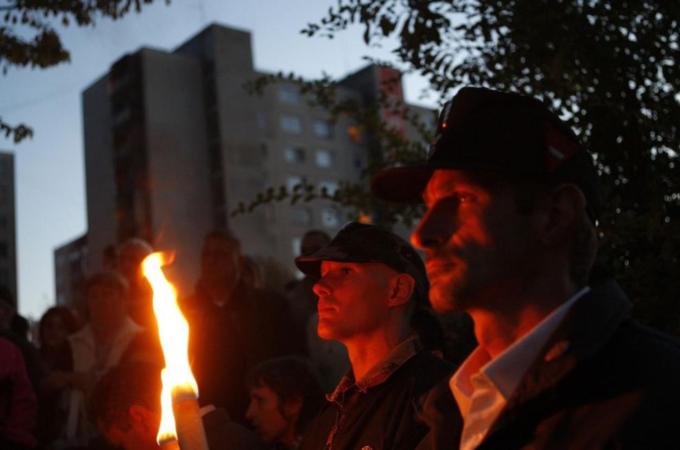
On March 1, 2011, at least 2,000 members of a right-wing paramilitary group called the Civil Guard Association for a Better Future rolled into this sleepy former coal-mining village 80 kilometres east of Budapest.

Wearing black uniforms and hats, they pledged to help police maintain law and order and stamp out “Gypsy criminality.”