
Showing posts with label Indefinite Military Detentions. Show all posts
Showing posts with label Indefinite Military Detentions. Show all posts
Wednesday, February 24, 2016
Obama’s Plan to Close Guantánamo Would Establish Indefinite Detention on U.S. Soil
Tuesday, February 05, 2013
Daniel Ellsberg: NDAA Indefinite Detention Provision is Part of "Systematic Assault on Constitution"

Saturday, January 05, 2013
NDAA Signed Into Law By Obama Despite Guantanamo Veto Threat, Indefinite Detention Provisions

Civil liberties advocates had roundly criticized the bill over Guantanamo and a separate section that could allow the military to indefinitely detain American citizens on suspicions of supporting terrorism. Just as he did with last year's version of the bill, however, Obama decided that the need to pass the NDAA, which also sets the armed forces' $633 billion budget for the 2013 fiscal year, was simply "too great to ignore," according to a presidential signing statement released in the early morning hours Thursday.
Wednesday, December 19, 2012
NDAA Indefinite Detention Provision Mysteriously Stripped From Bill
 WASHINGTON -- Congress stripped a provision Tuesday from a defense bill that aimed to shield Americans from the possibility of being imprisoned indefinitely without trial by the military. The provision was replaced with a passage that appears to give citizens little protection from indefinite detention.
The amendment to the National Defense Authorization Act of 2013 was added by Sen. Dianne Feinstein (D-Calif.), but there was no similar language in the version of the bill that passed the House, and it was dumped from the final bill released Tuesday after a conference committee from both chambers worked out a unified measure.
Tuesday, September 18, 2012
Obama Admin Appeals NDAA Ruling in Bid to Preserve Indefinite Detention at Home and Abroad
 The Obama administration has filed an emergency appeal of a federal
judge’s decision to block a controversial statute that gave the
government the power to carry out indefinite detention. Judge Katherine
Forrest ruled against a provision in the National Defense Authorization
Act, or NDAA, authorizing the imprisonment of
anyone deemed a terrorism suspect anywhere in the world without charge
or trial. A group of journalists, scholars and political activists had
brought the case, arguing the provision was so broad it could easily
infringe on freedom of speech. In a court filing on Monday, the
government argued Judge Forrest’s ruling could go beyond the statute
itself to curb the indefinite provisions contained in the legislation
authorizing the so-called post-9/11 "War on Terror," potentially
jeopardizing the imprisonment of foreigners in Afghanistan without
charge. We look at the Obama administration’s support for indefinite
detention at home and abroad with Empty Wheel blogger Marcy Wheeler.
The Obama administration has filed an emergency appeal of a federal
judge’s decision to block a controversial statute that gave the
government the power to carry out indefinite detention. Judge Katherine
Forrest ruled against a provision in the National Defense Authorization
Act, or NDAA, authorizing the imprisonment of
anyone deemed a terrorism suspect anywhere in the world without charge
or trial. A group of journalists, scholars and political activists had
brought the case, arguing the provision was so broad it could easily
infringe on freedom of speech. In a court filing on Monday, the
government argued Judge Forrest’s ruling could go beyond the statute
itself to curb the indefinite provisions contained in the legislation
authorizing the so-called post-9/11 "War on Terror," potentially
jeopardizing the imprisonment of foreigners in Afghanistan without
charge. We look at the Obama administration’s support for indefinite
detention at home and abroad with Empty Wheel blogger Marcy Wheeler.Video
Source: Democracy Now!
Author: --
Friday, May 18, 2012
Bill To End Indefinite Detention Fails In House

On Wednesday, Federal Judge Katherine Forrest found that the law violates rights to free speech and due process. But House members defended it, ultimately voting 238 to 182 against an amendment to guarantee civilian trials for any terrorism suspect arrested in the United States.
The measure, sponsored by Reps. Adam Smith (D-Wash.) and Justin Amash (R-Mich.), had been backed by a mix of conservatives, moderates and liberals who argued that letting the president decide to detain anyone -- including Americans -- deemed to be a terrorist was granting the executive too much power. And they argued that with more than 400 terrorists having been tried and convicted in civilian courts while dozens of plots were prevented, the law was unnecessary.
Thursday, May 17, 2012
Journalist, Plaintiff Chris Hedges Hails "Monumental" Ruling Blocking NDAA Indefinite Detention
 In a rare move, a federal judge has struck down part of a controversial
law signed by President Obama that gave the government the power to
indefinitely detain anyone it considers a terrorism suspect anywhere in
the world without charge or trial — including U.S. citizens. Judge
Katherine Forrest of the Southern District of New York ruled the
indefinite detention provision of the National Defense Authorization Act
likely violates the First and Fifth Amendments of U.S. citizens. We
speak with Chris Hedges, a journalist who filed the suit challenging the
NDAA along with six others, and Bruce Afran,
the group’s attorney. "This is another window into ... the steady
assault against civil liberties," Hedges says. "What makes [the ruling]
so monumental is that, finally, we have a federal judge who stands up
for the rule of law."
In a rare move, a federal judge has struck down part of a controversial
law signed by President Obama that gave the government the power to
indefinitely detain anyone it considers a terrorism suspect anywhere in
the world without charge or trial — including U.S. citizens. Judge
Katherine Forrest of the Southern District of New York ruled the
indefinite detention provision of the National Defense Authorization Act
likely violates the First and Fifth Amendments of U.S. citizens. We
speak with Chris Hedges, a journalist who filed the suit challenging the
NDAA along with six others, and Bruce Afran,
the group’s attorney. "This is another window into ... the steady
assault against civil liberties," Hedges says. "What makes [the ruling]
so monumental is that, finally, we have a federal judge who stands up
for the rule of law."Video
Source: Democracy Now!
Author: ---
Friday, March 30, 2012
Indefinite Detention Targeted By GOP As House Committee Weighs Proposals To Revise Provision

Republicans and Democratic lawmakers said this week that the GOP majority on the House Armed Services Committee was weighing several proposals to revise the provision on indefinite detention that was part of the far-reaching defense bill that Congress passed in December and President Barack Obama signed into law.
Last year, Congress' approach to handling terror suspects divided Republicans and Democrats, pitted the White House against lawmakers and drew fierce opposition from civil liberties groups. The anger still lingers, and GOP leaders are under pressure from a number of rank-and-file members, tea partyers and libertarians to change the law.
"I intend to help put as much political pressure on this issue as possible," said Rep. Justin Amash, R-Mich., whose staff has spoken to the Armed Services panel. "I intend to spend a lot of time – and I already have been doing so – making the public aware of this issue so we can get the change we need to address it."
Friday, March 09, 2012
Indefinite Detention Targeted In Democratic Bill On Handling Terrorist Suspects
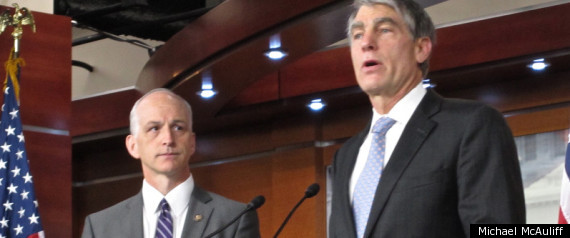
The power of military authorities to arrest and jail people as long as they want stems from Congress' 2001 joint resolution authorizing the use of military force against terrorists, but was explicitly codified into law last year after President Obama signed the National Defense Authorization Act on New Year's Eve. While allowing military detention of anyone, the act mandated that certain terrorist suspects had to be held by the armed forces.
Civil libertarians on the left and right were sharply critical of the law, even though the president promised not to grab Americans.
Obama set out policy rules last month making good on that pledge, specifying that U.S. citizens and numerous other categories of suspected terrorists would not be clapped into the military system, which somewhat mollified critics.
Wednesday, February 29, 2012
Barack Obama Waives Rule Allowing Indefinite Military Detention Of Americans

Indefinite military detention of Americans and others was granted in the defense authorization bill President Barack Obama signed just before Christmas, sparking a storm of anger from civil libertarians on the left and right.
The new rules -- which deal with Section 1022 of the law -- are aimed at soothing many of their gravest concerns, an administration official said. Those concerns are led by the possibility that a law that grants the president authority to jail Americans without trial in Guantanamo Bay based on secret evidence could easily be abused.
"It is important to recognize that the scope of the new law is limited," says a fact sheet released by the White House, focusing on that worry. "Section 1022 does not apply to U.S. citizens, and the President has decided to waive its application to lawful permanent residents arrested in the United States."
Tuesday, February 21, 2012
Challenging indefinite detention: Chris Hedges sues Barack Obama
Attorneys Carl J. Mayer and Bruce I. Afran filed a complaint in the Southern U.S. District Court in New York City on my behalf as a plaintiff against Barack Obama and Secretary of Defense Leon Panetta to challenge the legality of the Authorization for Use of Military Force as embedded in the latest version of the National Defense Authorization Act, signed by the president Dec. 31.
The act authorizes the military in Title X, Subtitle D, entitled "Counter-Terrorism," for the first time in more than 200 years, to carry out domestic policing. With this bill, which will take effect March 3, the military can indefinitely detain without trial any U.S. citizen deemed to be a terrorist or an accessory to terrorism. And suspects can be shipped by the military to our offshore penal colony in Guantanamo Bay and kept there until "the end of hostilities." It is a catastrophic blow to civil liberties.
I spent many years in countries where the military had the power to arrest and detain citizens without charge. I have been in some of these jails. I have friends and colleagues who have "disappeared" into military gulags. I know the consequences of granting sweeping and unrestricted policing power to the armed forces of any nation. And while my battle may be quixotic, it is one that has to be fought if we are to have any hope of pulling this country back from corporate fascism.
Monday, January 30, 2012
Edmonton man accused of terrorism faces indefinite incarceration in U.S.

Faruq Khalil Muhammad ‘Isa, known locally as Sayfildin Tahir Sharif, is accused of helping co-ordinate a 2009 suicide bombing in Iraq that killed seven people, including five American soldiers. He faces seven charges.
The Iraqi Kurd, who received Canadian citizenship in 2005, made a brief court appearance on Monday, sitting quietly before his case was delayed another four months. He was returned to an Edmonton jail, where he has spent the past 12 months.
However, if he’s extradited, his time in pre-trial custody may not soon end – and that’s where the Canadians and Americans disagree.
A U.S. law signed one month ago, known as the National Defense Authorization Act (NDAA), allows the government to hold terrorism suspects indefinitely at military prisons. President Barack Obama’s administration has been under fire from human rights activists over the provision.
A spokesman for the U.S. District court in Eastern New York, which is seeking the extradition, told The Globe and Mail the U.S. court will determine whether the accused can be detained indefinitely, without trial, under the NDAA. The defence believes that’s the case.
Tuesday, January 17, 2012
Journalist Chris Hedges Sues Obama Admin over Indefinite Detention of U.S. Citizens Approved in NDAA
 Pulitzer Prize-winning journalist Chris Hedges has filed suit against President Obama and Secretary of Defense Leon Panetta to challenge the legality of the National Defense Authorization Act, which includes controversial provisions authorizing the military to jail anyone it considers a terrorism suspect anywhere in the world, without charge or trial. Sections of the bill are written so broadly that critics say they could encompass journalists who report on terror-related issues, such as Hedges, for supporting enemy forces. "It is clearly unconstitutional," Hedges says of the bill. "It is a huge and egregious assault against our democracy. It overturns over 200 years of law, which has kept the military out of domestic policing." We speak with Hedges, now a senior fellow at the Nation Institute and former New York Times foreign correspondent who was part of a team of reporters that was awarded the Pulitzer Prize in 2002 for the paper’s coverage of global terrorism. We are also joined by Hedges’ attorney Carl Mayer, who filed the litigation on his behalf in the U.S. District Court for the Southern District of New York.
Video
Source: Dmocracy Now!
Sunday, January 15, 2012
The sad anniversary and shameful legacy of Guantánamo
 Last week marked the 10th anniversary of the creation of the infamous Guantánamo Bay. This place created by G. W. Bush but still in existence today under the presidency of Barack Obama is a symbol of of blatant human rights injustice and human rights violations.
The first flashbacks that come to our minds when we speak of Guantánamo Bay are of chained and shackled detainees, wearing orange jumpsuits, their heads bent down, transported in cages like ferocious animals.
On this U.S. naval base near Cuba, in the middle of the ocean, 779 detainees had once been held. The vast majority of these detainees were held there without charge or criminal trial. About 600 hundred of them were eventually released. However, 171 detainees, mainly Yemenis, are still being detained at the camp.
Human rights organizations all over the world decried and condemned the creation and continued existence of Guantánamo Bay, as well as the treatment afflicted on detainees. The horrible treatment consisted of psychological torture, sexual harassment and religious intimidation.
Many Western politicians spoke against Guantánamo Bay, except Canadian Prime Minister Stephen Harper, who never uttered a word about it and is still silent on the issue. His silence is more troubling especially knowing that Omar Khadr, a Canadian citizen and a child soldier who was brought to the camp as a minor, is still detained there without any political commitment from the current government to bring him home.
In 2006, Mrs. Merkel told the German magazine Der Spiegel: "An institution like Guantánamo can and should not exist in the longer term."
Saturday, January 14, 2012
White House Threatens Veto Of Indefinite Detention Bill
 WASHINGTON -- Accusing the Senate of "political micromanagement" of national security, the White House Friday stood by its threat to veto a defense bill over controversial military detention provisions.
The National Defense Authorization Act passed Thursday by the Senate contains a section that spells out the military's power to detain Americans indefinitely without trial and mandates military detention for some terrorism suspects.
The White House warned last month that senior advisers would recommend a veto, saying the detainee provisions could restrict the ability of law enforcement to combat terrorism and "make the job of preventing terrorist attacks more difficult."
It also contended that rather than clarifying the rules, the bill was adding uncertainty to the difficult legal landscape around detentions. Civil libertarians and many senators opposed to the detainee section charged that the bill was trampling Americans' basic rights to due process.
The Senate sought to soothe the objections Thursday night by adding an amendment that says the provision will not affect current law on detainees.
It won almost unanimous passage in the Senate, but the compromise was not sufficient for the White House.
Thursday, January 12, 2012
Guantanamo Bay 10th Anniversary: Obama's Detention Law Could Fill Prison Obama Tried To Close

Tucked into the National Defense Authorization Act of 2012, which Obama signed on New Year's Eve, are provisions that appear to allow indefinite military detention of American terrorism suspects, and to require it of suspected foreign enemies.
The Obama administration insists the law merely codifies existing standards, but its strong supporters and vehement opponents are sure it does much more, legally enshrining for the first time in 60 years the authority to hold citizens without trial.
"We're no longer in the box of having to read Miranda rights to terrorists who come to America to try to kill us," said Sen. Lindsey Graham (R-S.C.), an author of the bill who praised its passage on his website earlier this month.
"Homegrown terrorism is a real threat," he said. "There are a lot of people being radicalized on the Internet. So if someone goes to Pakistan as an American citizen, gets radicalized in a madrassa and comes back here and starts attacking Americans, I want to make sure they're held for intelligence-gathering purposes and they're not read their Miranda rights but they're held by the military, the CIA, and the FBI to find out, 'Is another attack coming?'"
Monday, January 09, 2012
The Sketchy Plan for Terrorist Suspects
 One of the stranger ironies of the controversial defense bill signed recently by President Obama is that, while it eroded the rights of Americans at home, it may have augmented those of detainees in Afghanistan.
As it stands, detainees in Afghanistan are essentially in limbo. Thanks to a 2008 Supreme Court ruling, Guantanamo detainees have habeas corpus rights and can challenge their detention in federal court. But individuals held by American forces in Afghanistan face military panels where they rarely get to see, let alone challenge, the evidence against them.
"It's Brechtian," says Daphne Eviatar, a senior associate with Human Rights First's Law and Security Program, who observed detainee review board proceedings in Afghanistan last February. "The government says, 'Trust us, we have evidence against you, but we're not going to tell you what it is.'"
That could all change. A little-noticed provision in the National Defense Authorization Act mandates that the administration provide suspected terrorist detainees being held in "long-term" military detention with the option of being represented by military attorneys while their status is evaluated by a military judge. The legislation would offer far more due process to detainees who, until now, haven't had any meaningful opportunities to challenge their detention. According to some legal experts, the measure would be an unprecedented extension of due process rights to detainees who are still being held in a war zone. Ironic, considering that elsewhere in the legislation it further militarizes domestic counterterrorism and hands the president the power to hold certain individuals suspected of terrorism without charge or trial.
Wednesday, January 04, 2012
Four Star Generals Demand That Obama Veto/Repeal Anti-Constitutional NDAA Rule aka; The Banker’s Indefinite Detention of Americans.
 Two four star Marine generals have written a stunning op-ed in the New York Times which demands that President Obama veto the National Defense Authorization Act, a bill that allows the government to use the military to indefinitely detain American citizens without due process.
Charles C. Krulak and Joseph P. Hoar, both 4 star Marine generals, published the piece on December 12. The op-ed starts with a direct demand that President Obama veto the NDAA bill in order to protect our country from the “false choice between our safety and ideals.”
It then gets into one of the most blatant anti American treasonous provisions in the history of the United States.
One provision would authorize the military to indefinitely detain without charge people suspected of involvement with terrorism, including United States citizens apprehended on American soil. Due process would be a thing of the past.
Some claim that this provision would merely codify existing practice. Current law empowers the military to detain people caught on the battlefield, but this provision would expand the battlefield to include the United States — and hand Osama bin Laden an unearned victory long after his well-earned demise.
The generals then go on to cite the fact that most in the military have not even asked for this extreme new power.
Original Article
Source: Political Velcraft
Sunday, January 01, 2012
Obama Signs Defense Bill Despite 'Serious Reservations'

The National Defense Authorization Act states how the military is to be funded, but also includes a number of controversial provisions on arresting and holding suspected terrorists, which at first drove Obama to threaten a veto.
He retreated from that threat after Congress added provisions that took the ultimate authority to detain suspects from the military's hands and gave it to the president. Congress also clarified that civilian law enforcement agencies -- such as the FBI -- would still have authority to investigate terrorism and added a provision that asserts nothing in the detention measures changes current law regarding U.S. citizens.
Still, the signing on New Year's Eve as few people were paying attention angered civil liberties advocates, who argue that the law for the first time spells out certain measures that have not actually been tested all the way to the Supreme Court, including the possibility of detaining citizens in military custody without trial for as long as there is a war on terror.
Thursday, December 29, 2011
Montanans Launch Recall Of State's Congressional Delegation Over Votes On NDAA, Indefinite Detention

Montana -- along with 8 other states -- has language that extends its "right of recall" to members of its federal congressional delegation "on the grounds of physical or mental lack of fitness, incompetence, violation of oath of office, official misconduct, or conviction of certain felony offenses," the group notes in a press release. The petition, drafted by Montana residents William Crain and Stewart Rhodes, then calls for recall elections for Senators Max S. Baucus (D) and Jonathan Tester (D), as well as Rep. Denny Rehberg (R) on charges that they have violated their oaths of office by not protecting and defending the United States Constitution in voting for the National Defense Authorization Act.
In their press release, Rhodes, the national president of the libertarian Oath Keepers organization and former staffer for Rep. Ron Paul (R-Texas), explained the recall campaign:
Subscribe to:
Posts (Atom)