Democracy Gone Astray

Democracy, being a human construct, needs to be thought of as directionality rather than an object. As such, to understand it requires not so much a description of existing structures and/or other related phenomena but a declaration of intentionality.
This blog aims at creating labeled lists of published infringements of such intentionality, of points in time where democracy strays from its intended directionality. In addition to outright infringements, this blog also collects important contemporary information and/or discussions that impact our socio-political landscape.

All the posts here were published in the electronic media – main-stream as well as fringe, and maintain links to the original texts.

[NOTE: Due to changes I haven't caught on time in the blogging software, all of the 'Original Article' links were nullified between September 11, 2012 and December 11, 2012. My apologies.]

Showing posts with label Internet Surveillance. Show all posts

Saturday, January 23, 2016

Canadians’ Internet traffic at risk

OTTAWA–Done any online shopping this holiday season? Paid any bills online? Maybe sent an email to your local MP about road salt?

If you answered yes to any of the above, there’s a good chance your data made its way through the United States. And that puts your personal information at risk of interception, new research by two Canadian academics shows.

Thursday, January 21, 2016

The RCMP wants more online surveillance power. We should say no.

The Mounties may always get their man, but they shouldn’t always get what they ask for.

That includes warrantless Internet snooping.

RCMP Commissioner Bob Paulson wants warrantless access to online subscriber information. That, in itself, is not remarkable. Police always want fewer obstacles between their work and the people they pursue — more John Wayne, less Perry Mason. It’s the old argument: It’s plenty hard enough to catch the bad guys, we’re told, without bureaucrats putting roadblocks in the way of the good guys.

Friday, November 13, 2015

Internet Surveillance Bill Could Become Disturbing Reality For UK

British spies would be allowed to legally hack into smartphones and computers under the Tory government’s new surveillance law.

Telecoms firms will be forced to help MI5, the domestic intelligence agency; MI6, overseas intelligence; and the U.K.'s Government Communications Headquarters use James Bond-style “equipment interference" -- remotely accessing phones and using them as listening devices -- as part of the draft Investigatory Powers Bill.

Tuesday, November 19, 2013

Surveillance technology out of control, says Lord Ashdown

The technology used by Britain's spy agencies to conduct mass surveillance is "out of control", raising fears about the erosion of civil liberties at a time of diminished trust in the intelligence services, according to the former Liberal Democrat leader Lord Ashdown.

The peer said it was time for a high-level inquiry to address fundamental questions about privacy in the 21st century, and railed against "lazy politicians" who frighten people into thinking "al-Qaida is about to jump out from behind every bush and therefore it is legitimate to forget about civil liberties". "Well it isn't," he added.

Sunday, November 03, 2013

NSA surveillance may cause breakup of internet, warn experts

The vast scale of online surveillance revealed by Edward Snowden is leading to the breakup of the internet as countries scramble to protect private or commercially sensitive emails and phone records from UK and US security services, according to experts and academics.

They say moves by countries, such as Brazil and Germany, to encourage regional online traffic to be routed locally rather than through the US are likely to be the first steps in a fundamental shift in the way the internet works. The change could potentially hinder economic growth.

Monday, October 28, 2013

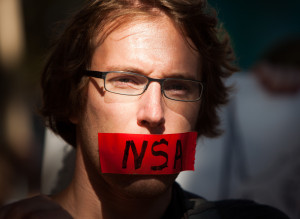
NSA 'Stop Watching Us' Protest Draws Thousands In Washington

WASHINGTON -- Thousands rallied against the National Security Agency's domestic and international surveillance programs Saturday, marching from Union Station to the Capitol to call for an end to mass surveillance.

"We are witnessing an American moment, in which ordinary people -- from high schools to high office -- stand up to oppose a dangerous trend in government," said a statement from Edward Snowden, read aloud at the rally by a participant.

The former NSA employee who leaked information about government surveillance programs to the media ended his statement by saying, "It is time for reform. Elections are coming, and we're watching you."

Monday, June 17, 2013

U.S. surveillance architecture includes collection of revealing Internet, phone metadata

On March 12, 2004, acting attorney general James B. Comey and the Justice Department’s top leadership reached the brink of resignation over electronic surveillance orders that they believed to be illegal.

President George W. Bush backed down, halting secret foreign-intelligence-gathering operations that had crossed into domestic terrain. That morning marked the beginning of the end of STELLARWIND, the cover name for a set of four surveillance programs that brought Americans and American territory within the domain of the National Security Agency for the first time in decades. It was also a prelude to new legal structures that allowed Bush and then President Obama to reproduce each of those programs and expand their reach.

Tuesday, May 21, 2013

Beyond Rosen and the AP: Who Else Has the DoJ Put Under Surveillance?

In light of the revelations about the Department of Justice's broad search of Associated Press phone records and Sunday's Washington Post piece revealing new details about DoJ surveillance of Fox News's James Rosen during its 2010 investigation into a State Department official suspected of leaking the reporter classified information about North Korea, there's an old Washington Post piece from 2010 that's worth turning back to.

Saturday, April 13, 2013

FBI Wants $41 Million Boost To Cyber Monitoring Capabilities

WASHINGTON -- The FBI has requested more than $41 million to improve the bureau’s ability to collect and analyze cyber information and address “critical gaps” in its capability to monitor web activities.

As part of an overall $86 million budget request for a "Next Generation Cyber Initiative," the FBI wants to hire 36 employees, including 10 agents, to improve its cyber collection and analysis capabilities. The justification for that $41 million request, which includes over $33 million in nonpersonnel spending, was submitted in a classified report to Congress as part of the bureau’s 2014 budget request.

Thursday, April 04, 2013

Jennifer Pawluck Arrested For Instagram Photo Of Ian Lafreniere Graffiti

A 20-year-old Montreal woman was surprised when police showed up at her home to arrest her for an Instagram photo she took of graffiti showing Montreal police spokesperson Ian Lafreniere with a bullet in his head.

Jennifer Pawluck took the photo in question in the Hochelaga-Maisonneuve neighbourhood of Montreal last month.

Thursday, February 28, 2013

Rajesh De, NSA General Counsel, Defends Warrantless Wiretapping Program

WASHINGTON -- One day after the Supreme Court blocked a lawsuit against warrantless wiretapping, the National Security Agency's top lawyer offered a rare public defense of the U.S. government's secret spying program. General Counsel Rajesh De's speech at the Georgetown University Law Center on Wednesday was short on specifics, but long on claims that the agency is protecting Americans' privacy.

Wednesday, February 27, 2013

Shelving Bill C-30 Didn't Save Your Privacy

The government's recent decision to kill its online surveillance legislation marked a remarkable policy shift. The outcry over the plan to require Internet providers to install surveillance capabilities within their networks and to disclose of subscriber information on demand without court oversight sparked an enormous backlash, leading to the tacit acknowledgment that the proposal was at odds with public opinion.

While many Canadians welcomed the end of Bill C-30, the year-long battle over the bill placed the spotlight on an ongoing problem with the current system of voluntary disclosure of subscriber information: Internet providers and telecom companies disclose customer information to law enforcement tens of thousands of times every year without court oversight.

Friday, December 28, 2012

Senate to Intel Agencies: We Don't Need to Know How Often You Spy on Americans

There's nothing like a debate over warrantless wiretapping to clarify how the two parties really feel about government. On Friday, the Senate voted to reauthorize the government's warrantless surveillance program, with hawkish Democrats joining with Republicans to block every effort to curtail the government's sweeping spying powers.

As the Senate debated the renewal of the government's warrantless wiretapping powers on Thursday, Republicans who have accused President Barack Obama of covering up his involvement in the death of an American ambassador urged that his administration be given sweeping spying powers. Democrats who accused George W. Bush of shredding the Constitution with warrantless wiretapping four years ago sung a different tune this week, with the administration itself quietly urging passage of the surveillance bill with no changes, and Senator Dianne Feinstein (D-Calif.) accusing her Democratic colleagues of not understanding the threat of terrorism.

Friday, July 13, 2012

CSIS chief supports online surveillance bill, offers to help tweak legislation

OTTAWA - Canada's spy chief backs the Conservative government's troubled bid to bolster Internet surveillance powers, and has offered to help tweak the legislation to make it more palatable to a wary public.

In a letter to Public Safety Minister Vic Toews, Canadian Security Intelligence Service director Dick Fadden says the spy agency was "extremely pleased" to see the bill come before Parliament, considering it "vital" to protecting national security.

Thursday, July 12, 2012

Magnotta Case And Online Surveillance Bill Linked In Memos

The controversial online surveillance Bill C-30 would help police catch criminal suspects such as Luka Rocco Magnotta more quickly, according to briefing notes for Public Safety Minister Vic Toews prepared in the aftermath of the gruesome killing of Jun Lin.

The documents drawing a link with the Magnotta case and Bill C-30 were drafted and circulated by senior officials June 4 — the same day the suspect was arrested in Berlin and more than a week after the crime occurred.

Sunday, June 17, 2012

Bill C-11: Copyright Legislation And Digital Lock Provisions Face Opposition On Eve Of Passage In Canada

Before the end of the summer, breaking a lock on a CD you legitimately purchased to upload songs to your iPhone will be illegal.

Opposition MPs, researchers, artists and even merchants have told the Conservative government the digital locks provisions in its copyright bill make little sense, but the Tories have so far refused to listen.

Monday, MPs are scheduled to vote on the Copyright Modernization Act before sending it to the Senate where it is expected to pass before the summer holidays.

Tuesday, June 05, 2012

Lies, damn lies and Vic Toews

In spite of some initial setbacks, Canada's long-dreaded 'warrantless wiretapping' legislation isn't dead yet.


Bill C-30, originally introduced in February by Public Safety Minister Vic Toews as the Lawful Access Act, has profoundly negative implications for social movements, democracy and an open internet. If passed, it will go a long way toward establishing a surveillance society in Canada.

As Prof. David Murakami-Wood noted when I interviewed him last year, this legislation is "part of a wider campaign to control the internet" that is being waged in Canada, the US, Europe, Australia, China and elsewhere. Murakami-Wood is one in a long line of Canadian experts, including the government's own privacy commissioner, who have come out strongly against a Bill that was greeted with almost universal disdain. A mere hour after tabling it, C-30 was rebranded by Toews as the Protecting Children from Internet Predators Act (he must have figured we weren't going to fall for the old 'terrorism' bugaboo).

Sunday, May 27, 2012

The Internet Is Getting A 'Cat Signal'

The Internet has a new line of defense against laws like SOPA and PIPA that threaten the web's free-flow of information: The Internet Defense League.

The roster of websites that have already signed up reads like the Internet's own version of the Justice League. According to AllThingsD, "WordPress, Imgur, Reddit, Cheezburger Network, Public Knowledge, the Electronic Frontier Foundation and Craigslist founder Craig Newmark" have all agreed to participate.

The group plans to help organize websites around a specific issue that might threaten the Internet as we know it. Whenever the Defense League wants to organize a new cause, they send out code to participating websites that adds a pop up message -- the 'cat signal' -- for every new user that visits the site. The message will ask visitors to participate in some form of protest, like "a prominent message asking everyone to call their elected leaders," according to the IDL's website.

As the IDL point out on their website, the mass protests and blackouts helped beat SOPA and PIPA in the past, and the aim of the new group is to be able to organize protests and blackouts more quickly should another bill threaten the way the Internet operates.

Original Article
Source: the atlantic wire
Author: Connor Simpson

Friday, May 25, 2012

Internet Freedom and the Erosion of Democracy

This week, at least 125 million people are watching the Eurovision Song Contest, an annual competition of singers from 56 countries across Europe and parts of the former Soviet Union. This year’s contest is hosted by Azerbaijan, a country whose human-rights record has come under heavy fire.

Azerbaijan is a classic example of how, even when people are free to connect to the global Internet, they can be subject to pervasive, unaccountable, and unconstrained surveillance. It is also a case of how, while western democratic governments have been quick to follow the lead of the United States and Secretary of State Hillary Clinton in calling for a free and open global Internet, they are much more conflicted when it comes to surveillance. The democratic world has failed to address the freedom-eroding potential of government surveillance through commercial networks.

Thursday, May 24, 2012

FBI Web Surveillance: Bureau Creates Unit To Eavesdrop On Internet Communications

With the Federal Bureau of Investigation's recent push for web wiretaps and increased Internet surveillance, the U.S. seems to be edging closer to the fictional state described in George Orwell's "1984."

As CNET reported earlier this week, the FBI recently created a secret web-surveillance unit, the Domestic Communications Assistance Center, aimed at creating tech that would allow the authorities to more easily eavesdrop on Internet and wireless communications. The DCAC will act as hub for all web surveillance, but will not be directly involved in executing Internet wiretapping court orders or operating investigations if proposed legislation passes as planned.