A sharp bone of contention in the contest between Hillary Clinton and Bernie Sanders is who cares more about the lives of African Americans. One area of concern is minority voting rights — last week, a conservative federal judge upheld a repressive North Carolina voter ID law, passed by Republicans, clearly aimed at suppressing black turnout. This provides yet another pointed reminder of why the supporters of both candidates should unite come November — to stop Chief Justice Roberts and his allies from further gutting measures to protect minorities.
Democracy Gone Astray
Democracy, being a human construct, needs to be thought of as directionality rather than an object. As such, to understand it requires not so much a description of existing structures and/or other related phenomena but a declaration of intentionality.
This blog aims at creating labeled lists of published infringements of such intentionality, of points in time where democracy strays from its intended directionality. In addition to outright infringements, this blog also collects important contemporary information and/or discussions that impact our socio-political landscape.
All the posts here were published in the electronic media – main-stream as well as fringe, and maintain links to the original texts.
[NOTE: Due to changes I haven't caught on time in the blogging software, all of the 'Original Article' links were nullified between September 11, 2012 and December 11, 2012. My apologies.]
Showing posts with label John Roberts. Show all posts
Tuesday, May 03, 2016
Tuesday, November 03, 2015
Chief Justice Roberts' Wild Question About Congress And Immigration
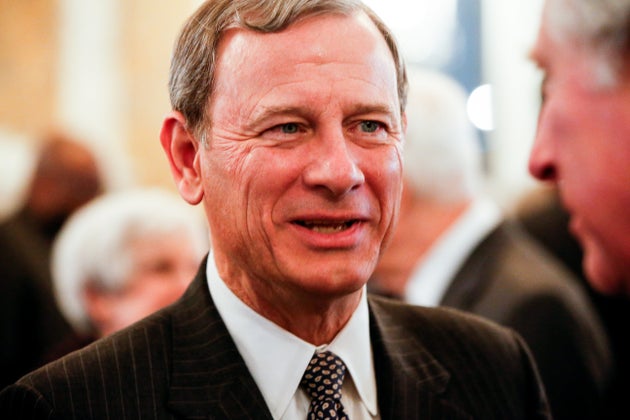
WASHINGTON -- During oral arguments in a Supreme Court case that has the tech industry on alert, Chief Justice John Roberts asked a strange hypothetical Monday about an immigration statute that doesn't exist.
If you didn't know any better, you'd think the idea for it came directly from Arizona Sheriff Joe Arpaio's playbook.
Tuesday, June 23, 2015
Chief Justice Roberts Is Poised To Score A Major Victory Against Racial Justice
In February of 1982, a young John Roberts was fresh out of his clerkship for the conservative Justice William Rehnquist, and only a few months into his new job working as an aide to Attorney General William French Smith. Less than two years earlier, the Supreme Court had read the Voting Rights Act narrowly, holding that the law did not permit many cases alleging disenfranchisement against minority voters to move forward. Roberts was now working within the Justice Department to defend his boss’s position that this narrow interpretation of the law should remain in place.
Saturday, May 09, 2015
John Roberts Basically Thinks It's OK When Politicians Just Do What Wealthy Donors Say
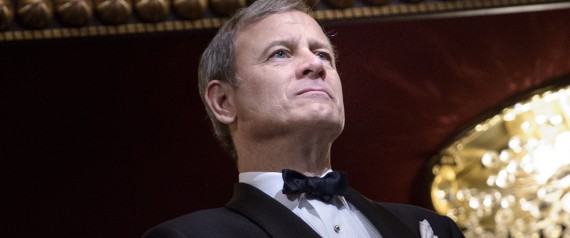
WASHINGTON -- When it comes to campaign finance law, Chief Justice John Roberts taketh away even as he giveth.
On Wednesday, the Supreme Court upheld a state campaign finance law banning judicial candidates from soliciting contributions for their elections in Williams-Yulee v. Florida Bar. The majority opinion, written by Roberts, was a surprising move by a court that has recently been hostile to all campaign finance regulation. But it also contained a line that suggested just how comfortable this court may be with the malign influence of money in politics.
Tuesday, February 03, 2015
How the Roberts Supreme Court Has Strengthened the Powerful and Screwed Everyone Else
Wednesday, November 26, 2014
Should We Impeach Chief Justice John Roberts?
Republicans like to talk about impeaching President Obama, but there is a far more deserving candidate for impeachment—Chief Justice John Roberts of the Supreme Court. While the Republicans in Congress have blocked Democrats from enacting much of substance, the GOP majority in control of the Court has been effectively legislating on its own, following an agenda neatly aligned with their conservative party. Step by step, the five right-wing justices are transforming the terms of the American political system—including the Constitution.
Wednesday, November 12, 2014
The Questions John Roberts Has Never Answered
As the Supreme Court prepares to invalidate Obamacare’s federal tax subsidies in yet another assault on the social safety net, it’s a good time to review the promises Chief Justice John Roberts made at his September 2005 Senate confirmation hearing and re-examine the key questions he was never forced to answer.
Students of judicial history will recall that Roberts was initially nominated to take the place of retiring Justice Sandra Day O’Connor and was tapped for the chief’s position only after the death of former Chief Justice William Rehnquist. Suddenly thrust into the national spotlight, Roberts declared in his now famous opening statement to the judiciary committee that he was “humbled” by his nomination. In keeping with that humility, he pledged that he would “decide every case based on the record, according to the rule of law, without fear or favor, to the best of my ability. And I will remember that it’s my job to call balls and strikes and not to pitch or bat.”
Tuesday, April 15, 2014
THE JOHN ROBERTS PROJECT
If you think that the Supreme Court’s decision in McCutcheon v. Federal Election Commission was bad, just wait: worse may be on the way.
The issue before the Court was fairly narrow, even a little obscure. Congress bars individuals from contributing more than fifty-two hundred dollars to any candidate for federal office in any election cycle. It also bars individuals from contributing more than a hundred and twenty-three thousand dollars, in total, to multiple federal candidates in a cycle. In the McCutcheon case, by a vote of five to four, the Court struck down the overall hundred-and-twenty-three-thousand-dollar limit. But this ruling will affect relatively few campaign contributors. In the most recent cycle, fewer than six hundred donors maxed out to candidates.
Sunday, April 13, 2014
THE JOHN ROBERTS PROJECT
If you think that the Supreme Court’s decision in McCutcheon v. Federal Election Commission was bad, just wait: worse may be on the way.
The issue before the Court was fairly narrow, even a little obscure. Congress bars individuals from contributing more than fifty-two hundred dollars to any candidate for federal office in any election cycle. It also bars individuals from contributing more than a hundred and twenty-three thousand dollars, in total, to multiple federal candidates in a cycle. In the McCutcheon case, by a vote of five to four, the Court struck down the overall hundred-and-twenty-three-thousand-dollar limit. But this ruling will affect relatively few campaign contributors. In the most recent cycle, fewer than six hundred donors maxed out to candidates.
Monday, August 12, 2013
Does the Chief Justice Have Too Much Power?
John Roberts has a way of inserting himself into almost every political setting. He upstaged Barack Obama at his first Inauguration; he made his the most important single vote cast in the 2012 election; he has upended 2014 politics with his opinion gutting the Voting Act. Now it turns out he has assumed a key role in the War on Terror.
So it seems entirely reasonable for The New York Times's Linda Greenhouse to suggest that "we have given the chief justice -- any chief justice, not just this one -- too much to do."
Friday, July 26, 2013
Roberts’s Picks Reshaping Secret Surveillance Court
In making assignments to the court, Chief Justice Roberts, more than his predecessors, has chosen judges with conservative and executive branch backgrounds that critics say make the court more likely to defer to government arguments that domestic spying programs are necessary.
Ten of the court’s 11 judges — all assigned by Chief Justice Roberts — were appointed to the bench by Republican presidents; six once worked for the federal government. Since the chief justice began making assignments in 2005, 86 percent of his choices have been Republican appointees, and 50 percent have been former executive branch officials.
Tuesday, June 25, 2013
Roberts's Rules of Order
In his impeccable Senate confirmation performance in 2005, John Roberts provided for himself a sort of mission statement. As chief justice, he pledged to be restrained, modest, and deferential toward precedents and legislatures; he would seek consensus and not decide more than was necessary to resolve a case. Modesty, he testified, “means an appreciation that the role of the judge is limited, that a judge is to decide the cases before them, they’re not to legislate, they’re not to execute the laws…. It is their job to say what the law is.” Congressional Republicans, ecstatic about President George W. Bush’s selection of such an impressive nominee, perceived that the conservative legal revolution was finally at hand. They proudly presented Roberts to the nation as the very model of a Supreme Court justice.
Monday, March 04, 2013
John Roberts Voting Rights Act Comments Wrong, Massachusetts Official William Galvin Says
Massachusetts Secretary of State William Galvin is calling out Supreme Court Chief Justice John Roberts for making "deceptive" and "disturbing" remarks about voting rates among minorities in the Bay State.
Justices heard arguments Wednesday in a challenge to the part of the Voting Rights Act that forces places with a history of discrimination, like the Deep South, to get approval before changing the way elections are held. During the arguments, Roberts asked Solicitor General Donald Verrilli if he knew "which state has the worst ratio of white voter turnout to African-American voter turnout," claiming that state is Massachusetts.
Monday, July 09, 2012
John Roberts Health Care Switch Sparks 'Deep' Supreme Court 'Discord': CBS News

More than a week removed from the Supreme Court's landmark health care ruling, a new report of dissension among the justices has emerged.
In a Sunday appearance on "Face The Nation," CBS News Chief Political and Legal Correspondent Jan Crawford provided new details about the aftermath of the 5-4 decision to uphold the Affordable Care Act's individual mandate as constitutional.
"The discord is deep and it is personal," said Crawford on the broadcast. "This could affect this court for a long time."
Crawford reported last Sunday that Chief Justice John Roberts switched his vote after initially siding with the court's conservative justices to strike down the mandate.
In the court's majority opinion, Roberts wrote that the individual mandate "need not be read to do more than impose a tax," which falls under Congress' constitutional power to collect taxes.
"No one has any idea how it's going to be resolved but conservatives feel this sense of betrayal -- that Roberts changed his mind for the wrong reasons," Crawford said on "Face The Nation." "If he had been with the liberals from the beginning … that would have been one thing. But to have switched his position -- and relatively late in the process -- infuriated conservatives."
Crawford interviewed Justice Clarence Thomas in 2007, and she interviewed Justice Antonin Scalia at an event held by the conservative Federalist Society in 2010.
Original Article
Source: huffington post
Author: Chris Gentilviso
In a Sunday appearance on "Face The Nation," CBS News Chief Political and Legal Correspondent Jan Crawford provided new details about the aftermath of the 5-4 decision to uphold the Affordable Care Act's individual mandate as constitutional.
"The discord is deep and it is personal," said Crawford on the broadcast. "This could affect this court for a long time."
Crawford reported last Sunday that Chief Justice John Roberts switched his vote after initially siding with the court's conservative justices to strike down the mandate.
In the court's majority opinion, Roberts wrote that the individual mandate "need not be read to do more than impose a tax," which falls under Congress' constitutional power to collect taxes.
"No one has any idea how it's going to be resolved but conservatives feel this sense of betrayal -- that Roberts changed his mind for the wrong reasons," Crawford said on "Face The Nation." "If he had been with the liberals from the beginning … that would have been one thing. But to have switched his position -- and relatively late in the process -- infuriated conservatives."
Crawford interviewed Justice Clarence Thomas in 2007, and she interviewed Justice Antonin Scalia at an event held by the conservative Federalist Society in 2010.
Original Article
Source: huffington post
Author: Chris Gentilviso
Tuesday, July 03, 2012
The Roberts Rules
Thursday was destined to be an historic day for American liberty, and it was, though the new precedent is grim. The remarkable decision upholding the Affordable Care Act is shot through with confusion—the mandate that's really a tax, except when it isn't, and the government whose powers are limited and enumerated, except when they aren't. One thing is clear: This was a one-man show, and that man is John Roberts.
The Chief Justice ruled that ObamaCare's mandate violated the Commerce Clause, joined by the Court's conservative bloc, but he also said that the mandate fell within Congress's power to tax, joined by the Court's liberal bloc. In practice this is a restraint on federal power without real restraint—and, worse, the Chief Justice had to rewrite the statute Congress passed in order to salvage it. The ruling will stand as one of the great what-might-have-beens of American constitutional law.
John Roberts' Switch On Obamacare Sparks Fascination With Supreme Court, Possible Leaks
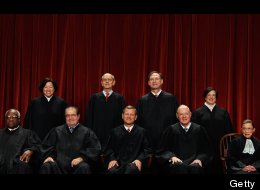
WASHINGTON -- Since the U.S. Supreme Court handed down a ruling to uphold the heart of President Barack Obama’s health care law, the media’s fascination with Chief Justice John Roberts' decision to side with the majority and uphold the mandate as a tax has reached a fever pitch.
Now, Jan Crawford’s CBS report that Roberts changed his opinion on the Affordable Care Act -- going from agreeing with the court’s conservative justices to siding with its liberal faction -- has sparked a new wave of analysis. It's focused not just on his decision, but on who would leak information around the inner workings of a court typically cloaked in secrecy.
Friday, June 29, 2012
Michael Savage Links Justice John Roberts' Epilepsy Medication To Obamacare Ruling
Conservative firebrand Michael Savage is not known to mince words--one of his favorite adjectives is "Islamofascist," and in 2009 he was banned from entering the United Kingdom on grounds of extremism.
But on Thursday, the popular radio talk show host's outspokenness veered into particularly strange territory when he suggested that Chief Justice John Roberts' epilepsy medication was responsible for his decision to uphold President Obama's health care law.
"Let's talk about Roberts," Savage said. "I'm going to tell you something that you're not gonna hear anywhere else, that you must pay attention to. It's well known that Roberts, unfortunately for him, has suffered from epileptic seizures. Therefore he has been on medication. Therefore neurologists will tell you that medication used for seizure disorders, such as epilepsy, can introduce mental slowing, forgetfulness and other cognitive problems. And if you look at Roberts' writings you can see the cognitive disassociation (sic) in what he is saying..."
Original Article
Source: huffington post
Author: Benjamin Hart
But on Thursday, the popular radio talk show host's outspokenness veered into particularly strange territory when he suggested that Chief Justice John Roberts' epilepsy medication was responsible for his decision to uphold President Obama's health care law.
"Let's talk about Roberts," Savage said. "I'm going to tell you something that you're not gonna hear anywhere else, that you must pay attention to. It's well known that Roberts, unfortunately for him, has suffered from epileptic seizures. Therefore he has been on medication. Therefore neurologists will tell you that medication used for seizure disorders, such as epilepsy, can introduce mental slowing, forgetfulness and other cognitive problems. And if you look at Roberts' writings you can see the cognitive disassociation (sic) in what he is saying..."
Original Article
Source: huffington post
Author: Benjamin Hart
John Roberts Outrages Conservatives In Health Care Ruling

"This was an activist court that you saw today," Tea Party favorite Rep. Michele Bachmann (R-Minn.) told reporters. "Anytime the Supreme Court renders something constitutional that is clearly unconstitutional, that undermines the credibility of the Supreme Court. I do believe the court's credibility was undermined severely today," she said, later adding that Congress could now force you to buy Ikea furniture.
Monday, May 14, 2012
Money Unlimited How Chief Justice John Roberts orchestrated the Citizens United decision
When Citizens United v. Federal Election Commission was first argued before the Supreme Court, on March 24, 2009, it seemed like a case of modest importance. The issue before the Justices was a narrow one. The McCain-Feingold campaign-finance law prohibited corporations from running television commercials for or against Presidential candidates for thirty days before primaries. During that period, Citizens United, a nonprofit corporation, had wanted to run a documentary, as a cable video on demand, called “Hillary: The Movie,” which was critical of Hillary Clinton. The F.E.C. had prohibited the broadcast under McCain-Feingold, and Citizens United had challenged the decision. There did not seem to be a lot riding on the outcome. After all, how many nonprofits wanted to run documentaries about Presidential candidates, using relatively obscure technologies, just before elections?
Chief Justice John G. Roberts, Jr., summoned Theodore B. Olson, the lawyer for Citizens United, to the podium. Roberts’s voice bears a flat-vowelled trace of his origins, in Indiana. Unlike his predecessor, William Rehnquist, Roberts rarely shows irritation or frustration on the bench. A well-mannered Midwesterner, he invariably lets one of his colleagues ask the first questions.
Subscribe to:
Posts (Atom)

