Democracy Gone Astray

Democracy, being a human construct, needs to be thought of as directionality rather than an object. As such, to understand it requires not so much a description of existing structures and/or other related phenomena but a declaration of intentionality.
This blog aims at creating labeled lists of published infringements of such intentionality, of points in time where democracy strays from its intended directionality. In addition to outright infringements, this blog also collects important contemporary information and/or discussions that impact our socio-political landscape.

All the posts here were published in the electronic media – main-stream as well as fringe, and maintain links to the original texts.

[NOTE: Due to changes I haven't caught on time in the blogging software, all of the 'Original Article' links were nullified between September 11, 2012 and December 11, 2012. My apologies.]

Showing posts with label Low Wage. Show all posts

Sunday, April 17, 2016

The Workers Caring For Our Grandparents Are Paid Poverty Wages

Kim White started her job at a nursing home in Florida five years ago hoping it would open the doors to a fulfilling career. Instead, she’s been paid so little that her dreams have been indefinitely put on hold.

The certified nursing assistant job “was something that I wanted to use as a stepping stone to get into nursing school,” she said. “But it just always ended up being that it was never enough pay.”

Tuesday, March 08, 2016

Taking On Corporations That Pollute Communities Not With Chemicals, but With Poverty Wages

Imagine if a corporation set up shop in your community and immediately dumped toxic sludge in your local waterways and buried radioactive waste next to your biggest playground. You and your neighbors, I bet, would demand full compensation from that corporation to pay for the clean-up and public health costs.

You’d have a strong case.

Friday, March 06, 2015

Why Are Liberals Resigned to Low Wages?

Liberals need to own the wage problem. Wages remain lower than they were before the Great Recession, following a generation of virtually no growth. Identifying why this is, and understanding the way out, will be essential as the economy gains steam yet still leaves many people behind. And this, in turn, will require overthrowing the reigning attitude that liberals have brought to our economic crisis. Let’s call it liberal nihilism.

Liberal nihilists try to explain why the economy isn’t serving workers, but they do so in ways that render us powerless to fix the problem. There’s a version where workers simply don’t have the education or skills necessary to handle new high-tech jobs. There’s another, similar story in which robots and globalization are taking all the jobs, leaving workers behind in the process.

Thursday, December 18, 2014

For Low-Wage Americans, The Holiday Season Is A Time To Work

For many American workers, this is the time of year for tying up loose ends and taking it easy. For Simon Ting, this is the time of year for working harder than ever.

Ting, 24, works at a Macy’s in San Francisco, and he’s paid largely on commission. That means the more he sells, the more money he makes -- and the holiday season is a great time for selling. Ting tries to be at Macy’s for as many of the store’s extended hours as he can during the holiday rush. He knows sales will be hard to come by after New Year’s. In past holiday seasons, when he staffed other retailers’ stores, Ting worked so much he slept on the stockroom floor between shifts.

Thursday, October 30, 2014

Women, Minorities Earn Far Less In Private Sector Than Public: CCPA

OTTAWA - A new report says it pays to work in the public sector — especially if you're a minority.

The study by the Canadian Centre for Policy Alternatives found that overall, full-time wages in public sector jobs are 2.3 per cent higher than those in the private sector.

But it also found that government workers who are female, Aboriginal, or belong to a visible minority group do much better from a relative wage standpoint than their counterparts at private companies.

Wednesday, October 15, 2014

Jimmy John's Makes Low-Wage Workers Sign 'Oppressive' Noncompete Agreements

If you're considering working at a Jimmy John's sandwich shop, you may want to read the fine print on your job application.
A Jimmy John's employment agreement provided to The Huffington Post includes a "non-competition" clause that's surprising in its breadth. Noncompete agreements are typically reserved for managers or employees who could clearly exploit a business's inside information by jumping to a competitor. But at Jimmy John's, the agreement apparently applies to low-wage sandwich makers and delivery drivers, too.

Wednesday, September 24, 2014

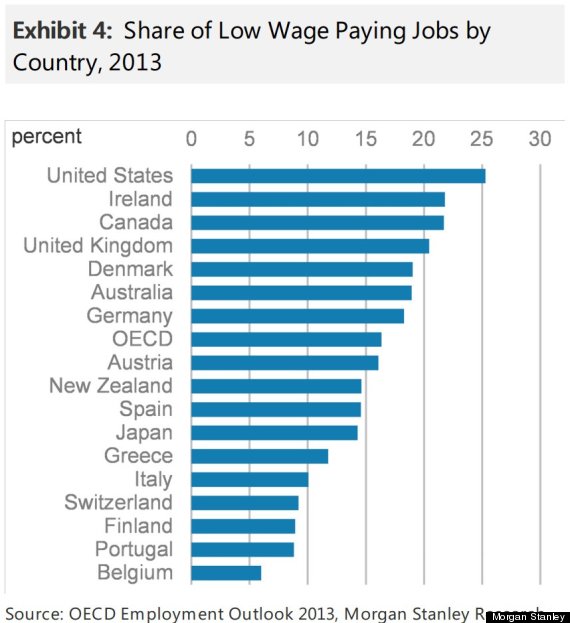
America Has More Low-Paying Jobs Than Any Other Developed Country

America may be exceptional in many ways, but it also tops the charts of a new, troubling ranking.

The U.S. has more low-paying jobs than any other country in the Organisation for Economic Co-operation and Development, an economic group of 34 developed countries, according to a research note released by Morgan Stanley on Monday.

Economists Ellen Zentner and Paula Campbell based their analysis on the OECD Economic Outlook Report, which documents employment and labor trends in each member nation.

Sunday, August 31, 2014

Dunkin' Donuts Worker's Death Reveals The True Cost Of Our Low-Wage, Part-Time Economy

A New Jersey woman died earlier this week trying to catch a few hours of sleep between jobs, a chilling reminder of the struggle low-wage workers, particularly women, face making ends meet.

Police found Maria Fernandes dead in her car on Monday night, parked in a convenience-store parking lot in Elizabeth, N.J., according to a police press release. Fernandes, 32, was wearing a Dunkin’ Donuts uniform when she was found. A friend and fellow employees told officials she worked as many as four jobs, said Lt. Daniel Saulnier, a spokesman for the Elizabeth police department.

Sunday, May 11, 2014

Fast-Food Protests Expected In More Than 30 Countries

Union representatives from countries including Argentina, Hong Kong, Italy, New Zealand and Panama gathered in New York this week to share tips and strategize for the demonstrations slated to take place on May 15. Organizers plan to announce the global actions at a news conference outside a McDonald's in New York on Wednesday afternoon.

The protests calling for pay of $15 an hour in the U.S. have gained national media attention since they began in New York in late 2012. The push is getting financial and organizational support from the Service Employees International Union — which has more than 2 million members — and has served as an important backdrop as President Barack Obama and Democratic lawmakers seek to raise the federal minimum wage in an election year.

Wednesday, April 30, 2014

Disposable workers: Bigger profits from lower wages

In her much-discussed Walrusprofile of Jason Kenney, award-winning journalist Marci McDonald questions how well immigration policy designed as part of Harper Conservative political strategy is playing out.
Most observers of Canadian politics know about efforts led by Kenney to woo "hard-working Canadians" -- recent immigrants -- to expand the base of the governing party. McDonald lays out problems in the Kenney/Harper approach that could come back to haunt the Conservatives at election time.

Fast-Food CEOs Make 1,200 Times As Much As One of Their Workers—and They Want to Keep It That Way

David Novak is the chief executive of Yum! Brands, the parent company that runs Pizza Hut, Taco Bell and KFC. Last year, while Yum! Brands and other restaurant companies lobbied against raising the minimum wage, Novak made at least $22 million—more than 1,000 times what the average fast-food worker makes in a year. In return for paying him so much, Yum! got a tax break.

Monday, April 21, 2014

Low wages, not poor work ethic, behind surge of foreign labour

Tired of being demonized by the media, denounced in Parliament and disciplined by Employment Minister Jason Kenney, Canada’s small business owners are starting to push back.
The reason they hire foreign temporary workers when 1.3 million Canadians are unemployed, they insist, is that they have a better work ethic than domestic job applicants. “If we’re not prepared to do these jobs and we don’t want our kids to do them either — yet we still want to go to the mall and find a clean bathroom and we still want someone to clean our hotel rooms — why are we so afraid to allow people to come to Canada to happily do these jobs?” asked Dan Kelly, head of the Canadian Federation of Independent Business (CFIB).

Friday, January 31, 2014

The cost of low wages? Poor health, says report

For a minimum wage worker, how much does it cost to make a nutritious meal?
Let’s assume you’re a meat eater, and that you want at least one carb and one vegetable on your plate. You’ll also probably want something to drink. We’ll also assume you work in Ontario, where the minimum wage is $10.25.
To put together a meal of chicken, potatoes and carrots with milk to drink based onCanada’s average food prices, is going to run you about $16 -- just over an hour and half of work.

Thursday, January 30, 2014

Thirty-Two Arrested at a LaGuardia Rally for Higher Wages

Around thirty-two people were arrested Monday on Martin Luther King Jr. Day, including Representative Charles Rangel and nine New York City Council members, when they blocked a bridge to LaGuardia Airport during a rally for liveable wages and an MLK Day paid holiday. In total, close to a 1,000 people attended the protest that was organized by Local 32BJ of the Service Employees International Union.

Before the march to the bridge, Representative Rangel told the crowd: “No one should be one pay check from homelessness. We have a new mayor now, Bill de Blasio, and I am certain that he will be spearheading our fight for better wages.”

Monday, December 30, 2013

Pay workers more, CBI chief tells thriving firms

Companies benefiting from the economic recovery must pay their long-suffering workers more next year, the head of the CBI in an unprecedented attack on firms he accuses of keeping "far too many people stuck in minimum-wage jobs".

John Cridland, director-general of the CBI, Britain's biggest business lobby group, will criticise many of the 240,000 companies he is paid to represent for failing to pass on their new-found prosperity to employees. He will tell employers – who in the FTSE 100 are paid 136 times the national average – that they must ensure that all citizens benefit from the recovery.

Thursday, December 19, 2013

More Than 1 In 10 Americans Who Work Full Time Are Still Poor

A good job may be hard to find in this tepid recovery, but low-wage work still abounds. Whether it's washing dishes, serving Big Macs or folding sweaters for a store display, low-paying jobs have been added to the American economy at a fairly brisk clip since the recession ended in 2009. Middle- and high-paying jobs, not so much.

By one estimate, one in four private-sector jobs in the U.S. now pays less than $10 per hour, well below a living wage in many areas of the country. Compared to better-paying positions, these jobs are also more likely to come without regular schedules or benefits, like health care coverage, paid vacation time or sick leave -- the basic trappings of middle-class work. In other words, employment doesn't guarantee a life above the poverty line; according to census data, more than one in 10 Americans who work full-time are still poor.

Low-wage workers have been striking over pay, and Congress is considering legislation that would raise the federal minimum wage from $7.25 to $10.10 per hour. With the U.S. Senate set to debate its bill soon, HuffPost reached out to readers who work hard and still have a difficult time making ends meet. Many struggle to secure full-time employment and scramble to find extra work in their spare time. Others make just above the minimum wage and still can barely scrape by.

They eat what they can afford, rather than what they want. Some avoid going to the doctor, even when they're gravely ill. Others turn off the hot water in their homes and wear clothes given to them by friends.

What they all seem to have in common is a desire to work and a hope to someday earn something more. "I think there's great honor in working," Bernadette Feazell, a pawn shop employee in Austin, Texas, said. "I work hard. And frankly, it's not because I think I'm worth $9 an hour."

Original Article
Source: huffingtonpost.com/
Author: Dave Jamieson

Thursday, December 12, 2013

Jobs That Pay Less Than $15 An Hour Are Replacing Higher Wage Work

A growing share of the country’s jobs pay less than $15 an hour, replacing higher wage jobs, according to a new report from the Alliance for a Just Society.

The number of jobs in occupations that pay a median wage below $15 an hour grew by 3.6 million between 2009 and 2012, increasing by about 3 percent. During the same time period, the number of jobs that pay above that level fell by 4 million. There were more than 51 million jobs paying less than $15 an hour last year. Someone making $15 an hour working 40 hours a week, 52 weeks a year will make $31,200, while experts say a two-income family with two kids needs $72,000 a year to be economically secure.

Thursday, December 05, 2013

Low-wage workers across the U.S. are organizing for better pay, labour rights

The holiday season is upon us. Sadly, the big retailers are Scrooges when it comes to paying their staffs. Undergirding the sale prices is an army of workers earning the minimum wage or a fraction above it, living cheque to cheque on their meagre pay and benefits. The dark secret that the retail giants like Wal-Mart don't want you to know is that many of these workers subsist below the poverty line, and rely on programs like food stamps and Medicaid just to get by. This holiday season, though, low-wage workers from Wal-Mart to fast-food restaurants are standing up and fighting back.

Tuesday, August 06, 2013

The Pay Is Too Damn Low

A few weeks ago, Washington, D.C., passed a living-wage bill designed to make Walmart pay its workers a minimum of $12.50 an hour. Then President Obama called on Congress to raise the federal minimum wage (which is currently $7.25 an hour). McDonald’s was widely derided for releasing a budget to help its employees plan financially, since that only underscored how brutally hard it is to live on a McDonald’s wage. And last week fast-food workers across the country staged walkouts, calling for an increase in their pay to fifteen dollars an hour. Low-wage earners have long been the hardest workers to organize and the easiest to ignore. Now they’re front-page news.

The workers’ grievances are simple: low wages, few (if any) benefits, and little full-time work. In inflation-adjusted terms, the minimum wage, though higher than it was a decade ago, is still well below its 1968 peak (when it was worth about $10.70 an hour in today’s dollars), and it’s still poverty-level pay. To make matters worse, most fast-food and retail work is part time, and the weak job market has eroded what little bargaining power low-wage workers had: their earnings actually fell between 2009 and last year, according to the National Employment Law Project.

Monday, July 22, 2013

'The scale of low pay in Britain is a national scandal,' says Sentamu

The archbishop of York, John Sentamu, has condemned the low wages of millions of Britons as a "national scandal", saying businesses have ignored a moral duty to ensure that all employees are paid enough to live on.

In an outspoken intervention that will reignite tensions between church leaders and the government, Sentamu accuses those in power of offering only "warm words" and "sticking plaster" solutions to a problem that is having "devastating" effects on people's lives.