Democracy Gone Astray

Democracy, being a human construct, needs to be thought of as directionality rather than an object. As such, to understand it requires not so much a description of existing structures and/or other related phenomena but a declaration of intentionality.
This blog aims at creating labeled lists of published infringements of such intentionality, of points in time where democracy strays from its intended directionality. In addition to outright infringements, this blog also collects important contemporary information and/or discussions that impact our socio-political landscape.

All the posts here were published in the electronic media – main-stream as well as fringe, and maintain links to the original texts.

[NOTE: Due to changes I haven't caught on time in the blogging software, all of the 'Original Article' links were nullified between September 11, 2012 and December 11, 2012. My apologies.]

Showing posts with label Manitoba. Show all posts

Thursday, October 12, 2023

Canada’s first First Nations provincial premier elected in Manitoba

Manitoba has elected Canada’s first provincial First Nations premier, handing the progressive leader a legislative majority following a contentious election campaign.

Wab Kinew, the 41-year-old head of the leftwing New Democratic party (NDP), has led the province’s party since 2017. A former rapper, broadcast journalist and university administrator, Kinew said his newly elected government will focus on reopening three emergency rooms shuttered in recent years. He also said the province would invest in more social housing.

Thursday, July 13, 2017

Manitoba's unions are ready to fight proposed labour legislation

Manitoba's labour leaders are pushing back against new legislation they say drastically reduces workers' rights and puts Manitobans' health care at risk.

Earlier this month, the provincial government passed Bill 28 and Bill 29. Bill 28, The Public Services Sustainability Act, creates a rolling four-year period of wage freezes or minimal wage increases. Bill 29, The Health Sector Bargaining Review Act, dramatically decreases the number of unions in the health-care sector, and could possibly pit unions against each other.

Tuesday, March 03, 2015

Bucking the trend: Manitoba defends workers' pensions

Each day Canadian newspapers carry a version of the same story: working Canadians are not prepared for retirement. Statisticians and economists who look at the problem conclude that about half of middle-class baby boomers will experience a steep drop in living standards when they retire.
They also show that with each successive generation of retirees subsequent to the boomers, this problem is projected to get worse. We used to be told that after a career of hard work all workers deserved to retire with dignity and security. Now with decent and secure retirements harder and harder to come by, this important part of middle-class life seems ever more out of reach.

Tuesday, December 30, 2014

A Canadian City Once Eliminated Poverty And Nearly Everyone Forgot About It

On a December afternoon, Frances Amy Richardson took a break from her quilting class to reflect on a groundbreaking experiment she took part in 40 years earlier.

“Well, that was quite a few years ago,” she said. “There was a lot of people that really benefitted from it.”

Between 1974 and 1979, residents of a small Manitoba city were selected to be subjects in a project that ensured basic annual incomes for everyone. For five years, monthly cheques were delivered to the poorest residents of Dauphin, Man. – no strings attached.

Friday, January 31, 2014

Manitoba Pipeline Explosion Leaves Thousands Without Natural Gas Service

ST. PIERRE-JOLYS, Man. - Several thousand people in southern Manitoba have been told that a pipeline explosion could mean they'll be without natural gas service for up to several days as temperatures hover close to —20 C.

"As far as the temperature is concerned, the words 'polar vortex' is what they're saying," Myron Dyck, a spokesman for the Town of Niverville, said on Saturday.

The explosion and fire at a TransCanada Pipelines valve site near St. Pierre-Jolys happened early Saturday morning, sending a massive fireball into the dark sky.

Friday, July 12, 2013

PST scrap may send province to poorhouse

The stalemate in the legislature threatens to push the government over a "fiscal cliff," NDP house leader Jennifer Howard said Wednesday.

Howard, who was loath to use those two words six weeks ago, said the possibility the government could run out of money by the end of July looms larger as Brian Pallister's Progressive Conservatives continue to plug up the government's legislative and fiscal agenda.

Wednesday, March 20, 2013

Manitoba Métis win historic ruling

"Louis Riel must be smiling."

That was the front-page headline of the Winnipeg Free Press on March 9, 2013. It’s taken from the response of the head of the Manitoba Métis Federation to the ruling by the Supreme Court of Canada released the day before that the Canadian and Manitoba governments abrogated their responsibilities to respect land rights won by the Métis people when the province was established in 1870.

Louis Riel was one of the leaders of the Métis people during the latter half of the 19th century. They are the people of mixed European/Indigenous ancestry in western Canada.

Thursday, January 24, 2013

Manitoba Tories reject calls to revoke membership of former youth president

WINNIPEG - Manitoba's Opposition party is not going to revoke the membership of a former youth wing president who made admittedly racist comments about aboriginals — at least not right now.

The Progressive Conservative board of directors met Wednesday night and formally accepted the resignation of Braydon Mazurkiewich as the party's youth president. But it rejected, at least for the time being, calls to revoke Mazurkiewich's member card.

Mazurkiewich stirred up controversy last month when he took to Facebook to blast a proposed urban reserve on a former military base in Winnipeg, saying the area was "built for hardworking men and women of the military, not freeloading Indians."

Monday, June 18, 2012

Don’t defund freshwater research, Ontario and Manitoba tell Tories

Two provincial environment ministers are pleading with the Conservative government to continue its funding of a research station in Northwestern Ontario that has studied the ecology of freshwater lakes for more than 50 years.

Gord Mackintosh, Manitoba’s Minister of Conservation and Water Stewardship, and Ontario Environment Minister Jim Bradley say the work conducted at the Experimental Lakes Area (ELA) is relied upon by all Canadian bodies that are responsible for managing freshwater resources and many of their international counterparts.

Sunday, June 03, 2012

Mulcair blames Harper for East-West divisions

Federal NDP Leader Tom Mulcair says he isn't pitting Canada's East against the West, in prepared remarks to provincial New Democrats gathered for a party convention in Winnipeg on Saturday.

"Those are Stephen Harper's battle lines," Mulcair said on his last day of a three-day tour of the Prairies. "Not mine."

Mulcair's controversial "Dutch Disease" comments unleashed a fury of reaction from federal Conservatives and western premiers alike who called his comments "divisive", "goofy" and intended to divide the country.

Mulcair feels Manitoba love

Federal New Democrat Leader Thomas Mulcair, on a tour of Western Canada, finally found some love in Winnipeg Saturday when he addressed the party's faithful at the provincial NDP's annual convention.

The newly minted leader of the official opposition was soundly criticized during stops in Alberta, where he toured the oilsands on Thursday, and in Saskatchewan for saying the Canadian dollar has been artificially inflated by oilsands exports by companies that don't pay the full cost of their pollution.

Mulclair argues that drives up the Canadian dollar and hurts the manufacturing sectors of central Canada -- an economic phenomenon known as "Dutch disease."

Monday, May 14, 2012

Frost is definitely in air these days

OTTAWA -- There's a cool wind blowing between Broadway and Parliament Hill these days.

Some days it's positively icy.

It's not uncommon for there to be friction, particularly when large amounts of money are involved and opposing political ideologies are at play.

But it's not every day you see federal MPs taking seats on the loges in the Manitoba legislature to issue a stare-down at provincial cabinet ministers over an immigration feud.

It's pretty rare for a premier to accuse the federal government outright of cancelling the immigration settlement agreement as punishment for the province's criticism on other issues.

On Thursday, Selkirk-Interlake Conservative MP James Bezan even used precious time for debating the federal budget implementation bill to criticize the Manitoba budget.

Saturday, May 12, 2012

Solve reserves' water crisis, don't squabble, Rae urges

OTTAWA and the province must set aside jurisdictional squabbles and fix the clean-water crisis that plagues remote reserves, federal Liberal Leader Bob Rae said Friday.

"You can't let these things descend into jurisdictional and constitutional battles. Every Canadian should have access to running water," Rae said. "The two governments have to get their act together and get it done."

Along with Manitoba Liberal Leader Jon Gerrard, Rae travelled to St. Theresa Point Friday afternoon to visit homes with no proper plumbing and meet with the chief and council.

St. Theresa Point is one of four reserves around Island Lake, where most of the province's 1,400 homes without modern sanitation are located.

Rae and Gerrard visited the home of Alice and Francis Taylor, who live with their son, Kevin, who has cerebral palsy. Their home has no running water and the family has been outspoken about their need for better services for their son.

"You just feel, as a Canadian, that we're not living up to the most basic of standards," Rae said.

The interim Liberal leader touted an unusual agreement he made with Ottawa in the early 1990s to solve Ontario's on-reserve water crisis. Back then, a retrofit agreement saw the two governments spend more than $200 million over 10 years to upgrade electrical wiring and install running water, bathtubs, sinks and toilets in hundreds of homes.

"It was the decision of the province to insist on doing it, and to say to the federal government, 'Listen, these questions of jurisdiction, we won't continue this pointless fight,' " Rae said in French. "We will share the cost."

Original Article
Source:  winnipeg free press
Author: Mary Agnes Welch 

Tuesday, March 13, 2012

Lynn Lake, Manitoba Caribou Slaughter: First Nations Protest, But Province Says Killing Perfectly Legal

WINNIPEG - Provincial investigators say the killing of dozens of caribou decried by Manitoba First Nations groups last week as wasteful and uncalled for was perfectly legal.

Tim Cameron, the province's chief natural resources officer, said conservation officials looked into the matter immediately after a northern chief discovered the bloody carcasses of 30 animals near Lynn Lake. The officers found the area was a popular butchering site and the animals were killed over a period of time.

Although First Nations chiefs complained about the killing, saying meat was left to rot, Cameron said officers didn't find any whole carcasses that were abandoned.

"Our investigation showed no wanton waste of meat of caribou at all," he said. "It was just skinned hides and heads that were left behind."

Cameron said the winter road is wider where the carcasses were discovered, which makes the spot a good site for hunters to set up camp and to butcher their catch.

Thursday, March 08, 2012

Caribou Slaughter Outrages Manitoba First Nations

Northern Manitoba chiefs are demanding answers after 30 dead caribou were found at the side of a winter road with only the antlers missing.

"This is lot of waste here that should never happen. And I want investigation on exactly who did this," Chief Joe Antsanen of the Northlands Denesuline First Nation told reporters in Winnipeg on Wednesday.

He was joined by Grand Chief David Harper of the Manitoba Keewatinowi Okimakanak (MKO), an organization representing northern Manitoba First Nations.

Antsanen made the discovery while driving to Winnipeg on a winter ice road near the community of Lynn Lake, Man., last week. It looked like the animals had been killed and dragged there, he said.

"The only thing I can think of is this is done just for trophy — just for sports — and that's totally, totally unacceptable," Antsanen said.

Sunday, January 08, 2012

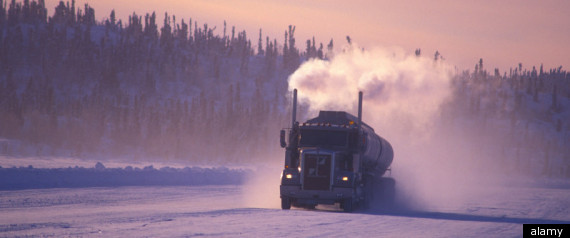
Manitoba Ice Roads Threatened By Mild Weather

Northern Manitoba residents are desperately hoping for some cold weather, because milder than normal temperatures are leaving the opening of northern ice roads in doubt.

Many people in remote northern communities use ice roads every winter to get groceries and other essential supplies transported by truck from urban centres like Winnipeg.

Some also drive on the roads to buy their own groceries, which they say would cost twice as much at home.

"Winter roads are a necessity with the high costs of living up north, and we all depend on the winter roads," said Irma Harper of St. Theresa Point, Man., who was buying supplies in Winnipeg on Saturday.

The seasonal roads, which are built on frozen lakes as well as land, take some time to prepare, and in a typical year are open from mid-January until March.

But above-normal temperatures across much of Manitoba so far this winter have northern residents nervous that this year's ice road season could be cut short, or the roads may not be built at all.

Saturday, December 10, 2011

‘History on trial’ in Manitoba Métis land case

OTTAWA—If justice delayed is, indeed, justice denied, the Supreme Court of Canada is about to preside over one of the greatest denials of justice in Canadian history.

With the plight of the people of Attawapiskat dominating the Canadian agenda and sparking fresh introspection of our treatment of aboriginals, another indigenous people is quietly ready for its date with destiny.

For the Métis of Manitoba, the wheels of justice have taken three decades to get to this point.

But they are trying to undo what they believe is a wrong perpetrated 141 years ago.

No court has yet seen history through their eyes.

The country’s highest court will hear arguments on a Métis land deal from 1870, an unfinished piece of Confederation that hinges on a promise John A. Macdonald made to Louis Riel.

The Métis case will be made by Thomas Berger, whose long career has included court victories for Canadian aboriginals, including the 1973 decision that led to the formal recognition of aboriginal title in this country, leading to land claim settlements covering half the Canadian land mass.

Tuesday, October 18, 2011

NDP Leader Nycole Turmel Supports Manitoba's Call For Flood Help

WINNIPEG - Interim NDP Leader Nycole Turmel urged the federal government to develop a national disaster-prevention program Saturday, following a half-hour meeting with Manitoba Premier Greg Selinger.

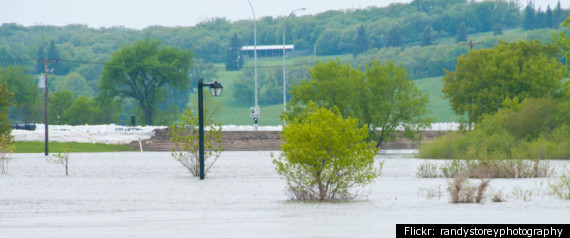
Turmel was shown maps of areas around Lake Manitoba and Lake St. Martin, where flooding this year has forced more than 1,000 people from their homes.

She said the federal government must follow through on a promise to develop a national strategy to prevent floods and other disasters before they happen.

"We support the position of the government here to have a national strategy on ... issues of disaster," Turmel said.

"(Selinger) explained to me with the map, so it was great to see what you can do and what the federal government can do to prevent disasters like this."

Prime Minister Stephen Harper has talked about a new disaster-mitigation program to prevent or minimize damage from floods, fires and other natural disasters. The money would be used to build or enlarge structures such as dikes along flood-prone riverbanks.

Sunday, October 02, 2011

Manitoba Election: Third-World Living Conditions For First Nations Should Be Election Issue Says Grand Chief David Harper

WINNIPEG - One of Manitoba's aboriginal leaders says the lack of clean, running water and the third-world living conditions of Manitoba's First Nations should be a central issue in the provincial election.

Grand Chief David Harper, who represents the province's northern First Nations, said many communities in the northeast have been neglected for years.

"Here we are sitting in northeastern Manitoba and it's in a third world state," he said in a recent interview. "There is a lack of running water, no running water. This coming winter, some kids and elders in that area, will not have any clean drinking water. Yet every flu season, it seems to happen that people are dying."

But as the province prepares to go to the polls Tuesday, very little has been done to woo First Nation voters. Very few political leaders have ventured into predominantly First Nation northern ridings and none have focused heavily on aboriginal policies.