Democracy Gone Astray

Democracy, being a human construct, needs to be thought of as directionality rather than an object. As such, to understand it requires not so much a description of existing structures and/or other related phenomena but a declaration of intentionality.
This blog aims at creating labeled lists of published infringements of such intentionality, of points in time where democracy strays from its intended directionality. In addition to outright infringements, this blog also collects important contemporary information and/or discussions that impact our socio-political landscape.

All the posts here were published in the electronic media – main-stream as well as fringe, and maintain links to the original texts.

[NOTE: Due to changes I haven't caught on time in the blogging software, all of the 'Original Article' links were nullified between September 11, 2012 and December 11, 2012. My apologies.]

Showing posts with label Minnesota. Show all posts

Thursday, August 09, 2018

Native communities threaten Standing Rock-style protests after Minnesota pipeline approval

Native communities and environmental advocates slammed the approval of a controversial oil pipeline on Thursday, threatening protests in the style of Standing Rock and pledging civil unrest in response to the project.

In a unanimous vote Thursday, all five members of the Minnesota Public Utilities Commission (PUC) approved a certificate allowing Canadian energy company Enbridge to proceed with rebuilding the deteriorating Line 3 oil pipeline. The project would see the pipeline likely restored to its full capacity of 760,000 barrels of crude oil per day — this would bring a boost to the total 2.5 million barrels of tar sands crude oil that is currently exported into the United States from Canada each day.

Thursday, August 02, 2018

“The Next Standing Rock.” Minnesota's Indigenous Water Protectors Stand Up to Line 3

Debra Topping has been harvesting wild rice near her home on the Fond du Lac Ojibwe reservation in Minnesota for thirty-eight years. Around late summer, she skims the shallow lakes where it grows, using two lightweight wood batons, called “knockers,” to pull the stalks of grass over the canoe, and swatting the husked tips, the “spikelets,” into the boat. The seeds are protein-rich and nutty in flavor. Topping sometimes cooks them inside a pumpkin, with sweet potatoes and squash—her grandson’s favorite dish. An uncle once told Topping that the family needed 100 pounds of finished wild rice per year for each person. In practice, she says, it’s more like four times that much—enough to share with the community during feasts, ceremonies, and funerals. “Wild rice is why the creator put us where we’re at, as indigenous Anishinaabe people,” she tells The Progressive.

Tuesday, July 24, 2018

Enbridge’s plans to build tar sands pipeline through Minnesota just hit a snag

Enbridge’s proposed Line 3 project — an effort to replace and expand an oil sands pipeline through Minnesota — hit a roadblock Monday when the state’s Department of Commerce said that the project is environmentally and economically risky and that the company has failed to show that the pipeline is even needed at all.

“Enbridge has not established a need for the proposed project; the pipeline would primarily benefit areas outside Minnesota; and serious environmental and socioeconomic risks and effects outweigh limited benefits,” the Department of Commerce said in a statement announcing its filings to the Public Utility Commission (PUC). The PUC is evaluating the project in advance of issuing — or denying — a Certificate of Need and a Route Permit. Public hearings will be held between September 26 and October 26, followed by additional filings and hearings. The PUC is expected to make its final determination at the end of April 2018.

Monday, July 10, 2017

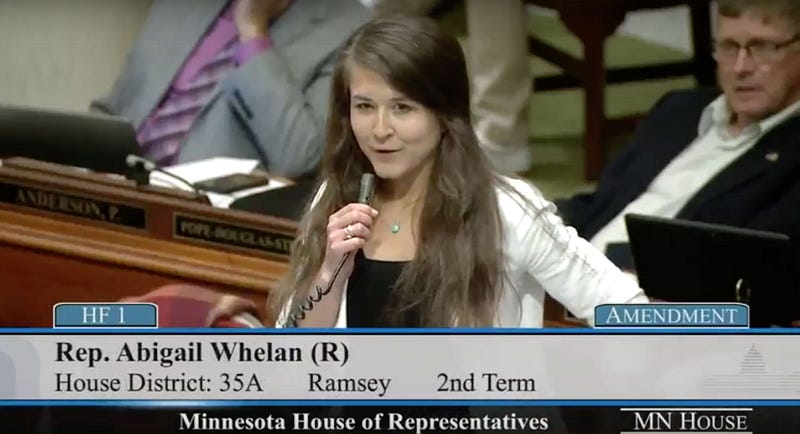
Minnesota Republican dodges question about tax havens by invoking Jesus

Pressed about her lack of support for an amendment that would close loopholes for offshore tax havens, a Minnesota Republican dodged the question in favor of talking about her religious beliefs.

Minnesota Rep. Abigail Whelan, a second-term House legislator from suburban Ramsey, was responding to a question from Democratic Rep. Paul Thissen early Wednesday morning about whether she thinks “benefiting people who are hiding money in Liberia is worth raising taxes on your own constituents.”

Wednesday, June 28, 2017

Minnesota Republicans accuse female legislator of racism because she criticized white men

On April 4, America’s first Somali legislator —Rep. Ilhan Omar (D) — made a speech on the House floor about the connection between today’s Black Lives Matter activists and civil rights icons like Martin Luther King Jr. She was speaking out in opposition to a Republican bill that would increase penalties for protesters if they block highways — a tactic that has been used in Minnesota in response to the deaths of Jamar Clark and Philando Castile at the hands of cops.

Monday, June 26, 2017

The Minnesota Eight Don’t Want to Be Deported to a Country They’ve Never Lived In

The Minnesota Eight are a group of Cambodian men in their thirties and forties with a troubled history in common: each came to the U.S. legally as a child refugee in the nineteen-eighties but later lost his green card after being convicted of a crime. By law, legal permanent residents are automatically deportable if they've committed an aggravated felony, and thousands of people every year are deported after completing prison terms. But when these men got out of prison they found themselves in a strange situation. Because of a long-standing diplomatic dispute between the U.S. and Cambodia, they were released rather than deported. Several of them got married and started families; they took jobs, and settled down. Twice a year, they were required to check in at their local Immigration and Customs Enforcement (ICE) office, in St. Paul, Minnesota, but after a few years these visits became routine. Then, last summer, when they each showed up for their appointments with ICE, they were abruptly rearrested, and informed that their deportations were back on schedule.

Sunday, December 25, 2016

Minnesota judge overturns state ban on transgender health coverage

A Minnesota state judge has issued a ruling that is good news for the state’s transgender community. After an 11-year ban, the state’s Medicaid system, known as Medical Assistance (MA) must provide coverage for transition-related surgical procedures.

A 64-year-old trans man by the name of Evan Thomas sued, with support from the ACLU of Minnesota and OutFront Minnesota, for the right to a double mastectomy. His doctors deemed the procedure medically necessary for resolving his gender dysphoria, but Thomas depended on MA, which denied him coverage. In the meantime, Thomas was relying on chest binding to help resolve his dysphoria, but he had to stop after it caused him chest infections and acute bronchitis.

Wednesday, April 16, 2014

GOP Candidate Wants To Get Elected To Keep His Daughter From Learning Evolution

Aaron Miller, a Republican congressional candidate in Minnesota, said a big reason he's running is to end classroom instruction on evolution, according to the Mankato Free Press.

Miller, a hospital account manager and Iraq War veteran, said during the congressional district's Republican Party convention in Albert Lea on Saturday that Minnesota needs more religious freedom. He cited an incident in which his daughter was forced to learn evolution in school.

Thursday, June 13, 2013

Striking Janitors in Minnesota Demand an End to Retaliation

The chemicals Maricela Flores uses to clean a Minnesota Target store’s floors are powerful enough to cut through her skin. Yet Flores says the contract cleaning company she works for, Carlson Building Maintenance, failed to give her protective gloves until after she participated in a February strike organized by the local labor group Centro de Trabajadores Unidos en Lucha.

Thursday, October 18, 2012

Minnesota Anti-Gay Constitutional Amendment Fuels National Battle Over Marriage Equality

Voters in Maine, Maryland and Washington will decide November 6 whether to recognize same-sex marriage, potentially marking the first time such marriages are legalized by popular vote. However, in Minnesota, opponents of same-sex marriage are pushing a constitutional amendment to define marriage as a union between a man and a woman. Thirty-two states have previously held votes on same-sex marriage and, each time, voters have opposed it. Civil rights groups are organizing to defeat the ballot measure, joined by a growing number of sympathetic churches. One of the groups at the forefront of the movement for marriage equality is Minnesotans United for All Families. The Human Rights Campaign — a national group that represents lesbian, gay, bisexual and transgender people — announced on Wednesday that it has invested an additional $200,000 in Minnesota to defeat the amendment. Meanwhile, the Catholic Church has spent at least $1.1 million to oppose same-sex marriage bills. For more, we’re joined now by Minnesota State Senator Scott Dibble, who is openly gay, and who helped found "Minnesotans United for All Families."

Video
Source: Democracy Now!
Author: ---

Thursday, July 07, 2011

Minnesota Government Shutdown 2011 Costing State Millions Of Dollars

ST. PAUL, Minn. -- While Minnesota's political leaders haggle over how much the state should spend in the next two years, state coffers are bleeding millions of dollars as a result of the state's week-old government shutdown.

"It's going to be a slow force on the economy," said Tom Stinson, a University of Minnesota professor who is laid off from his job as state economist.

Minnesota stands to lose tens of millions of dollars in the nation's only state government shutdown, as lottery tickets go un-purchased, tax cheats go un-pursued and 22,000 laid-off state workers collect unemployment and health benefits.

The government interruption also threatens to slow an already sluggish economic recovery as the state employees in limbo and others who lose state-dependent jobs – including construction workers and nonprofit staffers – tighten their spending.

Stinson said the shutdown isn't likely to cause a recession – but "it's clearly not good the longer that it goes on."

The political dispute that has closed state government centers on how to erase a $5 billion deficit. Republicans who run the Legislature want to cut projected spending to match the amount of revenue the state will collect over the next two years. Gov. Mark Dayton hopes to avoid some of those cuts by raising income taxes on the highest earners; he has also said he's willing to consider other ways to bring in new revenue.

Full Article
Source: Huffington 

Saturday, July 02, 2011

Minnesota Government Shutdown Begins, No End In Sight

ST. PAUL, Minn. -- Minnesota lawmakers headed home for a long holiday weekend, bracing for likely public anger as some of them meet constituents for the first time since a failure to reach a budget agreement forced a government shutdown.

The reception they get starting Saturday, and during 4th of July parades around the state, could go a long way toward determining how long the shutdown lasts. Democratic Gov. Mark Dayton and GOP leaders had no plans for new talks before Tuesday, five full days after the shutdown started.

Minnesota's second shutdown in six years was striking much deeper than a partial 2005 shutdown. It took state parks and rest stops off line, closed horse tracks and made it impossible to get a fishing license. But it also was hitting the state's most vulnerable, ending reading services for the blind, silencing a help line for the elderly and stopping child care subsidies for the poor.

The shutdown was rippling into the lives of people like Sonya Mills, a 39-year-old mother of eight facing the loss of about $3,600 a month in state child care subsidies. Until the government closure, Mills had been focused on recovering from a May 22 tornado that displaced her from a rented home in Minneapolis. Now she's adding a new problem to her list.

"It just starts to have a snowball effect. It's like you are still in the wind of the tornado," said Mills, who works at a temp agency and was allowed to take time off as she gets back on her feet – but after the shutdown also has to care for her six youngest children, ages 3 through 14, because she lost state funding for their daycare and other programs.

Minnesota is the only state to have its government shut down this year, even though nearly all states have severe budget problems and some have divided governments. Dayton was determined to raise taxes on the top earners to help erase a $5 billion deficit, while the Republican Legislature refused to go along with that – or any new spending above the amount the state is projected to collect.

Here, as in 21 other states, there's no way to keep government operating past the end of a budget period without legislative action. Even so, only four other states – Michigan, New Jersey, Pennsylvania and Tennessee – have had shutdowns in the past decade, some lasting mere hours.

The shutdown halted non-emergency road construction and closed the state zoo and Capitol. More than 40 state boards and agencies went dark, though critical functions such as state troopers, prison guards, the courts and disaster responses will continue.

On Friday, former state Supreme Court Chief Justice Kathleen Blatz started the court-appointed job of sifting through appeals from groups arguing in favor of continued government funding for particular programs.

Nonprofit groups helping the state's poor have already been hit hard. Some closed their doors immediately, while others continued services, at least for now. Some were looking at layoffs, said Sarah Caruso, president and CEO of Greater Twin Cities United Way, which funds 400 programs serving poor people. She said the impact will depend on how long the shutdown lasts.

"If we go well beyond that two-week window, I think then we will start seeing much more significant closure of programs to support the vulnerable, and the long-term financial viability of some of these agencies will really be called into question," she said.

So far, 30 agencies had accepted United Way's offer of advances on their grants, seeking cash to stay up and running.

The stoppage suspended some programs for the blind and visually impaired, including a radio reading service run by volunteers and training for blind people who are learning to walk with a cane. Bonnie Elsey, director of the state's Workforce Development Division, said a vocational rehabilitation program that places people with disabilities in jobs or school was halted.

Minnesota food pantries scurried to make sure they would still get 700,000 pounds of food – about 30 percent of their total volume – in the next two months through a federal program. Nearly a million pounds already in warehouses were also put on hold by the shutdown. Colleen Moriarty, executive director of Hunger Solutions Minnesota, said the federal program's operation depended on a single state employee working in a data management system. Later Friday, Moriarty said the employee had been called back to work.

The shutdown also idled a state hotline set up to help seniors and their caregivers find services, housing options, help with Medicaid and Medicare insurance and more. A call to the 800 number Friday got a recording saying callers could leave a message.

The political stalemate meant instant layoffs for 22,000 state workers, including Paul Bissen, a road and bridge inspector for more than 26 years. Bissen said he cut back on spending last month. He figured he could go a couple of months without worrying, but on the first day of the shutdown, he said it looked like his washing machine had died – adding another expense.

"I want to work. I've got road construction projects to build, to try to make them safe and make them smooth so people can get back to forth to their work," Bissen said.

Fearful of voter anger, both parties blasted each other for Minnesota's second shutdown in six years.

GOP Chairman Tony Sutton called Dayton a "piece of work" and accused him of inflicting "maximum pain" for political reasons.

Democratic-Farmer-Labor Party Chairman Ken Martin laid the blame on Republicans, saying they drove the state to a shutdown to protect millionaires from tax increases sought by Dayton.

The Alliance for a Better Minnesota, a left-leaning group supportive of Dayton, plans to run weekend radio ads in three popular vacation areas blaming Republicans for the impact of the shutdown, including closed state parks. The group also debuted a "shutdown shame" website.

The shutdown has been a slow-motion disaster, with a new Democratic governor and new Republican legislative majorities at odds for months over how to eliminate the state budget deficit. Dayton has been determined to raise taxes on high-earners to close the deficit, while Republicans insisted that it be closed only by cuts to state spending.

Even after the shutdown looked like a certainty, Dayton and Republicans did not soften their conflicting principles. Dayton said he campaigned and was elected on a promise not to make spending cuts to a level he called "draconian."

Origin
Source: Huffington 

Friday, July 01, 2011

Minnesota Government Shutdown 2011: Budget Deal Unreached

ST. PAUL, Minn. -- Minnesota stumbled into its second government shutdown in six years on Thursday, with a partisan divide over taxes and spending to close a $5 billion deficit becoming only more bitter as a midnight deadline came and went without agreement.

Any hope of a last-minute budget deal between Democratic Gov. Mark Dayton and Republican legislative leaders evaporated around 10 p.m., when Dayton appeared to say he and Republicans were still fundamentally divided over how much the state should spend the next two years and that he saw no chance of avoiding a shutdown.

"It's significant that this shutdown will begin on the Fourth of July weekend," Dayton said. "On that date we celebrate our independence. It also reminds us there are causes and struggles worth fighting for."

Republicans appeared again minutes later, and tried to hang blame for the shutdown around the governor's neck. They said the two sides were closer than he admitted, and they criticized his refusal to call a special session so lawmakers could pass a "lights on" budget bill to keep government running. Dayton refused, saying he's been clear for months that he would only agree to a total budget approach.

"I think the governor's insistence that we pass a full budget is not going to be of much comfort to Minnesotans who are going to see delays on the highways because construction projects stop," said Senate Majority Leader Amy Koch, R-Buffalo. "It's not going to comfort people who can't use our state parks, or who can't get a driver's license."

The two sides didn't meet again ahead of the deadline.

Full Article
Source: Huffington 

Minnesota on the Brink

The GOP's opposition to tax hikes for the rich is about to send 36,000 workers packing.


Imagine if every generation in your family had a history of gainful employment with the same company, which was renowned all over the state for having better wages, hours, and benefits than any other employer. While you were growing up, maybe your parents and grandparents encouraged you to work for the same company, because they knew it would pay you fairly for the hours you put in, and that it would take care of you after retirement. Now, imagine that the same employer has shut down indefinitely, meaning that you and 36,000 others are now on the streets with nowhere to go.

In the Land of 10,000 Lakes, that employer is the state of Minnesota. At 5 p.m. today, the state of Minnesota is laying off tens of thousands of loyal employees, all of them victims of the same obstructionist politicking that pollutes Washington.

Just as congressional Republicans are threatening to bring about another crippling recession by forcing the U.S. to default on the national debt, Minnesota Republicans are refusing to accept any alternative to their cuts-only budget, meaning the entire state government will shut down. Minnesota’s largest employer is about to padlock its doors, and Republicans are willing to take away the livelihoods of 36,000 of their constituents in order to score petty political points.

Gov. Mark Dayton is asking for a modest three per cent tax increase for the wealthiest two per cent of Minnesotans, shifting the tax burden for those earning above $193,687 from 8.1 per cent to 11.1 per cent. This is nothing compared to the tax burden of Minnesotans earning less than $11,201 per year, who already pay 22.1 per cent of their income in taxes. However, the Republican-controlled state legislature stubbornly adheres to president of Americans for Tax Reform Grover Norquist’s “No New Taxes” pledge, and is ready to shut the government down so the richest two per cent won’t have to pay even just 10 per cent less, proportionally, than the poorest of the poor.

Starting July 1, a college professor teaching a summer class at a public university won’t have a job to go to. Her students won’t get to complete a class credit, and won’t even have a school to attend.

By the end of the month, during one of the busiest and most prosperous seasons in the American tourism industry, not one state park in Minnesota will be open to host campers, hikers, or sportsmen, ensuring that the state will lose untold millions in revenue.

By the end of the business day on Thursday, June 30, folks who depend on the state of Minnesota for a steady paycheck will be forced to either draw unemployment or depend on the money they saved for retirement to pay the bills and stay fed and clothed.

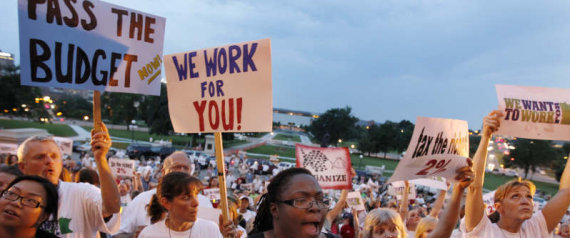
So, at 5 p.m. today, when the doors of the state capitol are padlocked, U.S. Uncut Minnesota will fight back with sustained, non-violent resistance until obstructionist Republicans accept their governor’s modest, reasonable, necessary tax increase.

After today, 36,000 people in Minnesota won’t have jobs. And, by the next election cycle, Minnesota Republicans will have to explain why they should be able to keep their own jobs while allowing their constituents working in state government to lose theirs. Hopefully, like an elephant, the people never forget.

Origin
Source: The Mark 

Minnesota Government Shutdown: State Could Close Doors Friday

A simmering labor dispute in Minnesota could erupt into a full-blown state government shutdown just in time for the July 4th holiday weekend if a $5 billion budget gap isn't closed by the end of Thursday.

Across the border from where Gov. Scott Walker (R-Wis.) launched his assault on public sector employees' collective bargaining rights, a conflict over Minnesota's budget threatens to temporarily lay off more than 20,000 state workers. Only this time, Gov. Mark Dayton, from the state's Democratic Farmer Labor Party, is facing off against intransigent Republican legislative leaders.

State parks and zoos are scheduled to close, potentially infuriating thousands of Independence Day campers, revelers and barbecuers. If the Thursday midnight deadline is not met, the state capitol would shut its doors. Non-critical functions like road construction would screech to a halt, creating an economic ripple effect that would raise the state unemployment rate by as much as a whole percentage point.

"This is going to be a tough shutdown," said David Lillehaug, an attorney for the governor, on Wednesday.

Read updates about the Minnesota shutdown on a HuffPost live blog here.

Dayton is proposing progressive income tax increases to fix the state budget, which faces a huge gap over the next two years, while the GOP is demanding further spending cuts. Both sides said they were attempting to compromise. But time is running out, and even if an agreement is reached Thursday, it may not come soon enough to avoid a partial shutdown.

If the shutdown occurs, "It's the largest single layoff that's ever occurred in the state of Minnesota," said Jim Monroe, head of the Minnesota Association of Professional Employees (MAPE). Monroe estimates that more than 8,000 of his union's members would be temporarily out of a job, and the effects on the state as a whole would be "almost unimaginable."

The budget battle fight has taken on the ideological cast of a clash between an unapologetic progressive, Dayton, and Tea Party-favored state legislators. The state's House and Senate are both dominated by Republican majorities. David Schultz, an adjunct professor at the Hamline University School of Law in Saint Paul, Minn., told HuffPost the showdown is the result of "a real enormous game of constitutional chicken."

Full Article
Source: Huffington