Democracy Gone Astray

Democracy, being a human construct, needs to be thought of as directionality rather than an object. As such, to understand it requires not so much a description of existing structures and/or other related phenomena but a declaration of intentionality.
This blog aims at creating labeled lists of published infringements of such intentionality, of points in time where democracy strays from its intended directionality. In addition to outright infringements, this blog also collects important contemporary information and/or discussions that impact our socio-political landscape.

All the posts here were published in the electronic media – main-stream as well as fringe, and maintain links to the original texts.

[NOTE: Due to changes I haven't caught on time in the blogging software, all of the 'Original Article' links were nullified between September 11, 2012 and December 11, 2012. My apologies.]

Showing posts with label PBS. Show all posts

Friday, June 23, 2017

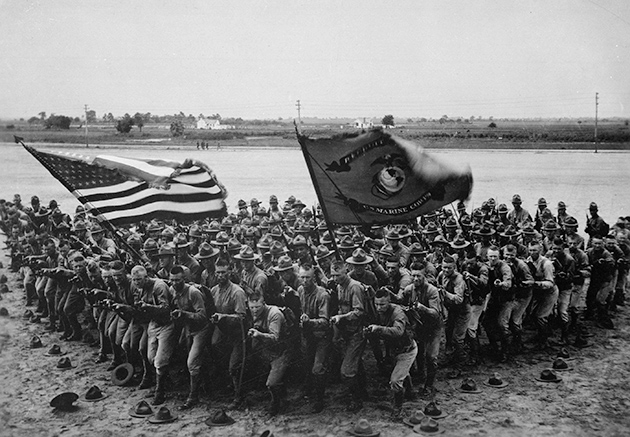
This Epic PBS Documentary Shows How Creepily Little Has Changed Since World War I

I was never that much of a history buff, so it’s pretty rare for me to sit down and watch a documentary about a war that ended before my mom was born. But I’m rethinking my slacker ways after watching The Great War, a captivating new series premiering April 10 on PBS’ American Experience.

The history of this nation’s involvement in World War I is as fascinating as it is unsettling. The Great War also was our global coming of age, the beginning of America’s transformation into a nation deeply engaged in world affairs and conflicts. Perhaps what struck me most about the three-part, six-hour series was the familiarity of so many of its themes—a sense of déjà vu that left me feeling like even those of us who know our history are doomed to repeat it.

Thursday, May 30, 2013

Did Public Television Commit Self-Censorship to Appease Billionaire Funder David Koch?

Filmmakers Tia Lessin and Carl Deal say plans for their new documentary to air on public television have been quashed after billionaire Republican David Koch complained about the PBS broadcast of another film critical of him, "Park Avenue: Money, Power and the American Dream," by acclaimed filmmaker Alex Gibney. Lessin and Deal were in talks to broadcast their film, "Citizen Koch," on PBS until their agreement with the Independent Television Service fell through. The New Yorker reports the dropping of "Citizen Koch" may have been influenced by Koch’s response to Gibney’s film, which aired on PBS stations, including WNET in New York late last year. "Citizen Koch" tells the story of the landmark Citizens United ruling by the Supreme Court that opened the door to unlimited campaign contributions from corporations. It focuses on the role of the Koch-funded Americans for Prosperity in backing Wisconsin Gov. Scott Walker, who has pushed to slash union rights while at the same time supporting tax breaks for large corporations. The controversy over Koch’s influence on PBS comes as rallies were held in 12 cities Wednesday to protest the possible sale of the Tribune newspaper chain, including the Los Angeles Times and Chicago Tribune, to Koch Industries, run by David Koch and his brother Charles.

Video
Source: democracynow.org
Author: -

Monday, May 20, 2013

A Word from Our Sponsor

Last fall, Alex Gibney, a documentary filmmaker who won an Academy Award in 2008 for an exposé of torture at a U.S. military base in Afghanistan, completed a film called “Park Avenue: Money, Power and the American Dream.” It was scheduled to air on PBS on November 12th. The movie had been produced independently, in part with support from the Gates Foundation. “Park Avenue” is a pointed exploration of the growing economic inequality in America and a meditation on the often self-justifying mind-set of “the one per cent.” As a narrative device, Gibney focusses on one of the most expensive apartment buildings in Manhattan—740 Park Avenue—portraying it as an emblem of concentrated wealth and contrasting the lives of its inhabitants with those of poor people living at the other end of Park Avenue, in the Bronx.

Thursday, August 16, 2012

Mitt Romney: Slash Amtrak, PBS Funding, But Defense Cuts And Middle Class Tax Cuts Off The Table

WASHINGTON -- In an interview with Fortune Magazine that was published on Wednesday morning, Mitt Romney gave a bit more detail than normal about how he would fulfill his promise to get the nation on track towards fiscal balance.

But the proposals he laid out largely ducked the so-called "painful" choices that experts insist must be made, and seemed to be drawn from rosy assumptions about the immediate political and economic future. At one point, Romney was asked to respond to a Tax Policy Center analysis that concluded he would need to take away tax benefits that primarily help the middle class if he wanted his broader proposals to be deficit neutral.

Wednesday, April 25, 2012

PBS Frontline Investigation Into Financial Crisis Suggests Another Disaster On Horizon

Frontline's new documentary about the financial crisis probably doesn't say much you didn't already know, at least if you've followed the story. But it's a story worth telling again anyway, because memories on Wall Street and in Washington are dangerously short.

On Tuesday night PBS will air the first two parts of a four-part documentary on the crisis, called "Money, Power and Wall Street," with the second two parts to air next Tuesday, May 1.

The first hour tells the history of the credit derivatives at the heart of the crisis, while the second hour tells the blow-by-blow of the crisis itself, culminating with the bank bailouts in the fall of 2008.

Viewers familiar with all of this material -- and there's not much new in the first two hours, which could probably have been condensed to one hour without losing much -- might be confused about the point of rehashing what is by now old history. The trailer for the whole series suggests Frontline is slowly building a case, maybe to be hammered home in the final two hours next week, that the financial system is still just as primed for disaster as it was four years ago.

The second part of the documentary, airing in the second hour tonight, is more entertaining than the first, but mainly in the way oft-told horror stories are fun to hear around the campfire. Stop me if you've heard any of this before: Bear Stearns goes down because of toxic mortgage debt early in 2008. Policy makers take the summer off. Treasury Secretary Hank Paulson decides to let Lehman Brothers die, to teach Wall Street a lesson. Oops! AIG and the rest of Wall Street get hundreds of billions of dollars to keep the financial system from going down the drain.