Democracy Gone Astray

Democracy, being a human construct, needs to be thought of as directionality rather than an object. As such, to understand it requires not so much a description of existing structures and/or other related phenomena but a declaration of intentionality.
This blog aims at creating labeled lists of published infringements of such intentionality, of points in time where democracy strays from its intended directionality. In addition to outright infringements, this blog also collects important contemporary information and/or discussions that impact our socio-political landscape.

All the posts here were published in the electronic media – main-stream as well as fringe, and maintain links to the original texts.

[NOTE: Due to changes I haven't caught on time in the blogging software, all of the 'Original Article' links were nullified between September 11, 2012 and December 11, 2012. My apologies.]

Showing posts with label PIPA. Show all posts

Saturday, January 21, 2012

The struggle against Sopa and Pipa is not over

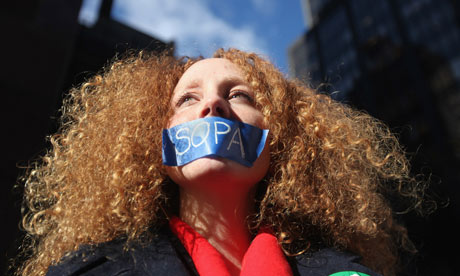
Has Sopa, the draconian copyright legislation under consideration by the American Congress, been firmly put to rest? You might imagine that, while the dust settles from a series of mini-explosions this week in the copyright arena, as a bill that once seemed certain to be enacted has stalled.
 
But you would be mistaken to think it's dead. The powerful interests backing Sopa (Stop Online Piracy Act), which proponents say is aimed to stop the worst of the worst infringers, are unhappy with this week's events, but they have not remotely given up. And they still have time and money on their side.

For the moment, however, it's plain that the internet community made a huge impact on Congress with a mass online protest that led to a flooding of lawmakers' email accounts and phone/fax lines. Dozens of lawmakers either backed away from earlier support or announced that they'd gone from neutral to against.
Meanwhile, proponents of a non-censored internet got support from Neelie Kroes, the EU commissioner for the digital agenda, who tweeted on Friday:
Glad tide is turning on Sopa: don't need bad legislation when should be safeguarding benefits of open net.
Friday, January 20, 2012

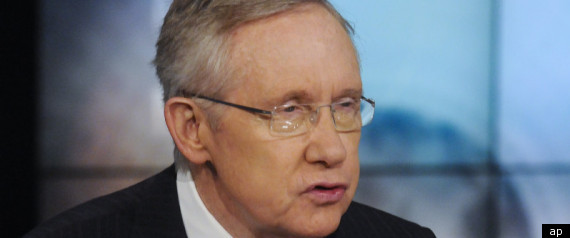
PIPA Vote: Sen. Harry Reid Postpones Vote, Seeking Compromise On Anti-Piracy Bill

WASHINGTON -- In a significant victory for open Internet advocates, Senate Majority Leader Harry Reid (D-Nev.) and House Judiciary Committee Chairman Lamar Smith (R-Texas) both indefinitely postponed votes on controversial anti-piracy legislation.

"In light of recent events, I have decided to postpone Tuesday’s vote on the Protect IP Act," Reid said in a written statement.

The move followed a frantic week of political jockeying on Capitol Hill amid intense online activism, in which Wikipedia and other major websites voluntarily blocked access to their content in protest of the bills. The Stop Online Piracy Act and its Senate companion, Protect IP, would have given the government broad powers to shut down entire websites accused of violating copyright laws -- without a trial or a traditional court hearing. Hollywood movie studios and other content creators would also get new powers to sue companies like banks and advertisers that do business with websites accused of piracy.

In the House, Smith had been planning to hold a committee vote on SOPA in February, which lobbyists on Capitol Hill expected to closely mirror whatever legislative language passed the Senate. While the delayed Senate vote does not necessarily mark a final failure for the anti-piracy legislation, it almost certainly delays any vote for months. During an election year in which lawmakers are particularly cautious about bringing up controversial legislation, the bill's supporters now face a steep uphill battle to pass anything on piracy at all.

Thursday, January 19, 2012

How Rupert Murdoch's Fear Is Getting in the Way of Internet TV

News Corp. mogul Rupert Murdoch's reaction to a Google TV presentations is the best explanation yet of why we won't be seeing truly integrated Internet TV any time soon. On Saturday, Murdoch took to his new Twitter account to vent about how much he hates Google: "Piracy leader is Google who streams movies free, sells advts around them. No wonder pouring millions into lobbying." Like many who saw the tweet, we thought that he was weighing in on SOPA, but, according to Forbes' Jeff Bercovici, it turns out he was actually recoiling in horror at seeing the web's streaming piped into a TV. Bercovici's sources said the tweet came after a Google TV presentation at the Consumer Electronics Show and he learned that search results for movie titles would include sites that offer pirated versions, just like regular Google.

The notion of the rules of the freewheeling web moving onto your TV set in your living room is a nightmare scenario for corporate media who depend on your cable box being a gateway to their content. Though cable operators and content producers bicker over carriage fees from time to time, it's a comfy, codependent relationship. The worst thing for both sides would be for TV viewers to "cut the cord," not necessarily because they'd want to pay less (though, that's certainly a fear, too) but because the handful of companies that decide what comes onto your TV screen would lose control. And nothing could demonstrate how real this threat is than connecting Google's search to a TV screen. As Bercovici tells the tale:
Murdoch asked what would happen if he were to search for a particular blockbuster film, and the presenter explained that the results would be the same ones you’d find in any Google search. Including links to content-pirating sites? Murdoch pressed. Yes, unless those sites have already been removed from search results in response to takedown requests, the presenter confirmed.
Like Murdoch, cable companies have had this attitude since TVs started getting fancy. "The big fear for cable companies is that consumers are going to start realizing that they can get a lot of this content online for free, or pay less in any case, and they're going to start cutting the cord, as they say," a Gartner analyst told NPR in 2010. And when Google first announced its set back in the fall of 2010, Hollywood foresaw this scary future, eventually blocking cable access from Google TV. That attitude has stuck ever since. Instead, we have gotten the half-baked streaming box solution, which puts some, but not all, of the Internet on TVs -- just how the cable companies like it.

Original Article
Source: the Atlantic Wire 

SOPA: Anti-Piracy or Censorship? Wikipedia’s Jimmy Wales vs. Copyright Alliance’s Sandra Aistars

Congressional support for a pair of anti-piracy bills is weakening after Wednesday’s historic online protest in which thousands of websites went dark for 24 hours. Hollywood film studios, music publishers and major broadcasters support the anti-piracy legislation, saying it aims to stop the piracy of copyrighted material over the internet on websites based outside the United States. "We’re talking about sites that are operated and dedicated to piracy and that are really preventing individual creators across the country from having an economic livelihood from their creative pursuits," says Sandra Aistars, executive director of the Copyright Alliance, whose members include the Motion Picture Association of America, NBCUniversal, Time Warner, Viacom, ASCAP and BMI. But critics say the bills could profoundly change the internet by stifling innovation and investment, hallmarks of the free, open internet. "Wikipedia could be defined as a search engine under these [bills]," says Wikipedia co-founder Jimmy Sales. "That would mean that it would be illegal for Wikipedia to link to a site, even if we’re writing an encyclopedia article explaining to the public what is The Pirate Bay, what is going on here, and we want to send you there so you can go and take a look for yourself. That would become illegal. This is outrageous, and it’s just not acceptable under the First Amendment."

Video
Source: Democracy Now! 

Wednesday, January 18, 2012

How Copyright Industries Con Congress

I’ve yet to encounter a technically clueful person who believes the Stop Online Piracy Act will actually do anything to meaningfully reduce—let alone “stop”—online piracy, and so I haven’t bothered writing much about the absurd numbers the bill’s supporters routinely bandy about in hopes of persuading lawmakers that SOPA will be an economic boon and create zillions of jobs. If the proposed solution just won’t work, after all, why bother quibbling about the magnitude of the problem? But then I saw the very astute David Carr’s otherwise excellent column on SOPA’s pitfalls, which took those inflated numbers more or less as gospel. If only because I’m offended to see bad data invoked so routinely and brazenly, on general principle, it’s important to try to set the record straight. The movie and music recording industry have gotten away with using statistics that don’t stand up to the most minimal scrutiny, over and over, for years, to hoodwink both Congress and the general public. Wherever you come down on any particular piece of legislation, this is not how policy should get made in a democracy, and it’s high time they were shamed into cutting it out.

The bogus numbers Carr cites—which I’ll get to in a moment—actually represent a substantial retreat from even more ludicrous statistics the copyright industries long peddled. In my previous life as the Washington editor for the technology news site Ars Technica, I became curious about two implausible sounding claims I kept seeing made over and over—and repeated by prominent U.S. Senators!—in support of more aggressive antipiracy efforts.  Intellectual property infringement was supposedly costing the U.S. economy $200–250 billion per year, and had killed 750,000 American jobs. That certainly sounded dire, but those numbers looked suspiciously high, and I was having trouble figuring out exactly where they had originated. I did finally run them down, and wrote up the results of my investigation in a long piece for Ars. Read the whole thing for the full, farcical story, but here’s the upshot: The $200–250 billion number had originated in a 1991 sidebar in Forbes, but it was not a measurement of the cost of “piracy” to the U.S. economy. It was an unsourced estimate of the total size of the global market in counterfeit goods. Beyond the obvious fact that these numbers are decades old, counterfeiting of physical goods imported in bulk and sold by domestic retail distributors is, rather obviously, a totally different phenomenon with different policy implications from the problem of illicit individual consumer downloads of movies, music, and software. The 750,000 jobs number had originated in a 1986 speech (yes, 1986) by the secretary of commerce estimating that counterfeiting could cost the United States “anywhere from 130,000 to 750,000″ jobs. Nobody in the Commerce Department was able to identify where those figures had come from.

Four reasons why the Web hates the U.S. anti-piracy acts

The World Wide Web is going to feel a lot less wide on Wednesday. For a span of 12 hours, some of the Internet’s most popular sites – including Wikipedia, Reddit and the Internet Archive – will go dark, inaccessible to the tens of millions of users who visit every day.

The blackout is part of one of the most sprawling digital protests undertaken to date (for our live blog of the blackout and reaction, click here). Many of the world’s biggest tech companies have banded together with civil liberties activists, librarians and myriad other groups to protest two pieces of proposed U.S. legislation targeted directly at the way the Web works: The Stop Online Piracy Act and the Protect IP Act.

The laws, if passed, would give greater powers to the U.S. government to essentially blacklist foreign websites accused of hosting copyright-infringing content. Critics claim the laws are excessive in both remedy and scope, and would essentially make it impossible for sites such as YouTube and Flickr to exist in their current form.

Tuesday, January 17, 2012

Preparing for a Web on Strike

Sides both for and against SOPA are preparing for Wednesday's day of action, as other big Internet sites, like Wikipedia and Google, have joined Reddit in its protest. With Wikipedia's announcement that it would indeed blackout its site to raise awareness for the effects of the anti-piracy bill, this has turned into more than just a niche Internet movement. And, anti-blackout grumblings are peaking, with notorious pro-SOPA advocate former senator Chris Dodd calling the effort a "gimmick, albeit a dangerous one." Other sites (Mozilla, TwitPic, Wordpress) have joined Wikipedia in its blackout, while other companies, like Google, which will post an anti-SOPA link, have taken less drastic measures.

Even as the anti-SOPA camp can't quite agree on the right protest tactic, organizers have confirmed to Politico that over 7,000 sites will strike. SOPAStrike.com has the list of participants, which includes well known Internet destinations like Google, Icanhazcheesburger and Moveon.org. Not all of these sites will blackout, per se, but will "do the biggest thing you possibly can, and drive contacts to Congress," as the site describes. For others, the site also offers other ways to get involved, such as Tweeting #SOPASTRIKE or adding homemade plugins to WordPress blogs.

Meanwhile, hoping to get the Wikipedialess on their side before the protest starts, the Pro-SOPA side is decrying the whole thing as a publicity stunt. "It’s time for the stunts to end and those who claim to care about rogue website theft to back up their rhetoric and work with us on meaningful solutions," Jonathan Lamy, a spokesman for the Recording Industry Association of America, told Politico's David Saleh Raud, Kim Hart and Jonathan Allen. The falls in line with Dodd's statement, in which he calls the blackout an abuse of power. "It’s a dangerous and troubling development when the platforms that serve as gateways to information intentionally skew the facts to incite their users in order to further their corporate interests," he said. And, just in time for the mega protest, the SOPA cheerleaders have something to celebrate, as the Judiciary Committee has announced the hearings will resume next month.

Whether pro or anti the bill, prepare for some Internet outages between the hours of 8 a.m. and 8 p.m. EST. For those who have some explaining to do to their Wikipedia dependent kids, this teacher explanation of Why Is Wikipedia Going Away for a Day? might help.

Original Article
Source: Atlantic Wire  

Sopa and Pipa anti-piracy bills controversy explained

The Stop Online Piracy Act (Sopa) is the bill being considered by the House of Representatives.

The Protect Intellectual Property Act (Pipa) is the parallel bill being considered by the Senate.

The proposed legislation is designed to tackle online piracy, with particular emphasis on illegal copies of films and other forms of media hosted on foreign servers.

The bills propose that anyone found guilty of streaming copyrighted content without permission 10 or more times within six months should face up to five years in jail.

The US government and rights holders would have the right to seek court orders against any site accused of "enabling or facilitating" piracy. This could theoretically involve an entire website being shut down because it contains a link to a suspect site.

"Internet Censorship Affects Everybody": Rebecca MacKinnon on the Global Struggle for Online Freedom

As protests mount against two controversial internet anti-piracy bills moving through Congress, we speak with Rebecca MacKinnon, author of the forthcoming book, "Consent of the Networked: The Worldwide Struggle for Internet Freedom." "If we want democracy to survive in the internet age, we really need to work to make sure that the internet evolves in a manner that is compatible with democracy," MacKinnon says. "And that means exercising our power, not only as consumers and internet users and investors, but also as voters to make sure that our digital lives contain the same kind of protections of our rights that we expect in physical space." She argues that for every empowering story of the internet’s role, there are many more about the quiet corrosion of civil liberties by companies and governments. [Rush transcript to come.

Video
Source: Democracy Now! 

Wikipedia, Reddit to Shut Down Sites Wednesday to Protest Proposed Stop Online Piracy Act

Wikipedia, the online encyclopedia and sixth most visited site in the world, will join websites like the content aggregator Reddit to "go dark" on Wednesday in opposition to the Stop Online Piracy Act (SOPA) and its companion bill, the Protect IP Act (PIPA), which are currently being debated in Congress. "What these bills propose are new powers for the government and also for private actors to create, effectively, blacklists of sites that allegedly are engaging in some form of online infringement and then force service providers to block access to those sites," says Corynne McSherry, intellectual property director at the Electronic Frontier Foundation. "What we would have is a situation where the government and private actors could censor the net." Chief technology officials in the Obama administration have expressed concern about any "legislation that...undermines the dynamic, innovative global Internet." But the bills’ main backers—Hollywood movie studios and music publishers—want to stop the theft of their creative content, and the bills have widespread bipartisan support. A vote on SOPA is on hold in the House now, as the Senate is still scheduled vote on PIPA next Tuesday.

Video
Source: Democracy Now! 

Wikipedia Blackout: Jimmy Wales Announces Protest Of SOPA, PIPA On January 18

Wikipedia has issued an official statement confirming a planned blackout on January 18. Scroll down for update.

Wikipedia has apparently joined the ranks of several high-profile websites that are planning a "blackout" on Wednesday, January 18, in protest of Congress' proposed anti-piracy legislation. During the blackout period, many web pages will become unavailable and will likely be replaced with information about the protest.

Wikipedia co-founder Jimmy Wales took to Twitter on Monday to announce that the English-language version of Wikipedia will go dark on Wednesday for 24 hours -- from midnight EST on January 18 until midnight EST January 19. He noted in a later tweet that "Final details [are] under consideration but consensus seems to be for 'full' rather than 'soft' blackout!"

Wednesday's so-called SOPA Strike was initially proposed by Reddit, which will go dark for 12 hours to protest H.R. 3261, the Stop Online Piracy Act (SOPA), and S. 968, the PROTECT IP Act (PIPA). These bills are designed to punish primarily foreign-based websites found to violate or facilitate violations of U.S. copyrights. Backlash against the bills has been strong, particularly among the online community. Google, eBay, Mozilla, Twitter, Facebook, Huffington Post parent company Aol and other web giants have formally opposed the bills. The popular Cheezburger Network has joined Reddit in committing to a blackout-protest on January 18, as has news blog Boing Boing and several other prominent sites. Community classified ads site Craigslist has also come out recently against the bills but has not officially stated that it will participate in the blackout.

According a tweet posted by @Jimmy_Wales, Jimmy Wales' official Twitter handle, Wikipedia is planning for its January 18 blackout to affect only en.Wikipedia.org, though, the tweet continued, "the Germans will run a banner, and other languages will make their own decisions."

Saturday, January 14, 2012

White House Will Not Support SOPA, PIPA

Saturday marked a major victory for opponents of proposed anti-piracy legislation Stop Online Piracy Act (SOPA) and PROTECT IP Act (PIPA), which would target foreign-based websites violating U.S. copyrights.

House of Representatives bill SOPA and its Senate counterpart PIPA are designed to punish websites that make available, for example, free movies and music without the permission of the U.S. rights holders. Opponents of the bills, however, worry that the proposed laws would grant the Department of Justice too much regulatory power. Google Chairman Eric Schmidt has called the measures "draconian." Other Internet giants who oppose the bill include Facebook, eBay, Mozilla, Twitter, and Huffington Post parent company AOL.

The White House on Saturday officially responded to two online petitions, "Stop the E-PARASITE Act" and "Veto the SOPA bill and any other future bills that threaten to diminish the free flow of information," urging the President to reject SOPA and PIPA.

The statement was drawn up by Victoria Espinel, Intellectual Property Enforcement Coordinator at Office of Management and Budget, Aneesh Chopra, U.S. Chief Technology Officer, and Howard Schmidt, Special Assistant to the President and Cybersecurity Coordinator for National Security Staff. They made clear that the White House will not support legislation that disrupts the open standards of the Internet.

"While we believe that online piracy by foreign websites is a serious problem that requires a serious legislative response, we will not support legislation that reduces freedom of expression, increases cybersecurity risk, or undermines the dynamic, innovative global Internet," the statement read in part.

Wednesday, January 11, 2012

Reddit Blackout Over SOPA, PIPA: Site To Protest By Going Dark On January 18

Redditors have sounded the call to arms.

In a blog post on Tuesday, community news-sharing site Reddit announced that it will be shutting down normal operations on January 18 in protest of proposed legislation Stop Online Piracy Act (SOPA) and PROTECT IP Act (PIPA).

"The freedom, innovation, and economic opportunity that the Internet enables is in jeopardy," Reddit admins wrote in the blog post. "Congress is considering legislation that will dramatically change your Internet experience and put an end to reddit and many other sites you use everyday."

If passed, SOPA would allow the U.S. Department of Justice and copyright holders to seek court orders against foreign and even domestic websites that enable or facilitate copyright infringement. If a website is accused, it could be punished by being removed from search engine results, barred from online advertising networks, and blocked from payment processing networks. In other words, sites like Facebook, Wikipedia, YouTube and Reddit could be crippled for hosting or linking to user-uploaded content that potentially infringes on copyrights.

The bill would also make the unauthorized streaming of copyrighted content, such as a song or TV show, a crime punishable by up to five years in prison.

Reddit's 12-hour blackout, which is planned for 8 a.m. to 8 p.m. EST on Wednesday January 18, coincides with a congressional hearing on SOPA, at which tech and security leaders, including Reddit founder Alexis Ohanian, will air their grievances toward SOPA and PIPA.