Democracy Gone Astray

Democracy, being a human construct, needs to be thought of as directionality rather than an object. As such, to understand it requires not so much a description of existing structures and/or other related phenomena but a declaration of intentionality.
This blog aims at creating labeled lists of published infringements of such intentionality, of points in time where democracy strays from its intended directionality. In addition to outright infringements, this blog also collects important contemporary information and/or discussions that impact our socio-political landscape.

All the posts here were published in the electronic media – main-stream as well as fringe, and maintain links to the original texts.

[NOTE: Due to changes I haven't caught on time in the blogging software, all of the 'Original Article' links were nullified between September 11, 2012 and December 11, 2012. My apologies.]

Showing posts with label Private Prisons. Show all posts

Wednesday, September 20, 2023

Asylum Seekers Are Being “Disappeared” in Private Louisiana Jails

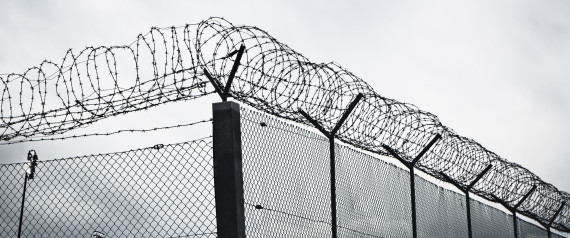
There isn’t much to see around the River Correctional Center, a small, privately run jail near the Mississippi River and the tiny town of Ferriday, Louisiana. Farmlands and fields stretch in either direction beyond the jail’s barbed wire fence. In the 19th century, enslaved people worked cotton and sugar cane fields here, enriching white plantation owners with their daily labors. The local economy is still extracting profit from maintaining the captivity of people of color today.

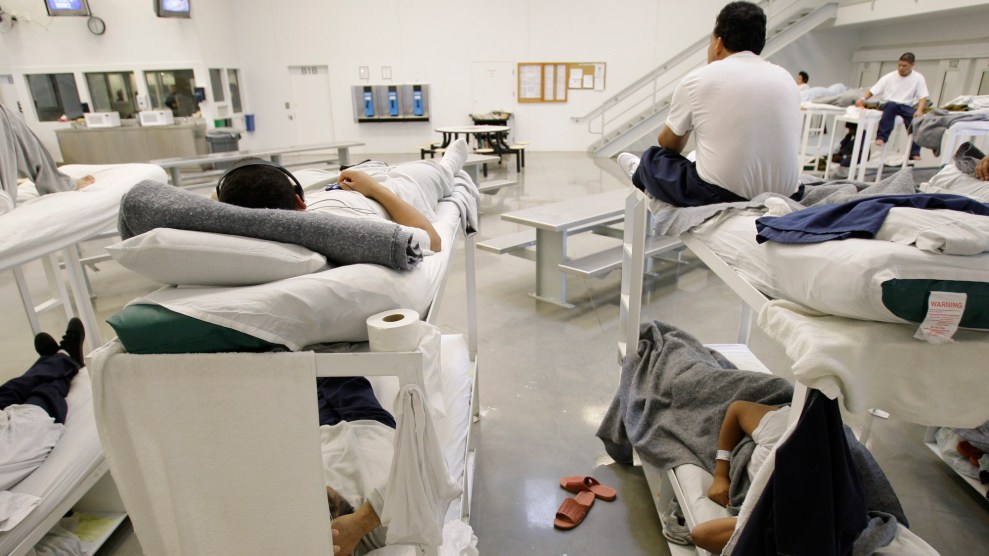
River Correctional Center is one of several local jails and state prisons in Louisiana, Mississippi and beyond that have lucrative contracts with Immigration and Customs Enforcement (ICE) to incarcerate hundreds of people detained in the federal immigration detention system, which has swelled

Wednesday, August 08, 2018

A Private Prison Company Gave 1,300 Recordings of Confidential Inmate Phone Calls to Prosecutors

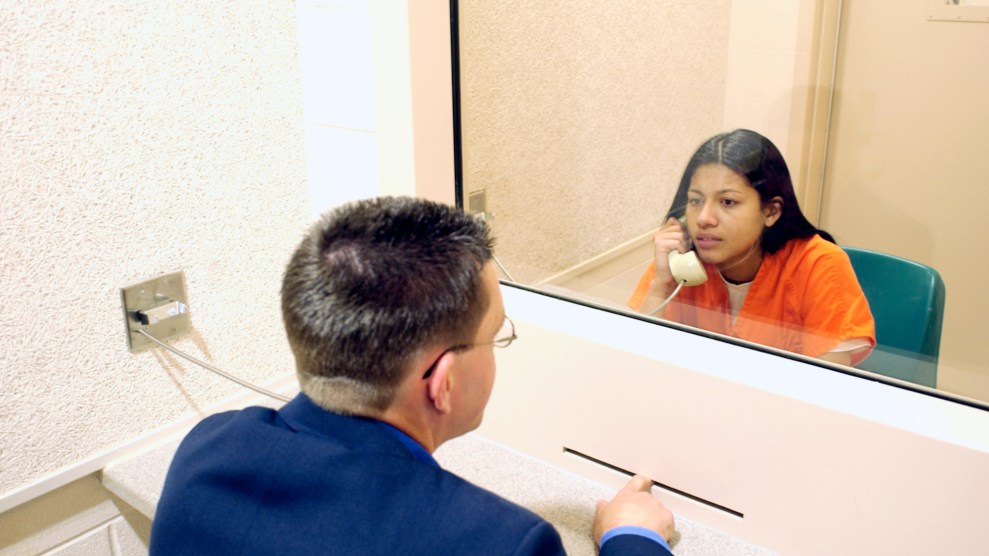
More than 1300 private conversations between a private prison’s inmates and their lawyers were recorded according to information in a new lawsuit against CoreCivic, the private company running the facility, and its technology provider Securus Technologies. Numerous charges and convictions against the inmates could ultimately be overturned if a judge finds prosecutors violated attorney-client privilege by listening to the recordings.

Tuesday, July 24, 2018

Washington Just Sued a Giant Private Prison Company for Paying Immigrant Workers $1 Per Day

Thousands of immigrant detainees were paid $1 per day or, in some cases, with extra food as compensation for keeping one of the country’s largest for-profit immigration detention centers running, according to a lawsuit filed today by Washington state Attorney General Bob Ferguson. The lawsuit targets the GEO Group, one of the country’s two most profitable private prison companies, over the controversial work program, which Ferguson says has violated the state’s minimum wage policy since it was implemented in 2005.

How JPMorgan Chase Is Cashing in on Private Prisons

JPMorgan Chase, like so many corporations, is trying to have its cake and eat it under the Trump administration. In the last few weeks, it has invested time, public relations' efforts and money in presenting itself as a defender of human rights. But the $2 million Chase pledged to fight racism is a drop in the ocean compared to the potential yield from its massive investment in the private prison system: one of the starkest manifestations of racial injustice in the U.S. today, profiting primarily from the detention of immigrants seeking a new life in the U.S. The DACA cancellation last week will only further boost the huge profit to be made from keeping yet more people under lock and key.

Tuesday, August 15, 2017

Private Prison Demands New Mexico and Feds Find 300 More Prisoners in 60 Days or It Will Close

The nation’s second-largest private prison corporation is holding New Mexico politicians hostage by threatening to close unless the state or federal authorities find 300 more prisoners to be warehoused there, according to local news reports.

“The company that has operated a private prison in Estancia for nearly three decades has announced it will close the Torrance County Detention Facility and lay off more than 200 employees unless it can find 300 state or federal inmates to fill empty beds within the next 60 days,” the Santa Fe New Mexican newspaper reported last week.

Friday, June 23, 2017

How a Private Prison Company Used Detained Immigrants for Free Labor

When Carlos Eliezer Ortiz Muñoz arrived at the Denver Contract Detention Facility in Aurora, Colorado, in 2014, he was given a clothing package and assigned to a housing unit, where he’d have to stay for months. Like tens of thousands of other immigrants across the country who are kept in Immigration and Customs Enforcement (ICE) detention each night, Ortiz and his fellow detainees were waiting to see if they’d win their immigration cases or face deportation.

Wednesday, April 13, 2016

How Private Prison Companies Use Big Tax Breaks and Low Wages to Maximize Profit

The two largest private prison firms in the United States are exploiting a loophole in the tax code to secure millions of dollars in corporate tax breaks.

Corrections Corporation of America (CCA) and GEO Group avoided a combined $113 million in federal income taxes in 2015 alone, according to an analysis of federal financial filings by the racial and economic justice group Enlace.

Friday, April 08, 2016

Prisoners in Multiple States Call for Strikes to Protest Forced Labor

PRISON INMATES around the country have called for a series of strikes against forced labor, demanding reforms of parole systems and prison policies, as well as more humane living conditions, a reduced use of solitary confinement, and better health care.

Inmates at up to five Texas prisons pledged to refuse to leave their cells today. The strike’s organizers remain anonymous but have circulated fliers listing a series of grievances and demands, and a letter articulating the reasons for the strike. The Texas strikers’ demands range from the specific, such as a “good-time” credit toward sentence reduction and an end to $100 medical co-pays, to the systemic, namely a drastic downsizing of the state’s incarcerated population.

Monday, February 01, 2016

How ICE Shields Its Financial Dealings With Private Prison Contractors From Public Scrutiny

The movement to put private prison contractors out of business won some amazing victories in 2015.  In the last two months, responding to organized action by California's Afrikan Black Coalition and campus Black Student Unions, the University of California announced it would be selling its $23 million stake in the private prison industry.  Just six months ago, in response to months of student protest, Columbia University became the first major university whose trustees have voted to divest from private prisons, selling off their shares of Corrections Corporation of America ("CCA").  In November, 2015, the City Council and Mayor of Gary, Indiana, refused to support the construction of a new immigrant detention facility proposed by the GEO Group.  As organized communities use financial tools to fight the private prison industry, Congressional legislators have followed, sponsoring legislation to end contractual incentives to detain immigrants in privately-operated facilities and to end the government's use of private prisons altogether.

Thursday, July 30, 2015

Private Prison Lobbyists Are Raising Cash for Hillary Clinton

As immigration and incarceration issues become central to the 2016 presidential campaign, lobbyists for two major prison companies are serving as top fundraisers for Hillary Clinton.

Corrections Corporation of America and the Geo Group could both see their fortunes turning if there are fewer people to lock up in the future.

Saturday, June 27, 2015

Here's the Latest Evidence of How Private Prisons Are Exploiting Inmates for Profit

The for-profit prison industry sells itself as a cost-effective option for cash-strapped states, but according to a new study from the University of Wisconsin, privatized prisons are keeping inmates locked up longer in order to boost profits.

Researcher Anita Mukherjee studied eight years* of data from Mississippi, which has one of the highest incarceration rates in the country, and found that private prisons there doled out twice the amount of infractions against inmates, lengthening their sentences by an average of two or three months. The extra time, Mukherjee found, adds up to an increase of about $3,000 in additional costs per prisoner. Mukherjee also noted that inmates housed in private prisons were more likely to wind up back in the system after being released—despite industry claims of lower recidivism rates.

Wednesday, April 08, 2015

Boycott, Divest and Sanction Corporations That Feed on Prisons

NEWARK, N.J.—All attempts to reform mass incarceration through the traditional mechanisms of electoral politics, the courts and state and federal legislatures are useless. Corporations, which have turned mass incarceration into a huge revenue stream and which have unchecked political and economic power, have no intention of diminishing their profits. And in a system where money has replaced the vote, where corporate lobbyists write legislation and the laws, where chronic unemployment and underemployment, along with inadequate public transportation, sever people in marginal communities from jobs, and where the courts are a wholly owned subsidiary of the corporate state, this demands a sustained, nationwide revolt.

Tuesday, March 31, 2015

Corporation Literally Served Inmates Trash

Two weeks ago Progress Michigan uncovered emails revealing that a prison food provider served cakes nibbled on by rats to inmates. They’ve now discovered that employees from this same food vendor, Aramark, served inmates at another facility an equally unsavory meal: garbage.
In an email exchange between the company’s general manager, Sigfried Linder, and the state’s Department of Corrections, Linder admitted that prisoners at Saginaw Correctional Facility were served food that was previously thrown in the trash. “Mr. Chisolm discarded the left-overs from the line before the last half unit was in the chow hall. He then realized that there were more inmates to serve so he rinsed them off, reheated them in the oven and instructed the inmates to serve them,” read one email. “They refused, so he and Miss Gibson proceeded to serve them to the remaining inmates.”

Saturday, February 28, 2015

Private Prison Companies Foresee Increased Profits as Ruling Limits Immigrant Detentions

Just before a federal court in Washington granted a preliminary injunction to temporarily halt the Obama administration's policy of incarcerating asylum-seeking mothers and children as a deterrent to other potential migrants, two major private prison corporations released their projections for 2015 earnings, and are betting on increased profits this year.

Corrections Corporation of America (CCA) and GEO Group, which have profited heavily from contracts with Immigration and Customs Enforcement (ICE) to lock up undocumented immigrants - including mothers and children seeking asylum from Central American countries - are predicting more such contracts at the state and federal level in 2015.

Tuesday, February 24, 2015

A 2-Day Revolt at a Texas Private Prison Reveals Everything That’s Wrong with Criminalizing Immigration

The latest uprising at the Willacy County Correctional Center began quietly on Friday morning, when prisoners refused to go to their work assignments or to breakfast. Then, inmates broke out of the massive Kevlar tents that serve as dorms. Willacy County Sheriff Larry Spence told reporters some had kitchen knives, sharpened mops and brooms. Prison officials sprayed tear gas; a SWAT team, the Texas Rangers, the FBI and the US Border Patrol all showed up. It took two days to quell the demonstration. Now administrators are beginning to transfer the 2,800 prisoners—undocumented immigrants, most serving time for low-level offenses—to other facilities, because the protest made the center “uninhabitable.”

Tuesday, December 16, 2014

Is the Gates Foundation Still Investing in Private Prisons?

One year after Mother Jones reported on multi-million-dollar investments made on behalf of the Bill & Melinda Gates Foundation that appeared to contradict the foundation's mission, the philanthropy's trust will not say if one of its most controversial holdings is still on its books.

In its 2012 tax filing, the Gates Foundation Trust, which manages the foundation's endowment, reported a $2.2 million investment in the GEO Group, a Florida-based prison company. In its most recent tax forms, the Gates Foundation Trust listed an investment in the GEO Group worth more than $2 million.

Wednesday, October 01, 2014

For-Profit Prison Bankers Prey On Inmates' Families With Exorbitant Fees

JOHNSON CITY, Tenn. — Pat Taylor doesn’t believe in going into debt. She keeps her bills in a freezer bag under her bed, next to old photo albums, and believes in paying them on time religiously. For Taylor, living within your means is part of being a good Christian.

Lately, Taylor, 64, has felt torn between that commitment and her desire to be a loving, supportive mother for her son Eddie.

Who Profits From Plans to Lock Up More Immigrant Families? Private Prison Companies

Last week, the federal government announced that it will detain as many as 2,400 women and children on property in Dilley, Texas, that is currently used as a “man camp” for oilfield workers. The new facility will be the largest family detention center in the country, and the third to open since the number of children and families crossing the US-Mexico border shot up early in the summer. Since then, the number of minors caught at the border has fallen back below last year’s levels.

Tuesday, September 30, 2014

Prisons Are Adopting the Walmart Business Model

The nation's biggest and baddest for-profit prison company suddenly cares about halfway houses -- so much so that they want in on the action.

About a year after acquiring a smaller firm that operates halfway houses and other community corrections facilities, Corrections Corporation of America (CCA) CEO Damon Hininger announced a few weeks ago that "[r]eentry programs and reducing recidivism are 100 percent aligned with our business model."

Wait, what?

High recidivism rates mean more people behind bars, and CCA depends on more and more incarceration to make its billions. Since when do they actually want people to do well after they get out, instead of being sucked back into the system?

The Score: Why Prisons Thrive Even When Budgets Shrink

Who says the government can’t do anything anymore? Even as Ronald Reagan argued that “government is the problem” throughout the 1980s, the state imprisoned twice the percentage of Americans previously incarcerated. As Bill Clinton declared “the era of big government” over in the 1990s, incarcerations skyrocketed to almost five times their rate in the 1970s—a rate that had been stable across the twentieth century. How did this happen?