Democracy Gone Astray

Democracy, being a human construct, needs to be thought of as directionality rather than an object. As such, to understand it requires not so much a description of existing structures and/or other related phenomena but a declaration of intentionality.
This blog aims at creating labeled lists of published infringements of such intentionality, of points in time where democracy strays from its intended directionality. In addition to outright infringements, this blog also collects important contemporary information and/or discussions that impact our socio-political landscape.

All the posts here were published in the electronic media – main-stream as well as fringe, and maintain links to the original texts.

[NOTE: Due to changes I haven't caught on time in the blogging software, all of the 'Original Article' links were nullified between September 11, 2012 and December 11, 2012. My apologies.]

Showing posts with label Reconciliation. Show all posts

Wednesday, July 29, 2015

Aboriginal Leaders Ask Premiers To Get Serious About Reconciliation, Violence

ST. JOHN'S, N.L. - Dawn Lavell Harvard says the time for well-intentioned but often empty talk is over.

The president of the Native Women's Association of Canada, along with other national aboriginal leaders, will step up pressure for action when they meet Wednesday with provincial and territorial premiers in Happy Valley-Goose Bay, N.L.

Saturday, June 27, 2015

Harper's silence over TRC report confusing: Fontaine

A former national chief of the Assembly of First Nations calls Ottawa’s two-week silence over the Truth and Reconciliation Commission report "confusing."

Phil Fontaine said on one hand, the Harper government claims — wrongly — that it created the TRC (when actually it was part of a court-approved settlement). On the other hand, it has failed to respond to the commission’s recommendations since they were released June 2.

Fontaine, in Winnipeg today to participate in Aboriginal Day celebrations on the grounds of the Manitoba Legislative Building, said the TRC report is a public document — and one that this government and future governments will have to contend with at some point.

Tuesday, June 23, 2015

Harper shows little enthusiasm for 'reconciliation' report

Prime Minister Stephen Harper is already distancing himself from a special commission that has called for fundamental changes to Canada’s relationship with its indigenous people.

Harper’s position of studied indifference calls into question whether the report of the Truth and Reconciliation Commission (TRC) will have a brutally short shelf-life. That could be the case if the Conservatives are re-elected to govern on Oct. 19.

On the other hand, with both the New Democrats and Liberals saying they support the TRC’s sweeping proposals, the commission’s blueprint could become federal government policy in coming years if Harper is turfed from office.

It wasn’t always this way.

Harper's record belies any pledge to 'reconciliation' with First Nations

For more than a century, Canadians were ignorant of the fact that, as Daniel Schwartzreports for CBC, the chances of children dying in Indian residential schools were the same as for those who served in the Second World War.
Most Canadians did not know that tens of thousands of children were stolen away from their families, beaten when they spoke their own languages, forced into humiliating situations such as posing in a parody of "Indian" costumes for visiting dignitaries, fed inadequate food, housed in poorly heated dormitories, sexually abused, and generally treated not much better than slaves.

Truth And Reconciliation Commission: 5 Things To Know

OTTAWA - The Truth and Reconciliation Commons examining Canada's now-defunct residential school system is scheduled to release its final report Tuesday. Here are five things to know about the commission.

1. The commission was established as part of the 2007 Indian Residential Schools Settlement Agreement, which also included money to pay for the commission's work.

2. The commission is led by Justice Murray Sinclair, Manitoba's first aboriginal justice. The other commissioners are Marie Wilson, a journalist, university lecturer and former senior manager at several Crown corporations; and Chief Wilton Littlechild, a lawyer and former Progressive Conservative MP.

3. The group is charged with collecting testimony from residential school survivors and compiling their stories into a comprehensive historical record of the schools aimed at educating all Canadians about the residential schools and their legacy.

4. The records of the commission, including recollections from 6,200 former students, many of whom spoke on video, with be kept and managed by the National Research Centre on Indian Residential Schools at the University of Manitoba in Winnipeg, where they will be publicly accessible.

5. Residential schools operated for about 150 years, with an estimated 150,000 aboriginal children spending time in them. At the height of the residential-school era, the federal government supported 130 such schools. There are an estimated 80,000 survivors of the schools who are still alive.

Original Article
Source: huffingtonpost.ca/
Author: CP
Sunday, May 31, 2015

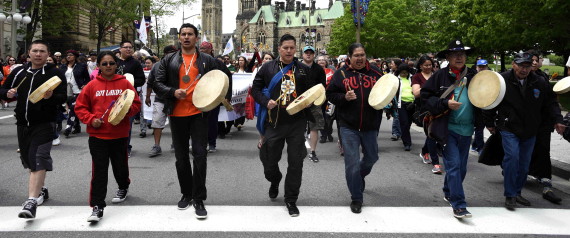
Walk for reconciliation draws thousands to downtown Ottawa

An estimated 7,000 to 10,000 people walked through downtown Ottawa-Gatineau in an effort to "transform and renew" the relationship between aboriginal people and other Canadians as the Truth and Reconciliation Commission of Canada prepares to release its final report on Tuesday.

"It's a dark chapter in Canada's history, no question. It was cultural genocide," said National Chief Perry Bellegarde, head of the Assembly of First Nations, who took part in the walk on Sunday.

Tuesday, September 24, 2013

Tens of thousands walk for Reconciliation in Vancouver

Tens of thousands participated in the Reconciliation Walk in Vancouver on Sunday, capping a week of events coinciding with the Truth and Reconciliation Commission's (TRC) hearings into the history of Indian Residential Schools in Canada.

First Nations, civil society groups and local politicians walked along with tens of thousands on a rainy morning to mark the culmination of Reconciliation Week. The event was supported by the City of Vancouver, who earlier this year proclaimed a Year of Reconciliation.

Thursday, September 19, 2013

An interview with Tsleil-Waututh elder Amy George at beginning of Truth and Reconciliation Week

It was just a few days before British Columbia’s Truth and Reconciliation Week when I went to visit Amy George, a 71-year-old Tsleil-Waututh elder, who is the daughter of Chief Dan George, and the mother of Rueben George, the band's leader in an ongoing to fight to stop Kinder Morgan's pipeline expansion proposal from going through. Having been  impressed by George at the 2013 Healing Walk in Fort McMurray, I was  curious to learn more about her and the occasion of Truth and Reconciliation week seemed a prime time to do that.

First Strokes of Justice at Reconciliation Hearings

Wrapped in a blanket with a Canadian flag on one side and "Jesus Christ" on the other, Keith Morriseau from the Sagkeeng First Nation in Manitoba stood outside Vancouver's Pacific National Coliseum yesterday morning. Morriseau is a residential school survivor, and this week he reconnected with his niece, who was taken into foster care as a small child. To him and many survivors, the connection between residential school and foster care is obvious.

On Wednesday, Sept. 18, the Truth and Reconciliation Commission opened its work at Vancouver's Coliseum, hearing testimony from residential school survivors and their descendants. The national event, which ends Saturday, includes testimony from survivors, workshops and panels, a marketplace with stunning crafts and fashions, and other activities. It's free and anyone can attend.