Democracy Gone Astray

Democracy, being a human construct, needs to be thought of as directionality rather than an object. As such, to understand it requires not so much a description of existing structures and/or other related phenomena but a declaration of intentionality.
This blog aims at creating labeled lists of published infringements of such intentionality, of points in time where democracy strays from its intended directionality. In addition to outright infringements, this blog also collects important contemporary information and/or discussions that impact our socio-political landscape.

All the posts here were published in the electronic media – main-stream as well as fringe, and maintain links to the original texts.

[NOTE: Due to changes I haven't caught on time in the blogging software, all of the 'Original Article' links were nullified between September 11, 2012 and December 11, 2012. My apologies.]

Showing posts with label Security Perimeter. Show all posts

Friday, November 30, 2012

Canada's privacy watchdog raises concerns about new mini-visa

OTTAWA — Canada’s privacy watchdog is raising concerns about a new mini-visa that will require certain visitors to Canada to disclose personal information that may include details about their mental health status and drug use and could be shared with the United States.

The Electronic Travel Authorization — a commitment made as part of Canada’s perimeter security deal with the U.S. — is among the measures crammed into the latest budget implementation bill.
Wednesday, October 05, 2011

Border Security Deal Between Canada And U.S. Reached, Will Come With $1 Billion Price Tag

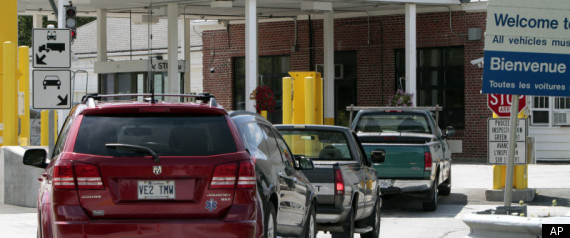
OTTAWA - A much-ballyhooed perimeter security deal between Canada and the United States will come with a $1-billion price tag for new border facilities and programs to make trade and travel easier, The Canadian Press has learned.

The Conservative government will use money cut from existing programs to cover the hefty cost of the international pact — an attempt to protect the continent from terrorist threats while speeding the flow of people and products across the 49th parallel.

The deal, as described by several sources, is more evolutionary than revolutionary, falling short of the grand vision outlined with fanfare eight months ago when Prime Minister Stephen Harper and U.S. President Barack Obama announced negotiations.

Emblematic of this reality is the fact there are no immediate plans for a prime ministerial-presidential announcement of the agreement — to be unfurled this month — because the Prime Minister's Office has been unable to persuade the White House to make Obama available.

Canadian officials are heading to Washington this weekend to make a final pitch for a public signing ceremony.

Canada, U.S. reach agreement on $1B perimeter security pact

OTTAWA—A much-ballyhooed perimeter security deal between Canada and the United States will come with a $1-billion price tag for new border facilities and programs to make trade and travel easier, The Canadian Press has learned.

The Conservative government will use money cut from existing programs to cover the hefty cost of the international pact — an attempt to protect the continent from terrorist threats while speeding the flow of people and products across the 49th parallel.

The deal, as described by several sources, is more evolutionary than revolutionary, falling short of the grand vision outlined with fanfare eight months ago when Prime Minister Stephen Harper and U.S. President Barack Obama announced negotiations.

Emblematic of this reality is the fact there are no immediate plans for a prime ministerial-presidential announcement of the agreement — to be unfurled this month — because the Prime Minister’s Office has been unable to persuade the White House to make Obama available.

Canadian officials are heading to Washington this weekend to make a final pitch for a public signing ceremony.

Saturday, September 10, 2011

Canadians With Mental Illnesses Denied U.S. Entry

More than a dozen Canadians have told the Psychiatric Patient Advocate Office in Toronto within the past year that they were blocked from entering the United States after their records of mental illness were shared with the U.S. Department of Homeland Security.

Lois Kamenitz, 65, of Toronto contacted the office last fall, after U.S. customs officials at Pearson International Airport prevented her from boarding a flight to Los Angeles on the basis of her suicide attempt four years earlier.

Kamenitz says she was stopped at customs after showing her passport and asked to go to a secondary screening. There, a Customs and Border Protection officer told Kamenitz that he had information that police had attended her home in 2006.

“I was really perturbed,” Kamenitz says. “I couldn’t figure out what he meant. And then it dawned on me that he was referring to the 911 call my partner made when I attempted suicide.”

Kamenitz says she asked the officer how he had obtained her medical records.

“That was the only thing I could think of,” she says. “But he said, no, he didn’t have my medical records but he did have a contact note from the police that [they] had attended my home.”

Tuesday, August 30, 2011

Baird promises Canadian sovereignty ‘will not be compromised’ by border deal

TORONTO — Canadian businesses are pushing for greater security and economic integration with the United States while individual citizens caution against losing privacy and police independence, the government reported Monday.

Foreign Affairs Minister John Baird presented two reports on the government’s consultations with Canadians, promised in February after Stephen Harper, the Prime Minister, and U.S. President Barack Obama signed a declaration on integrating security and harmonizing trade rules.

“Improving the movement of goods and people across the border was the number one priority for Canada’s business, industry and trade sector,” the reports say.

“When it came to integrated cross-border law enforcement, there was more interest from individual Canadians than from groups and associations. Many of the submissions from individuals expressed concerns regarding joint law enforcement measures between the two countries.”

Nearly half of Canadians oppose greater integration with U.S. law enforcement

Canadians consulted on a controversial border security deal still in the works with the United States aren’t sold on boosting collaboration between the two countries’ law-enforcement officials, a new report suggests.

The report on the potential perimeter security agreement released on Monday shows nearly half of Canadians who weighed in opposed greater integration of law enforcement between Canada and the United States.

Many who took part in a federal consultation on the agreement voiced concerns about information sharing and the impact of joint programs on civil liberties, the report says.

At the same time, others “called for an open border, more enforcement powers for the Canadian Border Services Agency, and joint enforcement and co-operation in support of a common perimeter,” it says.

Sunday, August 14, 2011

Vic Toews on the hot seat in security talks

A gang of cabinet ministers and bureaucrats from both sides of the border has spent much of the summer working to craft a historic overhaul of Canada-U.S. relations.

Some 32 different aspects of that relationship are under negotiation in the perimeter security talks and most of the heavy lifting is being done under the radar.

At this point, that is understandable.

But at some point the Harper government is going to have to come out of the bunker and level with the Canadian electorate on the messy parts of such huge negotiations.

When it does, it will be clear the toughest piece of this puzzle rests with Vic Toews.

It is the security piece that is driving the American agenda, while the Canadian agenda is dominated by facilitating trade and easing the flow of goods across the border.