Democracy Gone Astray

Democracy, being a human construct, needs to be thought of as directionality rather than an object. As such, to understand it requires not so much a description of existing structures and/or other related phenomena but a declaration of intentionality.
This blog aims at creating labeled lists of published infringements of such intentionality, of points in time where democracy strays from its intended directionality. In addition to outright infringements, this blog also collects important contemporary information and/or discussions that impact our socio-political landscape.

All the posts here were published in the electronic media – main-stream as well as fringe, and maintain links to the original texts.

[NOTE: Due to changes I haven't caught on time in the blogging software, all of the 'Original Article' links were nullified between September 11, 2012 and December 11, 2012. My apologies.]

Showing posts with label Social Media. Show all posts

Friday, October 06, 2023

Trump's 'Mental Acuity' Challenge Gets Exactly The Response You'd Expect

Donald Trump threw another fit on his social media website on Sunday, this time challenging a host of rivals to a “mental acuity test.”

Trump, who is refusing to debate any of his Republican presidential rivals but instead offered to debate Meghan Markle, is demanding that President Joe Biden, right-wing media mogul Rupert Murdoch and others take a test of his choosing, at a place of his choosing.

Appeals court scales back order squelching Biden administration contact with social media platforms

NEW ORLEANS — A federal appeals court Friday significantly whittled down a lower court’s order curbing Biden administration communications with social media companies over controversial content about COVID-19 and other issues.

The 5th U.S. Circuit Court of Appeals in New Orleans on Friday said the White House, the Surgeon General, the Centers for Disease Control and the FBI cannot “coerce” social media platforms to take down posts the government doesn’t like.

Wednesday, October 04, 2023

Trump social media startup wins more time to go public

Investors on Tuesday granted a last-minute lifeline to the company looking to take former President Donald Trump’s social media venture public, handing executives another year to finish the transaction ahead of a do-or-die deadline this week.

More than 65 percent of shareholders in Digital World Acquisition Corp. — a so-called special purpose acquisition company — signed off on giving it until next September to complete its beleaguered merger with Trump Media & Technology Group and list the combined firm on Nasdaq.

Saturday, September 30, 2023

Trump Ordered Not to Make Social Media Threats as Part of $200,000 Bond

Former President Donald Trump said Monday that he is planning to surrender himself to arrest in Fulton County, Georgia, on Thursday, as part of his indictment regarding his attempts to overturn the 2020 election in the state.

“Can you believe it? I’ll be going to Atlanta, Georgia, on Thursday to be ARRESTED by a Radical Left District Attorney, Fani Willis,” Trump wrote on his social media network, Truth Social. The prosecutor in the case, Fulton County District Attorney Fani Willis, has given Trump and his codefendants until Friday to turn themselves in.

Monday, September 25, 2023

Cuba’s president slams social media ‘hatred’ after protests

Havana, Cuba – The Cuban government held a massive rally in the early hours of Saturday morning on Havana’s Malecon, the city’s famed corniche, at the end of a week of unrest that spurred a slew of international criticism.

Crowds for the “Act of Revolutionary Reaffirmation” rally in the Cuban capital, which the government said numbered 100,000, arrived before the sun rose and spilled onto the highway near the United States embassy. Other rallies were held across the country.

Monday, September 18, 2023

Russia’s “Propaganda War” On US Social Media Is Ongoing, New Reports Say


WASHINGTON — Russian efforts to interfere in American politics were more pervasive on Instagram and other social media platforms than previously known and showed a clear preference for Donald Trump during the last presidential election, according to a pair of new reports prepared for the Senate.

Third-party researchers completed two reports for the Senate Intelligence Committee, which released them on Monday. The documents provide the most complete picture to date of the years-long campaign by the Internet Research Agency — a Kremlin-connected troll farm indicted by special counsel Robert Mueller in February — to sow divisions in American society, spread disinformation, and manipulate US voters through social media.

Sunday, July 29, 2018

At Least 30 Countries Use Social Media to Influence Elections Across the World

The governments of 30 countries around the globe are using armies of so called opinion shapers to meddle in elections, advance anti-democratic agendas and repress their citizens, a new report shows.

Unlike widely reported Russian attempts to influence foreign elections, most of the offending countries use the internet to manipulate opinion domestically, says US NGO Freedom House.

“Manipulation and disinformation tactics played an important role in elections in at least 17 other countries over the past year, damaging citizens’ ability to choose their leaders based on factual news and authentic debate,” the US government-funded charity said. “Although some governments sought to support their interests and expand their influence abroad, as with Russia’s disinformation campaigns in the United States and Europe, in most cases they used these methods inside their own borders to maintain their hold on power.”

Tuesday, July 18, 2017

The Dangers of the Increasingly Dominant Alt-Right Presence on Social Media

This week saw President Trump cross yet another line in his use of his Twitter account.  Trump tweeted a meme of himself symbolically beating up CNN.  While to some it might have appeared to be a funny way to epitomize Trump’s feud with CNN, to many the meme was aggressive, immature and inflammatory. CNN took the attacks seriously and released a statement stating, “It is a sad day when the President of the United States encourages violence against reporters.”

There are lots of questions to be asked about the tweet, not the least of which is what it tells us about the judgment of the president and those who work with him.  But the real story here is not about Trump; it’s about the increasing power and presence of alt-right communication on various social media platforms, from Twitter to YouTube to Reddit to Facebook.

Saturday, November 30, 2013

Feeling social? If so, feds could be watching

OTTAWA - Big Brother is watching you — on just about every social-media platform you can imagine.

Tweets, public Facebook posts and YouTube videos could soon be subject to round-the-clock scrutiny by the federal government, a procurement document posted this week by Public Works and Government Services Canada suggests.

Welcome to media monitoring in the 21st century, when simply leafing through a stack of newspapers in the morning is about as antiquated as, well, newspapers.

Monday, April 16, 2012

Rumor, Lies, and Weibo: How Social Media is Changing the Nature of Truth in China

When the message appeared on the Weibo account of Xinhua, China's official news agency on April 10, announcing charges against the family of high-profile party leader Bo Xilai, it ended many days of public speculation on China's largest political crisis in decades. But it also left Chinese web users even more deeply confused about the distinction between political truth and rumor, one that has always been hazy in China but is now blurred even more by social media.

Chinese web users began speculating, following Bo's firing as Chongqing party chief in March, about the Bo family's possible role in the mysterious death of Neil Heywood, a British businessman with close ties to the family. China's Internet censors muzzled the online discussions. The government spokesmen stonewalled inquiries from the British government and told curious Chinese that Heywood died of "excessive drinking," admonishing them "not to spread groundless rumor."

On the morning of April 11, Chinese web users woke up to find that the reports that had previously filled their Weibo pages -- in coded words adopted to evade the censors -- now featured the front page of every official newspaper. The rumor, repressed by censors and dodged by government spokesmen, had become a state-approved fact overnight.

Friday, August 12, 2011

David Cameron, Meet Hu Jintao

In my article in the current issue (subscribe!) about this spring's abortive "Jasmine Protests" in China, I mention how hard the Chinese authorities cracked down on social media, as a way of thwarting protests before they happened and of apprehending would-be organizers. In certain parts of Beijing and other cities, text-message transmission -- a main means of Chinese communication -- was blocked altogether. The "real" versions of Facebook, Twitter, and YouTube are banned, and the Chinese counterparts were heavily interfered-with.

Obviously constraints on Twitter, Facebook, YouTube, and similar social media were hallmarks of autocratic response during the "Arab Spring" protests as well.

Did David Cameron not read a single foreign news story this past year? Did he have no idea what camp he was placing himself in, with his call to block social media as a way of controlling violence in England? ("When people are using social media for violence we need to stop them" etc. "Free flow of information can be used for good, but it can also be used for ill." During the Jasmine era, I read more or less those views, from Chinese officials, about the need to get tough.)

Thursday, August 11, 2011

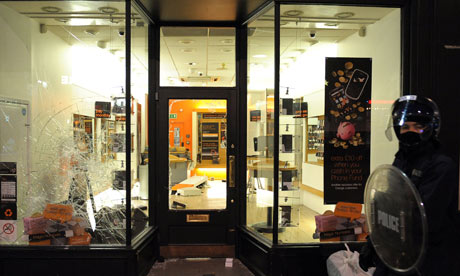
A social media crackdown is the wrong response to riots

If the UK government restricts social networking in answer to the riots, what separates it from the Arab tyrannies and China?

The government is contemplating tactics against the UK riots that set dangerous precedents.

In parliament today, prime minister David Cameron said authorities and the industry were looking at "whether it would be right to stop people communicating via these websites and services when we know they are plotting violence, disorder and criminality". Well, at least he did post it as a question of right and wrong.

It would be wrong, sir. Who is to say what communication and content should be banned from whom on what platform? On my BlackBerry? My computer? My telephone? My street corner?

Cameron also said, according to a Guardian tweet, that he would look at asking online services to take down offending photos. Again, who decides that content is offending? If you give authority to government and telco and social companies to censor that, what else can and will they censor?