Democracy Gone Astray

Democracy, being a human construct, needs to be thought of as directionality rather than an object. As such, to understand it requires not so much a description of existing structures and/or other related phenomena but a declaration of intentionality.
This blog aims at creating labeled lists of published infringements of such intentionality, of points in time where democracy strays from its intended directionality. In addition to outright infringements, this blog also collects important contemporary information and/or discussions that impact our socio-political landscape.

All the posts here were published in the electronic media – main-stream as well as fringe, and maintain links to the original texts.

[NOTE: Due to changes I haven't caught on time in the blogging software, all of the 'Original Article' links were nullified between September 11, 2012 and December 11, 2012. My apologies.]

Showing posts with label Stimulus. Show all posts

Monday, August 20, 2012

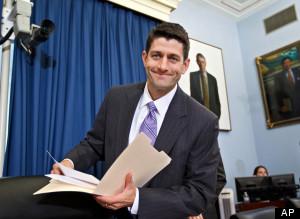
Paul Ryan Defended Stimulus -- When George W. Bush Wanted It In 2002

WASHINGTON - When Congressman Paul Ryan has been asked the past few years about the value of stimulus to the sagging economy and the nation's jobless, the Wisconsin Republican has dismissed it as meaningless, and dubbed it "sugar-high economics."

But that's when President Obama is pushing for the spending. When it was President George W. Bush arguing for more stimulus to boost a slow economy in the early 2000s, Ryan's economic analysis was entirely different.

Sunday, August 19, 2012

Paul Ryan Defended Stimulus -- When George W. Bush Wanted It In 2002

WASHINGTON - When Congressman Paul Ryan has been asked the past few years about the value of stimulus to the sagging economy and the nation's jobless, the Wisconsin Republican has dismissed it as meaningless, and dubbed it "sugar-high economics."

But that's when President Obama is pushing for the spending. When it was President George W. Bush arguing for more stimulus to boost a slow economy in the early 2000s, Ryan's economic analysis was entirely different.

Monday, May 14, 2012

Canadian stimulus money goes to companies, people implicated in Quebec scandals

MONTREAL - Some of the public money set aside for Canada's economic recovery has ended up in the hands of companies and individuals accused of taking part in an elaborate collusion scheme in Quebec.

An investigation by The Canadian Press of stimulus funding in three municipalities recently raided by police revealed three separate cases where companies tied to criminal charges received contracts under the multibillion-dollar federal-provincial infrastructure plan.

These include companies owned by construction entrepeneurs Tony Accurso and Lino Zambito, both of whom are facing a long series of charges. Money also went to BPR and Transport and Excavation Mascouche (TAM) — two companies charged with fraud and conspiracy.

Tuesday, November 22, 2011

Stimulus program failed to measure job-creation, auditor finds

Ottawa failed to measure how many jobs it created through its multi-billion stimulus programs, the federal spending watchdog says, but the Conservatives otherwise emerge relatively unscathed from a detailed audit of their Economic Action Plan.

Interim Auditor-General John Wiersema released an audit report Tuesday that focused on three stimulus programs with a combined budget of $7-billion.

The audit focused on how federal officials monitored the Economic Action Plan (EAP) projects in terms of progress on construction and spending. Auditors did not look at the merits of the projects or how they impacted the Canadian economy.

“For the three specific programs we audited, the government was diligent in monitoring the progress of projects and their spending,” said Mr. Wiersema in a statement.

Tuesday, October 18, 2011

Send Money, Stephen Harper

So welcome to the real world, Stephen Harper.

You see this is what happens when a level of government is chronically underfunded. Briefing notes from the Privy Council Office show that billions of dollars of stimulus funding have not been able to stop municipal infrastructure decay.

Pleas from the municipalities have gone mostly unheard when they cried that their road and water pipes needed replacing. The municipalities, creatures of the provinces, can’t rely on places like Queen’s Park for infrastructure money because those governments are strapped trying to cover health and education funding.

But the federal government has fewer critical and expensive responsibilities than municipalities and the provinces, but a great ability to raise revenue — through the very lucrative income tax.

Municipalities, the engines of our economy, need to know that a steady stream of funding will be made available to them so they can plan for infrastructure renewal. And don’t forget prime minister, solid municipal infrastructure is critical to building a successful Canadian economy. And that raises money for all levels of government.

Friday, October 14, 2011

Stimulus spending didn't stop growing backlog in Canada's infrastructure, feds told

OTTAWA — Billions of dollars in stimulus spending in recent years have failed to stop a growing liability from crumbling roads, bridges, water systems and other public infrastructure, the federal government was told in May.

Newly released briefing notes from the Privy Council Office, the central department in Canada's public service that advises Prime Minister Stephen Harper, suggest that it's time to review existing programs to ensure that they are effective.

"There is a significant backlog in municipal infrastructure maintenance, and costs for repairing and maintaining older infrastructure have grown substantially," said one passage from the briefing notes, which were released to Postmedia News through access-to-information legislation.

The analysis was prepared for Intergovernmental Affairs Minister Peter Penashue, who entered Harper's cabinet following the federal election in May. It also said that a major multi-billion dollar infrastructure program, the Building Canada Plan, has little money left for new projects even though it was designed to last until 2014.

"The vast majority of funds in the BCP are fully committed," said the briefing notes.

Monday, September 26, 2011

Olive: We need more stimulus, not cutbacks

We can only pray that the current “austerity chic” exhausts itself while the global economy is still standing.

Canadian MPs who took in David Cameron’s address to a joint session of Parliament last Thursday are well-advised to forget what they heard from the British PM. Save, of course, the obligatory acknowledgement that without Canada’s military heroism in the World War II, Britain might have lost its independence.

“Yes, demand matters,” Cameron said. “But let me say it again, it’s a debt crisis,” not a crisis of demand and income scarcity, our distinguished visitor said in contradiction of everything history teaches us about battling our way out of recessions.

Cameron’s message was that governments cannot spend anemic economies out of recession. He should have delivered it on the banks of the Thames rather than the Ottawa River.

While Cameron was preaching austerity Thursday, Cameron’s own ministers were hastily drawing up plans to jumpstart job creation and cut taxes on low-income earners in order to, of all things, revive demand.