Democracy Gone Astray

Democracy, being a human construct, needs to be thought of as directionality rather than an object. As such, to understand it requires not so much a description of existing structures and/or other related phenomena but a declaration of intentionality.
This blog aims at creating labeled lists of published infringements of such intentionality, of points in time where democracy strays from its intended directionality. In addition to outright infringements, this blog also collects important contemporary information and/or discussions that impact our socio-political landscape.

All the posts here were published in the electronic media – main-stream as well as fringe, and maintain links to the original texts.

[NOTE: Due to changes I haven't caught on time in the blogging software, all of the 'Original Article' links were nullified between September 11, 2012 and December 11, 2012. My apologies.]

Showing posts with label Summit. Show all posts

Friday, September 19, 2014

The UN Climate Summit Will Benefit Corporations

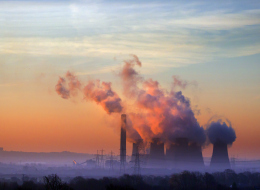
The United Nations will host dozens of governments, corporations and non-governmental organizations (NGOs) during a one-day Climate Summit 2014 in New York on September 23, but, alas, according to scientists and environmentalists, the meeting will deal mainly with only one limited way of fighting climate change.

In recent years the UN has proven incapable of playing an important role in slowing world climate change in a meaningful way, and is not practically dictated to by a powerful lobby.

Sunday, May 27, 2012

The secrets of political summits

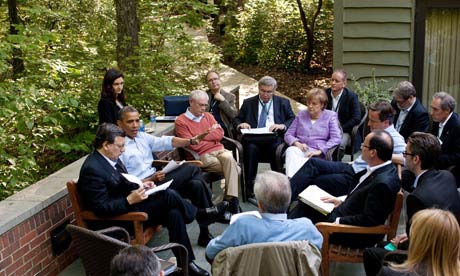
It is summit season again. In just over a week we have had three. The Nato summit was held in President Obama's home town Chicago; the G8 met in a display of conspicuous parsimony at Camp David rather than in the usual grand resort; and yet another EU summit took place in Brussels.

Summits happen so often now that leaders see more of their foreign colleagues than they do of their cabinet colleagues or even their families. Prime ministerial and presidential entourages criss-cross the skies in their planes. Aides scurry in the wake of world leaders, clutching bulging piles of agenda papers.

Of course, summits have existed as long as leaders have. Think of Henry VIII's Field of the Cloth of Gold, the Congress of Vienna or Yalta. Those were once-in-a-lifetime events that took leaders weeks or months to get to. But in the 1970s a new sort of summitry began, fuelled by easy air travel and an increasing role for leaders in foreign policy, at the expense of diplomats.

Tuesday, January 24, 2012

First Nations Summit: Stephen Harper Calls For Changes To Modernize Indian Act

OTTAWA - What was billed as the historic coming-together of the federal government and First Nations began with the two sides polarized over the future of the Indian Act.

Though there had been fears the prime minister would beat a hasty retreat from Tuesday's meetings, he extended his stay well past lunch and was expected to close out the day.

But that show of goodwill didn't move the two sides any closer by midday to deciding whether they could jointly agree on the next steps for the Crown-First Nations relationship or would remain divided.

The Indian Act became a flashpoint that high-profile chiefs seized upon to showcase the gap between the two sides.

Prime Minister Harper said he sees the act as something that can be updated to reflect modern practices.

But Shawn Atleo, national chief of the Assembly of First Nations, led a parade of speakers who described the century-old legislation as a boulder blocking the path to collaboration.

They laid out their views in back-to-back speeches Tuesday as the opening of the major meeting of leaders and government ministers and officials.