Democracy Gone Astray

Democracy, being a human construct, needs to be thought of as directionality rather than an object. As such, to understand it requires not so much a description of existing structures and/or other related phenomena but a declaration of intentionality.
This blog aims at creating labeled lists of published infringements of such intentionality, of points in time where democracy strays from its intended directionality. In addition to outright infringements, this blog also collects important contemporary information and/or discussions that impact our socio-political landscape.

All the posts here were published in the electronic media – main-stream as well as fringe, and maintain links to the original texts.

[NOTE: Due to changes I haven't caught on time in the blogging software, all of the 'Original Article' links were nullified between September 11, 2012 and December 11, 2012. My apologies.]

Showing posts with label Troy Davis. Show all posts

Monday, October 03, 2011

Troy Davis Funeral: More Than 1,000 People Attend Service

SAVANNAH, Ga. — Sent to death row 20 years ago as a convicted cop killer, Troy Davis was celebrated as "martyr and foot soldier" Saturday by more than 1,000 people who packed the pews at his funeral and pledged to keep fighting the death penalty.

Family, activists and supporters who spent years trying to persuade judges and Georgia prison officials that Davis was innocent were unable to prevent his execution Sept. 21. But the crowd that filled Savannah's Jonesville Baptist Church on Saturday seemed less interested in pausing in remorse than showing a resolve to capitalize on the worldwide attention Davis' case brought to capital punishment in the U.S.

Benjamin Todd Jealous, national president of the NAACP, brought the crowd to its feet in a chant of "I am Troy Davis" – the slogan supporters used to paint Davis as an everyman forced to face the executioner by a faulty justice system. Jealous noted that Davis professed his innocence even in his final words.

Thursday, September 29, 2011

The execution of Troy Davis

On Sept. 21 at 7 p.m., Troy Anthony Davis was scheduled to die. I was reporting live from outside Georgia's death row in Jackson, awaiting news about whether the Supreme Court would spare his life.

Davis was sentenced to death for the murder of off-duty Savannah police officer Mark MacPhail in 1989. Seven of the nine nonpolice witnesses later recanted or changed their testimony, some alleging police intimidation for their original false statements. One who did not recant was the man who many have named as the actual killer. No physical evidence linked Davis to the shooting.

Davis, one of more than 3,200 prisoners on death row in the U.S., had faced three prior execution dates. With each one, global awareness grew. Amnesty International took up his case, as did the National Association for the Advancement of Colored People. Calls for clemency came from Pope Benedict XVI, former FBI Director William Sessions and former Republican Georgia Congressman Bob Barr. The Georgia State Board of Pardons and Paroles, in granting a stay of execution in 2007, wrote that it "will not allow an execution to proceed in this state unless ... there is no doubt as to the guilt of the accused."

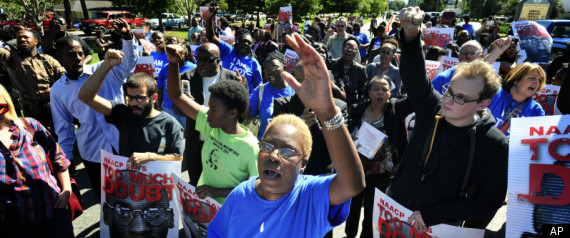
But it is just that doubt that has galvanized so much global outrage over this case. As we waited, the crowd swelled around the prison, with signs saying "Too Much Doubt" and "I Am Troy Davis." Vigils were being held around the world, in places such as Iceland, England, France and Germany. Earlier in the day, prison authorities handed us a thin press kit. At 3 p.m., it said, Davis would be given a "routine physical."

Friday, September 23, 2011

The Killing of Troy Davis

If the Georgia Board of Pardons and Paroles has its way, Troy Anthony Davis will be killed by lethal injection at 7 pm on September 21. His body will be carried out of the maximum-security prison in Jackson, the word “homicide” printed on his death certificate—the thirty-fourth US prisoner put to death this year.

The killing of Troy Davis would mark a devastating end to a case that inspired a global mobilization against the death penalty. Davis, 42, has faced execution four times in the past four years for a 1989 murder in Savannah, despite serious doubts about his guilt. His conviction hinged on nine witnesses—no physical evidence linked him to the crime—seven of whom later recanted their testimony. Some described being coerced by police. Others point to a different man—the eighth witness, who first implicated Davis—as the real killer. “If I knew then what I know now,” juror Brenda Forrest said in 2009, “Troy Davis would not be on death row.”

Forrest was one of several people who met with members of the pardons board on September 19 to plead for Davis’s life. Others included Davis’s nephew De’Juan, who grew up visiting his uncle on death row and whose mother, Davis’s sister Martina Correia, has been his most tireless defender, while also battling breast cancer. Davis’s more high-profile supporters range from the pope to former FBI director William Sessions, who wrote recently, “It is for cases like this that executive clemency exists.”

The Death of Troy Davis

In a perfect world, the execution of Troy Davis Wednesday night in Georgia would herald a new era in America's grim history with the death penalty. It would shake the criminal justice system out of its self-satisfied torpor and force government and the governed both to face the ugly truth about capital punishment in the United States in the twenty-first century. It would propel this question to the forefront both of the nation's political debate and the Supreme Court's docket: How many exceptions to the rule must we allow or tolerate, how many legitimate questions must linger beyond the death chamber, before we either fix the system or end the experiment?
When the state kills those whose guilt is in serious doubt, or when the state kills those to whom it has not given fair justice, it doesn't just perform an injustice upon the individual, the rule of law, and the Constitution. It also undermines the very legitimacy of the death penalty itself, for its continuing use as a sentencing option derives its civic and moral strength mostly from the fiction that it can be, and is, credibly and reliably imposed. Once our confidence in that credibility is shattered, as it should be now that Davis is gone, all that's left of the death penalty is state-sponsored retribution and the hangman's noose.

In a perfect world, the haunting execution of Troy Davis would spawn vital reforms to the clemency and parole process in states like Georgia and Texas, where such proceedings routinely make a mockery of the idea of reasoned justice. It would light a fire under local prosecutors to ensure that witnesses in capital cases are not coerced by law enforcement officials. It would cause jurors to think twice about rushing to judgments. It would force a supine Congress to reevaluate its so-called "effective death penalty" statute, which neuters legitimate post-conviction appeals. And it would at long last shame state court judges to cast off the yoke of their campaign contributors, who push them to be "tough on crime" at the expense of fealty to the Bill of Rights.

Troy Davis Executed in Georgia

Despite evidence that threw into question the veracity of testimony that led to his conviction, pleas from a former president and the Pope, and even a last-minute review of the case by the US Supreme Court on Wednesday night, Troy Davis was executed by lethal injection shortly after 11 p.m. on Wednesday in Georgia.

Davis, whose case we wrote about in full detail here, was convicted on 1991 on charges that he murdered a Savannah police officer. Davis had put off eating his final meal in the expectation that he would be granted a stay of execution—as he had three times before in the past—but by Wednesday morning, he had exhausted all of his options, and a standing offer to submit to a polygraph test was rebuffed by the Georgia Board of Pardons and Paroles. The final lethal injection was delayed for more than three hours as the state waited to hear from the Supreme Court (which dismissed the appeal without dissent).

By now, you probably know the facts: Of the nine witnesses to the murder, seven have since recanted, and in doing so alleged that they were coerced into identifying Davis. Police tainted the identification process by pointing out Davis' face before he ever appeared in the lineup; new psychological research suggests that the officers went about identifying the suspect in exactly the wrong way. Ballistics evidence used to convict Davis has since been debunked. Another witness has since emerged as a plausible suspect in the murder trial. Three jurors on the case now say that if they knew then what they know now, they would not have voted to convict. Davis was quite possibly innocent, but that was hardly the point. As expressed by the popular Twitter hashtag, the problem was simply that there was #TooMuchDoubt.

Jimmy Carter: Death Penalty System Flaws Exposed In Troy Davis Execution

ATLANTA -- Former President Jimmy Carter says the execution of death row inmate Troy Davis in Georgia shows that the nation's death penalty system is "unjust and outdated."

The Georgia Democrat said Thursday in a statement to The Associated Press that he hopes "this tragedy will spur us as a nation toward the total rejection of capital punishment."

Davis was executed late Wednesday night for the 1989 murder of off-duty Savannah police officer Mark MacPhail. His supporters say he was the victim of mistaken identity, while prosecutors and MacPhail's family said justice was finally served after four years of delays.

Carter says "if one of our fellow citizens can be executed with so much doubt surrounding his guilt, then the death penalty system in our country is unjust and outdated."

Thursday, September 22, 2011

Democracy Now! Special Report from Troy Davis Execution: Did Georgia Kill an Innocent Man?

Troy Anthony Davis was killed by lethal injection by the state of Georgia at 11:08 p.m. EDT last night, despite widespread doubts about his guilt. The execution occurred shortly after the U.S. Supreme Court declined to stop the execution. Democracy Now! was the only news outlet to continuously broadcast live from the prison grounds last night, where hundreds of supporters Troy Davis held an all-day vigil in Jackson, Georgia. Today we hear the voices of Troy Davis’s sister Martina Correia, hip-hop artist Big Boi, NAACP President Benjamin Jealous, Ed DuBose of the Georgia chapter of the NAACP, two members of the Troy Davis legal team, and more. We also hear from journalist Jon Lewis, a witness to the execution: "[Davis] said to the family [of slain police officer Mark MacPhail] that he was sorry for their loss, but also said that he did not take their son, father, brother. He said to them to dig deeper into this case, to find out the truth... And then he said to the prison staff, the ones he said 'who are going to take my life,' he said to them, 'May God have mercy on your souls.' And his last words were to them: 'May God bless your souls.'"

Video
Source: Democracy Now! 

Troy Davis Executed: Controversially Convicted Inmate Maintains Innocence Until The End

JACKSON, Ga. -- Troy Davis, convicted of murdering an off-duty Savannah police officer more than 20 years ago, held fast to his claims of innocence even as he was finally executed by lethal injection on Wednesday night.

Strapped to a gurney and minutes from death, Davis stated that he had not carried a gun the night of the murder and did not shoot the officer, Mark MacPhail, in a fast food restaurant parking lot on an August night in 1989.

Speaking directly to MacPhail's brother and son, who witnessed the execution, Davis beseeched them to continue to examine the events that night. "All I can ask is that you look deep into this case so you can really find the truth," he said.

Davis then addressed prison officials preparing to inject him with a lethal mix of chemicals. "May God have mercy on your souls," he said.

Thursday, September 08, 2011

Troy Davis' Execution Date Set By Georgia Authorities

Years of public appeals, pleas of innocence and international support have yet to prevent what may be Troy Davis' fate: Prison officials in Georgia have set the date of execution for Davis, one of the highest-profile inmates on the state's death row.

It is the fourth time in as many years that officials have set such a date. This time the date is September 21.

Davis, convicted of the 1989 killing of an off-duty Savannah police officer, has steadfastly maintained his innocence. In the decades since his conviction, his case has become somewhat of a cause célèbre, with former President Jimmy Carter, Archbishop Desmond Tutu and even Pope Benedict XVI, among others, having urged the courts to grant Davis a new trial. Family members have poured their hearts and souls into Davis' case. Advocacy groups rallied. Letter-writing campaigns were launched.