Democracy Gone Astray

Democracy, being a human construct, needs to be thought of as directionality rather than an object. As such, to understand it requires not so much a description of existing structures and/or other related phenomena but a declaration of intentionality.
This blog aims at creating labeled lists of published infringements of such intentionality, of points in time where democracy strays from its intended directionality. In addition to outright infringements, this blog also collects important contemporary information and/or discussions that impact our socio-political landscape.

All the posts here were published in the electronic media – main-stream as well as fringe, and maintain links to the original texts.

[NOTE: Due to changes I haven't caught on time in the blogging software, all of the 'Original Article' links were nullified between September 11, 2012 and December 11, 2012. My apologies.]

Showing posts with label Uganda. Show all posts

Thursday, May 29, 2014

Ugandan gay activists denied visas to World Pride conference

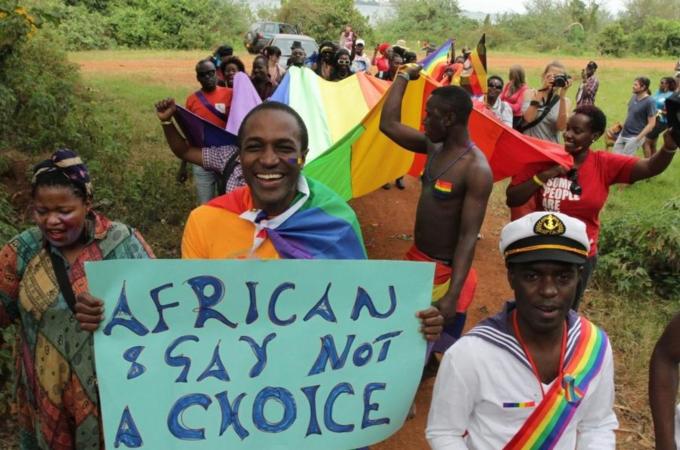
Canada has refused to issue visitor visas to 10 Ugandan activists invited to Toronto’sWorld Pride human rights conference in June over concerns they would stay to seek asylum.
Gay rights advocates say the decisions by the Canadian visa posts in Nairobi and London speak to the hypocrisy of the Stephen Harper government, which, in February,joined other Western nations in condemning Uganda for passing one of the world’s harshest anti-homosexuality laws.

Monday, December 23, 2013

Uganda Passes Anti-Gay Law Punishable By Life In Prison

The Ugandan parliament on Friday passed an anti-homosexuality bill that will see repeat “offenders” jailed for life.

MP David Bahati was behind the bill and told the AFP: “This is a victory for Uganda. I am glad the parliament has voted against evil.

“Because we are a God-fearing nation, we value life in a holistic way. It is because of those values that members of parliament passed this bill regardless of what the outside world thinks.”

"I am officially illegal," Ugandan gay activist Frank Mugisha said after the vote.

Saturday, June 29, 2013

The Love That Dares

"Ladies and gentlemen, welcome to karaoke. And those of you who were at Buckingham Palace: Welcome back." That's a joke; none of us was at Buckingham Palace, which is 4,000 miles from here, but we've all been watching Kate Middleton storm Westminster Abbey in five yards of ivory satin gazar and appliquéd lace on televisions citywide all day. On the projector screen in this Kampala bar, the news now focuses on footage from local events, like when cops used a pistol to smash out the window of a car, unleashed a torrent of pepper spray into the faces of its passengers, including opposition leader Kizza Besigye, and then dragged them off to custody. We watch subsequent crowds of protesters being dispersed by tear gas and live rounds, wince as men get beaten mercilessly over the head with batons. But then the TV is turned off and the karaoke machine is turned on, the Chinese kind that scrolls inexplicable pictures of hay bales and people going for sunset horseback beach rides and cityscapes (Rio, maybe?) behind the lyrics. Our emcee is wearing a sweater vest and a sassy lavender shirt and high-tops. He reminds us between every song that karaoke night is all about having fun and at one point welcomes to the microphone Kasha Jacqueline Nabagesera, a lanky, ropy dyke with skinny dreads who gets up from our table to rock "Livin' la Vida Loca." A string of rainbow lights spells out "Sappho" over the bartender's head. When a patron performs Bryan Adams' "Have You Ever Really Loved a Woman?," a guy yells out, "Yes, I have!"—dramatic pause—"My mother is a woman!" and everybody laughs because that guy is gaaaaaaay, and the boys slow-dancing up front are so tender it could break your heart, and when I make eye contact with a butch gal who has her hand down the front of a femme's strappy coral tank top, she smiles and says, "I'm just checking for a heartbeat." When I ask Kasha, who's ordering us whiskey and who owns this bar—Uganda's only gay bar—if she isn't worried about somebody coming in here and hurting or arresting anybody, she shakes her head. "We're not doing anything wrong."

Saturday, January 05, 2013

Uganda's 'Kill the Gays' bill spreads fear

Gay activist Gerald Ssentongo is afraid to talk openly about his cause in Uganda. Not only that, but he is terrified of being "caught" socialising with gay people and only meets his friends at night in out-of-reach places.

"The fear for our lives is everywhere, but it has increased of late. I am now verbally attacked, and last month my friend was assaulted simply because she said she was a lesbian. The attacks can happen in any scenario," said the 35-year-old. His concerns come at a time when the parliament of this East African nation has revived the infamous Anti-Homosexuality Bill, also known as the "Kill the Gays" bill.

Wednesday, December 19, 2012

Uganda’s “Kill the Gays” Bill Back in Limbo

The members of Uganda’s parliament are on vacation now, and won’t be coming back to work until February. It might not be much, given the threat hanging over them, but during those two months, L.G.B.T. Ugandans can rest a little easier. As I write in my story in this week’s issue, from the moment last month when Rebecca Kadaga, the speaker of parliament, announced that she would pass the proposed Anti-Homosexuality Bill, which would imprison gays (and originally suggested the death penalty for certain homosexual behavior), as a “Christmas gift” to Ugandans, activists have been coördinating a global effort to kill the bill, and those whose sexuality would be criminalized have been watching their government closely, as the bill seemed to be the closest it has come to passage since it was first introduced, in 2009. But lawmakers left for vacation on Friday without holding a vote on it, so now the notorious “Kill the Gays” bill is back in limbo, along with the lives of those in Uganda’s L.G.B.T. community.

Wednesday, April 18, 2012

Kony 2012: Ugandans Criticize Popular Video for Backing U.S. Military Intervention in Central Africa

We look at the controversial video, "Kony 2012," that targets Joseph Kony and his Lord’s Resistance Army (LRA), a group notorious for kidnapping children, forcing boys to become fighters, and using girls as sex slaves in Central Africa. Released on March 5, it was viewed more than 100 million times online in just under a week, making it the most viral video in history. We speak with two Ugandans about the impact of the film and how the Kony 2012 campaign calls for U.S. military intervention in Central Africa to fight the LRA. Milton Allimadi is publisher and editor-in-chief of Black Star News. Victor Ochen is a survivor of the LRA war and director of African Youth Initiative Network, based in northern Uganda.

Video
Source: Democracy Now!
Author: ---

Wednesday, January 18, 2012

The hunt for Joseph Kony - Will this be the last stand for Kony and his vicious Lord’s Resistance Army?

Patrick Chengo remembers waking as a hand tore him from bed. Rebels roped together 10 boys from his tiny village, marching them into the black June night. Clenching his jaw, Chengo, the eldest at 14, refused to cry, hoping to calm the other boys; the youngest, just six, had wet himself from fear. Whips drove the boys far from home, deep into the northern Ugandan forest, where they eventually crossed the Nile into the Democratic Republic of Congo. So began Chengo’s nightmare—six years as a child soldier for Joseph Kony’s Lord’s Resistance Army.

Chengo managed to escape 18 months ago, but freedom has proved bittersweet. His parents didn’t live to see his return. He can no longer read nor do even basic math. His village believes he is a murderer. Chengo, who is haunted by the horrors of the forest, wants Kony captured and tried for what he did to him and tens of thousands of other children. So, apparently, does Barack Obama. In a surprise announcement last fall, President Obama declared the U.S. government was sending combat-ready troops to aid in the hunt for, and fight against, Kony, one of the planet’s most reviled war criminals, and the LRA’s senior leadership.

In the beginning, the LRA was allied with northern Uganda’s Acholi people; it formed in the late ’80s in opposition to the Yoweri Museveni government, which it hoped to replace with one led by northerners, who had ruled Uganda after independence. Political aims, however, were subsumed by Kony’s pseudo-religious imperative: the Christian sociopath claims the Holy Spirit has commanded him to keep killing until Uganda is ruled by the Ten Commandments.


Sunday, November 27, 2011

Uganda: nomads face an attack on their way of life

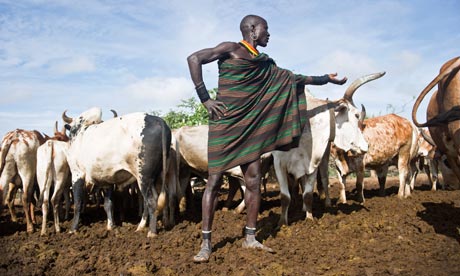
Three young Jei cattle herders firmly grasp a young white cow. Moding Ngolapus tightens a string round its scraggy neck, while his friend takes a roughly made bow, crouches and aims a blunt arrow from about 3ft away.

His first and second shots fail to even pierce the flesh, but the third finds an artery without severing it. The cow does not flinch as its blood squirts out and is collected in a bowl. Ngolapus pinches the wound, which clots quickly, then eases the string. It's all very precise, conducted in silence and over in two minutes. The cow's blood will be mixed with milk to make a liquid meal called ekacel.

This is Lobelai cattle camp in the heart of Karamoja province, north-eastern Uganda, a moving "city" of 10,000 or more cows which is home to about 300 mainly young Jei warrior nomads, who ceaselessly drive their herds across the 27,000 square miles of semi-arid land bordering Kenya and South Sudan.

The climate is harsh; water and pasture is scarce; for generations the Jei and other semi-nomadic clans, such as the Dodoth, have raided each other in constant low-level wars. Claiming all cattle as their own, they rustle – and in turn are raided – by fellow Karamojong groups as well as Turkana tribes from Kenya and the Toposa groups in South Sudan.