Democracy Gone Astray

Democracy, being a human construct, needs to be thought of as directionality rather than an object. As such, to understand it requires not so much a description of existing structures and/or other related phenomena but a declaration of intentionality.
This blog aims at creating labeled lists of published infringements of such intentionality, of points in time where democracy strays from its intended directionality. In addition to outright infringements, this blog also collects important contemporary information and/or discussions that impact our socio-political landscape.

All the posts here were published in the electronic media – main-stream as well as fringe, and maintain links to the original texts.

[NOTE: Due to changes I haven't caught on time in the blogging software, all of the 'Original Article' links were nullified between September 11, 2012 and December 11, 2012. My apologies.]

Showing posts with label Uranium. Show all posts

Friday, July 27, 2018

Bill Clinton sought State’s permission to meet with Russian nuclear official during Obama uranium decision

As he prepared to collect a $500,000 payday in Moscow in 2010, Bill Clinton sought clearance from the State Department to meet with a key board director of the Russian nuclear energy firm Rosatom — which at the time needed the Obama administration’s approval for a controversial uranium deal, government records show.

Arkady Dvorkovich, a top aide to then-Russian President Dmitri Medvedev and one of the highest-ranking government officials to serve on Rosatom’s board of supervisors, was listed on a May 14, 2010, email as one of 15 Russians the former president wanted to meet during a late June 2010 trip, the documents show.

Wednesday, March 02, 2016

Uranium Mining Is Coming To The Grand Canyon, If Koch-Backed Group Gets It Way

A dark money group backed by Charles and David Koch is behind a well-funded effort to undermine protections at the Grand Canyon and overturn the Antiquities Act, the law President Teddy Roosevelt used to permanently protect the area in 1908. If successful, the campaign could stop a permanent ban on uranium mining near the canyon’s rim, despite support for such a ban by a vast majority of Arizonans.

Monday, May 18, 2015

Multi-million dollar tax battle casts shadow over Canada-India uranium deal

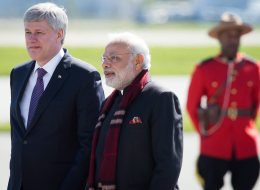
Prime Minister Stephen Harper met with Indian Prime Minister Narenda Modi on Thursday at the Pinnacle Harbourfront hotel to tout a $350 million deal in which Canada's largest uranium company, Cameco, will supply uranium to India.

The deal was praised by Modi earlier this week, as he addressed reporters in Ottawa.

Monday, April 27, 2015

Canada-India Uranium Deal Will Spur Proliferation, Experts Warn

India test-fired a nuclear-capable ballistic missile Thursday, just hours after signing a deal to buy 3,000 tons of Canadian uranium.

The Agni-III missile, which has a range of over 3,000 kilometres, was fired from the Indian army's test range on Wheeler Island in the Bay of Bengal. India declared the test a success.

It's a sign of India's confidence that — with the help of Canada — it has finally left behind its status as a rogue nuclear nation and become an accepted member of the nuclear arms establishment.

Monday, December 08, 2014

Iran Uranium Partner Could Get Gift From Lame-Duck Congress

WASHINGTON -- Congress may use must-pass legislation in the next two weeks to slip through a controversial land deal that would help a company that jointly owns a uranium mine with Iran, sources told HuffPost.

The company, the international mining conglomerate Rio Tinto, has been trying for nearly a decade to acquire 2,400 acres of the federally protected Tonto National Forest in southeast Arizona -- land that sits atop a massive copper deposit.

Monday, March 24, 2014

"A Slow Genocide of the People": Uranium Mining Leaves Toxic Nuclear Legacy on Indigenous Land

The iconic Grand Canyon is the site of a battle over toxic uranium mining. Last year, a company called Energy Fuels Resources was given federal approval to reopen a mine six miles from the Grand Canyon’s popular South Rim entrance. A coalition of Native and environmental groups have protested the decision, saying uranium mining could strain scarce water sources and pose serious health effects. Diné (Navajo) tribal lands are littered with abandoned uranium mines. From 1944 to 1986, 3.9 million tons of uranium ore were chiseled and blasted from the mountains and plains of the region. More than 1,000 mines have closed, but the mining companies never properly disposed of their radioactive waste piles, leading to a spike in cancer rates and other health ailments. Broadcasting from Flagstaff, Arizona, we speak with Taylor McKinnon, director of energy with Grand Canyon Trust, and Klee Benally, a Diné (Navajo) activist and musician. "It’s really a slow genocide of the people, not just indigenous people of this region, but it’s estimated that there are over 10 million people who are residing within 50 miles of abandoned uranium mines," Benally says. Benally also describes the struggle to preserve the San Francisco Peaks, an area considered sacred by 13 Native tribes, where the Snowbowl ski resort is using treated sewage water to make snow.

Video
Source: democracynow.org/
Author: --

Tuesday, April 02, 2013

Canada confronting a crisis between economy and energy

Energy is on everyone's minds these days. Prime Minister Stephen Harper is determined to make Canada an energy superpower, fuelled mostly by Alberta's tar sands.

Meanwhile, Alberta Premier Alison Redford now finds energy price fluctuations are reducing provincial revenues.

Saskatchewan is booming from oil, gas and uranium revenues, and B.C. Premier Christy Clark plans to vastly expand exploitation of liquefied natural gas, which requires huge amounts of energy and involves the highly contentious practice of fracking.

Thursday, December 06, 2012

'Collaboration Agreement' with uranium giants sparks opposition in northern Saskatchewan

Revelations last week that the northern Saskatchewan community of Pinehouse is set to sign a so-called "collaboration agreement" with uranium giants Cameco and Areva have sparked outrage in the community due to terms of the agreement that residents say is a blatant attempt to silence opposition to the expansion of uranium mining in the area.

A summary of the agreement, obtained by the Committee for Future Generations, contains a number of alarming terms, including that "Under the Collaboration Agreement, Pinehouse is expected to fully support Cameco/Areva's mining," including existing operations, proposed projects, and, incredibly, even future operations.

Wednesday, November 28, 2012

Community revs for fight against uranium plant

Several hundred people showed up to two neighbourhood meetings held this week in the wake of revelations that the GE-Hitachi plant at 1025 Lansdowne processes uranium into fuel for Canadian nuclear reactors.

It was standing-room-only as residents, concerned about everything from their personal health and safety to the area’s community vibe, peppered politicians, GE-Hitachi officials and environmentalists with questions.

Monday, March 26, 2012

Canada in hot seat at nuclear summit for uranium use

Canada may be the subject of some controversy at the nuclear security summit, which opens today in Seoul, South Korea.

The U.S. and several European countries are calling on countries such as Canada to phase out the use of highly enriched uranium, which Canada uses to make medical isotopes for medical diagnoses. Canada is the largest producer of medical isotopes.

"Highly enriched uranium can be used to make bombs, and the U.S. is calling on Canada and others to move toward using a lower grade," the CBC's Laurie Graham reports from the conference.

For Canada, "the cost of converting to get into a lower grade would be very expensive. Canada had promised in 2010 to start phasing out using it at the last summit. It's been sharply criticized for not moving fast enough, and no doubt that criticism will continue."

Ottawa-based MDS Nordion Inc., a major provider of medical isotopes, signed a supply agreement with a Russian company in 2010 to import the isotopes derived from cheaper highly enriched uranium.

Thursday, March 22, 2012

Harper targeted over Nordion’s bomb-grade uranium deal with Russia

Stephen Harper flies to Seoul next week for a nuclear security summit where not everyone will see his country as a model player: A Canadian company is accused of frustrating efforts to wean the world off bomb-grade uranium.

Ottawa-based Nordion Inc. is the world’s biggest producer of medical isotopes, the life-saving radioactive tools used to diagnose and treat cancer and other diseases. But it relies on materials drawn from highly enriched uranium – and has cut a 10-year deal to get supplies from Russia.

That has a coalition of American arms-control advocates and non-proliferation experts, and some members of the U.S. Congress, complaining that Canada is slowing efforts to ensure bomb-grade uranium does not fall into terrorists’ hands.

Mr. Harper signed on to efforts to reduce the civilian use of highly enriched uranium (HEU), as a key part of the first nuclear security summit U.S. President Barack Obama convened in 2010. But Canada’s willingness to move quickly is being questioned.
Like all nations that produce medical isotopes, Canada has pledged to phase out the production of HEU-based isotopes for the more expensive low-enriched uranium (LEU) version. Nordion, the biggest player in the global isotope market, supplying half of U.S. needs, is considered central to these efforts.

But in the fall of 2010, Nordion entered into a 10-year deal with a Russian company to ensure a steady source in the years ahead. While the deal includes a commitment to work on converting to LEU, the timeline has not been set. And it means Nordion could use Russian supplies to get around the provisions of a bill before the U.S. Congress to tighten controls on American HEU.

As a result, critics say, Russia now has less incentive to get rid of its HEU – despite the fact that both Canada and the U.S. have spent hundreds of millions of dollars to secure Russian nuclear materials – and Nordion has less incentive to convert to LEU more quickly.

In addition, they say, because Nordion’s HEU-based isotopes are cheaper to produce, others converting to LEU can’t compete, and that’s unlikely to change now that Nordion has a long-term supplier in Russia.

“This deal basically makes it impossible for people using the safer material to compete,” said Miles Pomper, a Washington-based senior research associate at the James Martin Center for Nonproliferation Studies. “It discourages other countries from converting, which means there’s more HEU in other places, too.”

Even some arms-control advocates acknowledge that, from a business point of view, Nordion had little choice.

Because Canada is not a nuclear-weapons state, it does not enrich uranium, so Nordion usually imports material extracted from U.S. HEU stockpiles. It uses the federally owned research reactor in Chalk River, Ont., to process it for medical use.

But that reactor, beset by leaks and problems from 2007 to 2009 that triggered global shortages of medical isotopes, is set to close in 2016. The government mothballed two new MAPLE reactors that were slated to take over, sparking Nordion to launch a $1.6-billion lawsuit against Atomic Energy of Canada Ltd., a Crown corporation.

Nordion says it is collaborating on projects to develop new ways to produce isotopes without HEU, but vice-president Tamra Benjamin said by email that “the large-scale commercially viable application of these new technologies is still several years away.” Eliminating access to HEU-based materials would “have a detrimental effect on tens of thousands of patients around the world,” she said.

Canadian federal agencies are financing research into non-HEU isotope production. And with the U.S. medical market so dependent on Nordion’s products, it’s questionable how far the U.S. can go in pressuring Canada to move more quickly. But Mr. Harper can expect pressure in the hallways in Seoul.

Chad Westmacott, an analyst at the OECD’s Nuclear Energy Agency, said it’s not the countries’ intent that’s questioned, “but actual timelines.”

“There’s probably going to be a lot of talk about this on the side,” he said.

Original Article
Source: Globe
Author: jeremy torobin

Wednesday, December 28, 2011

Uranium Shipped From Canada to U.S., Says 'Secret' Federal Memo

MONTREAL - Weapons-grade uranium is quietly being transported within Canada, and into the United States, in shipments the country's nuclear watchdog wants to keep cloaked in secrecy.

A confidential federal memo obtained through the Access to Information Act says at least one payload of spent, U.S.-origin highly enriched uranium fuel has already been moved stateside under a new Canada-U.S. deal.

The shipments stem from the highly publicized agreement signed last year by Prime Minister Stephen Harper and U.S. President Barack Obama, amid fears that nuclear-bomb-making material could fall into the hands of terrorists.

The Canadian stash gradually being shipped from Chalk River, Ont., contains hundreds of kilograms of highly enriched uranium — large enough to make several Hiroshima-sized nuclear bombs.

But even as the radioactive freight travels toward the U.S. border, the Canadian Nuclear Safety Commission has no plans to hold public hearings or disclose which communities lie along the delivery route.

The shipments themselves are protected by intense security protocol, which means specifics like routes, transportation method, quantities and schedules remain top secret.

Tuesday, December 27, 2011

Canada quietly shipping bomb-grade uranium to U.S., 'secret' federal memo says

Weapons-grade uranium is quietly being transported within Canada, and into the United States, in shipments the country's nuclear watchdog wants to keep cloaked in secrecy.

A confidential federal memo obtained through the Access to Information Act says at least one payload of spent, U.S.-origin highly enriched uranium fuel has already been moved stateside under a new Canada-U.S. deal.

The shipments stem from the highly publicized agreement signed last year by Prime Minister Stephen Harper and U.S. President Barack Obama, amid fears that nuclear-bomb-making material could fall into the hands of terrorists.

The Canadian stash gradually being shipped from Chalk River, Ont., contains hundreds of kilograms of highly enriched uranium — large enough to make several Hiroshima-sized nuclear bombs.

But even as the radioactive freight travels toward the U.S. border, the Canadian Nuclear Safety Commission has no plans to hold public hearings or disclose which communities lie along the delivery route.