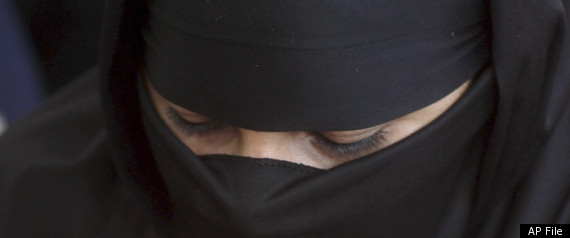
CANBERRA, Australia -- Muslim women would have to remove veils and show their faces to police on request or risk a prison sentence under proposed new laws in Australia's most populous state that have drawn criticism as culturally insensitive.
A vigorous debate that the proposal has triggered reflects the cultural clashes being ignited by the growing influx of Muslim immigrants and the unease that visible symbols of Islam are causing in predominantly white Christian Australia since 1973 when the government relaxed its immigration policy.
Under the law proposed by the government of New South Wales, which includes Sydney, a woman who defies police by refusing to remove her face veil could be sentenced to a year in prison and fined 5,500 Australian dollars ($5,900).
The bill – to be voted on by the state parliament in August – has been condemned by civil libertarians and many Muslims as an overreaction to a traffic offense case involving a Muslim woman driver in a "niqab," or a veil that reveals only the eyes.
The government says the law would require motorists and criminal suspects to remove any head coverings so that police can identify them.
Critics say the bill smacks of anti-Muslim bias given how few women in Australia wear burqas. In a population of 23 million, only about 400,000 Australians are Muslim. Community advocates estimate that fewer than 2,000 women wear face veils, and it is likely that even a smaller percentage drives.
"It does seem to be very heavy handed, and there doesn't seem to be a need," said Australian Council for Civil Liberties spokesman David Bernie. "It shows some cultural insensitivity."
The controversy over the veils is similar to the debate in other Western countries over whether Muslim women should be allowed to wear garments that hide their faces in public. France and Belgium have banned face-covering veils in public. Typical arguments are that there is a need to prevent women from being forced into wearing veils by their families or that public security requires people to be identifiable.
Bernie noted that while a bandit disguised with a veil and sunglasses robbed a Sydney convenience store last year, there were no Australian crime trends involving Muslim women's clothing.
"It is a religious issue here," said Mouna Unnjinal, a mother of five who has been driving in Sydney in a niqab for 18 years and has never been booked for a traffic offense.
"We're going to feel very intimidated and our privacy is being invaded," she added.
Unnjinal said she would not hesitate to show her face to a policewoman. But she fears male police officers might misuse the law to deliberately intimidate Muslim women.
"If I'm pulled over by a policeman, I might say I want to see a female police lady and he says, 'No, I want to see your face,'" Unnjinal said. "Where does that leave me? Do I get penalized 5,000 dollars and sent to jail for 12 months because I wouldn't?"
Sydney's best-selling The Daily Telegraph newspaper declared the proposal "the world's toughest burqa laws." In France, wearing a burqa – the all-covering garment that hides the entire body except eyes and hands – in public is punishable by a 150 euro ($217) fine only.
The New South Wales state Cabinet decided to create the law on July 4 in response to Police Commissioner Andrew Scipione's call for greater police powers. Other states including Victoria and Western Australia are considering similar legislation.
Full Article
Source: Huffington