
Showing posts with label Women Abuse. Show all posts
Showing posts with label Women Abuse. Show all posts
Saturday, September 16, 2023
Saudi Women Who Fought for the Right to Drive Are Disappearing and Going Into Exile
Wednesday, September 30, 2015
'Stolen Sisters' Invites National Reckoning on Missing Women
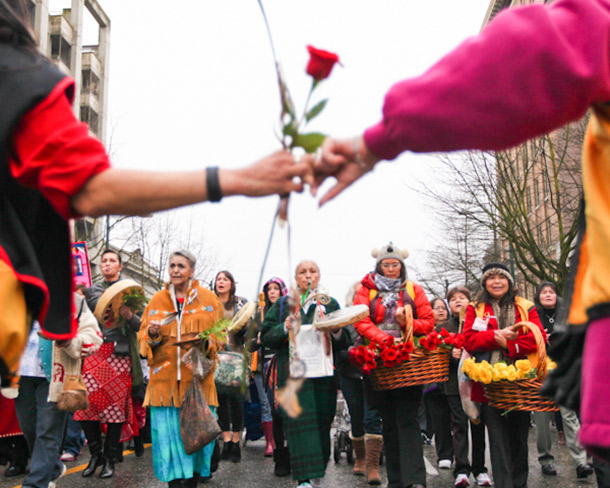
"I came across an article about the United Nations [wanting] to do an investigation about missing and murdered indigenous women in Canada, and I was shocked," Walter said in a phone interview with The Tyee from her home in Montreal. "After that I became obsessed with the topic, and at the end I decided to write the book."
Friday, May 29, 2015
How US Working Women Are Being Run Over

Friday, April 10, 2015
Families of missing and murdered indigenous women give police a failing grade
 Police departments across Canada get a failing grade for their efforts at solving cases of missing and murdered indigenous women, according to CBC interviews with more than 110 family members.
CBC News has embarked on an exhaustive search for families who have lost a relative either to an unsolved killing or whose loved one still remains missing.
Thursday, February 26, 2015
Hundreds of expert recommendations on violence against Indigenous women and girls go unimplemented

Researchers with the Legal Strategy Coalition on Violence Against Indigenous Women reviewed 58 reports dealing with aspects of violence and discrimination against Indigenous women and girls, including government studies, reports by international human rights bodies, and published research of Indigenous women's organizations. The reports cover a period of two decades. Shockingly, researchers found that only a few of more than 700 recommendations in these reports have ever been fully implemented.
"How many Indigenous women and girls would have been found or would still be alive if governments had acted on more of these recommendations?" asked Grand Chief Stewart Phillip, President of the Union of BC Indian Chiefs. "This is yet another piece of irrefutable evidence that governments in Canada have breached their fundamental moral and legal responsibility to ensure the safety of all women, without discrimination."
Thursday, October 23, 2014
Women Still Can't Walk Alone Without Being Harassed

I've been lucky. I haven't been assaulted; or rather, not on the street...yet. Too many friends haven't been as lucky.
Thursday, September 18, 2014
No Thanks From an Ungrateful Nation: The Surge of Female Vets Living on the Streets

Sexual assault is a major reason for the growing number of homeless female vets. In this particular case, the homeless woman was able to rebuild her life. I heard about it when I talked to her and two other female vets recently at a home provided by New Directions, a Los Angeles organization that offers substance abuse and mental health treatment, as well as transitional housing for homeless veterans or those at risk of ending up on the street.
Monday, May 19, 2014
Some Countries Spend More On Domestic Violence Costs Than On Primary Education: Report

A report out this week from the World Bank Group examined some of the challenges facing women around the world and uncovered some unequivocally devastating finds. As shown in the map below, a significant share of women, especially in Africa and South Asia, have experienced physical or sexual violence from an intimate partner during their lifetime.
Wednesday, December 11, 2013
Battered women morally entitled to kill abusers, U of O professor asserts

Elizabeth Sheehy raises the provocative idea in her new book, eight years in the making, called Defending Battered Women on Trial. It will be published Dec. 15 by UBC Press.
“Why should women live in anticipatory dread and hypervigilence?” she writes in the book’s concluding chapter. Would it not be just, Sheehy asks, “to shift the risk of death to those men whose aggressions have created such dehumanizing fear in their female partners?”
Monday, October 07, 2013
Aboriginal leader Shawn Atleo warns of 'grave' human rights crisis
 Canada is facing a "grave" human rights crisis, warned the National Chief for the Assembly of First Nations Shawn Atleo during a rally to honour and remember the lives of missing and murdered aboriginal women and girls on Parliament Hill Friday.
Canadians are rallying in over 200 locations across the country at Sisters In Spirit rallies, an event organized by the Native Women’s Association of Canada annually for the past eight years on Oct. 4.
Tuesday, September 24, 2013
Canada's rejection of inquiry into violence against Aboriginal women is a national disgrace

During that year, fifty submissions slammed Canada on topics from labour rights to foreign policy and highlighted the country in the worst way among the 192 UN member states. According to a report by the National Union of Public and General Employees (NUPGE), Secretary General of Amnesty International Canada, Alex Neve said: "The Canadian record of upholding the rights of indigenous peoples is a real disgrace and a source of national shame... These are not political, economic or natural resource matters. These are issues of human rights."
Tuesday, June 11, 2013
Canada blocking UN efforts to address sexual violence against women

In previous years, the Canadian government, which chairs the negotiations of the annual HRC resolution on violence against women, has played a leadership role in helping to create advances seeking to protect women from violence. Yet this year, a number of concerns have been raised regarding Canada’s approach to the new resolution on the theme of ‘sexual violence’. The concerns in question are the very proposals that Canada itself is putting forward which are regressive and represent a serious attack on women’s rights and the health and wellbeing of survivors of sexual violence.
Friday, February 22, 2013
Terrorism against women: The war that never ends

Friday, February 15, 2013
Explosive new report alleges widespread RCMP abuse of Indigenous women and girls
 A new report by Human Rights Watch alleging widespread abuse by the RCMP against Indigenous women and girls was the subject of fierce debate Wednesday in Parliament. The 89-page report "described abusive treatment by police officers, including excessive use of force, and physical and sexual assault."
"Those Who Take Us Away" details police failure to protect Indigenous women and girls in northern British Columbia in and around Highway 16 (known as the "Highway of Tears"), documents allegations of RCMP violence and abuse against Indigenous women, and calls on the government to convene a national inquiry into missing and murdered Indigenous women.
Thursday, February 14, 2013
Gender Pay Gap Widened In 2012, Back To 2005 Levels
 Women have made huge strides in the workplace but still are falling short when it comes to pay.
New data from the Labor Department reveals that in 2012, women made only 81 percent as much as male workers, on average. Women made less than men in all but two occupations, according to the available data.
The gender pay gap actually widened last year (women made 82 percent as much as men in 2011) and now has returned to 2005 levels, according to the Labor Department.
The latest push to end the gender wage gap is coming from President Barack Obama, who on Tuesday night made another push in support of a bill that would seek to ensure paycheck fairness.
Original Article
Source: huffingtonpost.com
Author: Bonnie Kavoussi
Wednesday, February 13, 2013
Canada: Abusive Policing, Neglect Along ‘Highway of Tears’
 (Ottawa) – The Royal Canadian Mounted Police in northern British Columbia has failed to protect indigenous women and girls from violence, Human Rights Watch said in a report released today. Women and girls Human Rights Watch interviewed also described abusive treatment by police officers, including excessive use of force, and physical and sexual assault.
Thursday, February 07, 2013
Ten Things to End Rape Culture

Wednesday, January 02, 2013
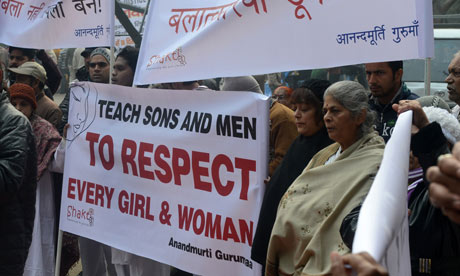
India rape suspects reportedly tried to run over victim
 The men in India accused in the brutal sexual assault and death of a 23-year-old student threw her off a bus after raping her and then tried to run her over, according to reports citing police notes on the incident.
The Indian Express newspaper says those details of the assault in New Delhi are contained in a 1,000-page charge sheet to be presented in court on Thursday, when police are expected to file formal charges against the suspects.
Delhi gang-rape: look westward in disgust
Tuesday, December 11, 2012
Afghanistan Women's Rights Abuses Prevail Despite New Law, U.N. Says

The report came out a day after gunmen shot and killed the head of the women's affairs department for eastern Laghman province. Afghan officials said Najia Sediqi, who took the job after her predecessor was killed in a bomb attack in July, was on her way to her office when she was shot dead.
Subscribe to:
Posts (Atom)