Democracy Gone Astray

Democracy, being a human construct, needs to be thought of as directionality rather than an object. As such, to understand it requires not so much a description of existing structures and/or other related phenomena but a declaration of intentionality.
This blog aims at creating labeled lists of published infringements of such intentionality, of points in time where democracy strays from its intended directionality. In addition to outright infringements, this blog also collects important contemporary information and/or discussions that impact our socio-political landscape.

All the posts here were published in the electronic media – main-stream as well as fringe, and maintain links to the original texts.

[NOTE: Due to changes I haven't caught on time in the blogging software, all of the 'Original Article' links were nullified between September 11, 2012 and December 11, 2012. My apologies.]

Friday, March 30, 2012

Adrienne Rich (1929-2012): Alice Walker & Frances Goldin on the Life of the Legendary Poet & Activist

The legendary poet, essayist and feminist Adrienne Rich, who died on Tuesday at the age of 82, was one of the most celebrated poets of the last half-century and a lifelong advocate for women, gay and lesbian rights, peace and racial justice. Rich drew widespread acclaim for her many volumes of poetry and prose, which brought the oppression of women and lesbians into the public spotlight. She was a key figure in the women’s movement and an uncompromising critic of the powerful. In 1997, Rich famously declined to accept the National Medal of Arts in a protest against the Clinton administration, writing that art "means nothing if it simply decorates the dinner table of power which holds it hostage." We remember Rich’s life with Pulitzer Prize-winning author Alice Walker and Rich’s literary agent Frances Goldin.

Video
Source: Democracy Now!
Author: ---
Workers of Canada Unite -- Against a Budget for the One Percent

For the past two decades, Canadian governments and Bay Street financiers have been conducting an ideological experiment on our economy. Their hypothesis: The only option to manage government finances is to cut public spending and drastically reduce tax revenues.

For a select few, this experiment has been an overwhelming success. Corporate profits and the salaries of top executives are steadily rising. Our corporate tax rate is the lowest of any G7 country, and our effective rate is lower than virtually all high income OECD countries.

But it's a sharply different story for Canadian workers. Spending cuts have meant stagnant wages, cuts in benefits, calls to claw back pensions, and efforts to dismantle vital public services.

Attempts to shrink our way to an economic recovery have been futile. The inequity between the richest and poorest in our society is growing at the fastest rate amongst developed nations, according to the OECD. This is harming our economy, dragging down Canadian workers, and eroding the middle class.

It's time for this failed experiment to end.

Whether it's public health care, community infrastructure, child care, or seniors' care, public services are the great equalizers of our society. They need to be strengthened, not torn apart. We need to move to a better tax system, where everyone pays their fair share.

Canada's Largest Social Housing Project Favours the Rich?

Reporters (even columnists) like the Sun's Sue-Ann Levy are rare and to be valued by their employers (and readers) more than their paycheques may indicate.

Recently, the dogged Sue-Anne has been rattling the cage over what's called the revitalization of Regent Park from low-income, affordable housing, to mixed-income housing where, presumably, the complex will more or less reflect society in general.

As a theory this makes sense, and with luck it sometimes works out.

The focus of the fuss over the Regent Park revitalization is that Councillor Pam McConnell snagged one of the prime, 1,200-square foot condos for $400,000-plus, while many former residents were moved out with the assurance that they could return -- a promise that was reneged on.

After Sue-Ann's digging and documentation, Toronto Community Housing Corp. (TCHC) announced that former Ontario Chief Justice Patrick LeSage would conduct an independent review of the Regent Park condo purchases.

This has got people like Pam McConnell squeaking: Witch hunt, unnecessary, scape-goating, waste of time and money, right wing paranoia, envy, and all that.

Without having a clue about what Justice LeSage will or won't find in his review, I'll be surprised if he finds anything that's overtly illegal.

OAS Cuts: Budget For 2012 Outlines Federal Government's Plans For Pension Program

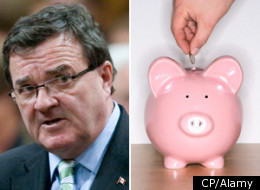
Finance Minister Jim Flaherty delivered a budget today that cut less than the government warned, but didn't spare Old Age Security from planned changes while also taking on civil service and MP pensions.

The budget cuts $5.2 billion in spending over the next three years, at the low end of the $4 to $8 billion range Flaherty had prepared Canadians for.

Among the departments hardest hit by the cuts are the Department of Finance, the Privy Council Office - the civil servants who provide administrative support to the Prime Minister’s Office – as well as Transport Canada and the Treasury Board. National Defence lost the most money overall, with cuts hitting $1.1 billion by 2014-15.

Flaherty said the budget was created for the long-term and it offers few of the targeted tax credits his government usually includes.

Changes to the age of eligibility for OAS will start in April 2023, rising gradually to age 67 from 65 by Feb. 1, 2029, affecting those born after April 1, 1958.

Those who choose to work longer will be able to defer their OAS for up to five years, giving them a higher pension later. And the government will start enrolling seniors automatically for OAS and GIS, rather than making them apply, a move the NDP suggested earlier this month.

Why the budget spares boomers on OAS

While the pre-budget hype was that Canadian baby boomers were going to have to delay their retirement after Thursday’s federal budget was unveiled, their Findependence Day has not been severely postponed for anyone who is now 54 years old or older as of March 31, 2012.


As expected, the Old Age Security eligibility age will rise gradually from the current 65 to 67 but this doesn’t start to happen until 2023, according to the just-released budget.  When you add the 11-year notification of this change to the six-year phase-in between 2023 and 2029, I’d agree with Finance Minister Jim Flaherty that Canadians [or their financial planners] have “ample time to make adjustments to their retirement plans.”

For younger people born on or after Feb. 1, 1962, OAS eligibility will be age 67. Technically, boomers were born between 1946 and 1964 but in my view, if you were born between 1962 and 1964, you likely didn’t grieve over the JFK assassination and can hardly be considered a true baby boomer.

Walking While Black: Killing of Trayvon Martin Evokes Memories of Civil Rights Martyr Emmett Till

hereThe killing of Trayvon Martin has drawn comparisons to that of civil rights martyr Emmett Till, who was slain at the age of 14 in Mississippi in 1955. We’re joined by Cynthia Dagnal-Myron, a writer who was taught by Till’s mother, Mamie Till Mobley. Dagnal-Myron is a former reporter for the Chicago Sun-Times and Arizona Daily Star who has also spent over 20 years as a teacher and administrator. Her most recent article for Salon.com is "For Trayvon and Emmett: My 'Walking While Black' Stories." Comparing the Jim Crow era to today, Dagnal-Myron says, "I don’t know how much progress has been made. ... [In] your day-to-day life, if you’re an African-American woman or man, you still feel the things that my parents felt. ... You’re still treated the way that my parents were afraid that I would be treated. It’s just an everyday thing for me. So, for those who think that it’s over, they’re not walking in our shoes."

Video
Source: Democracy Now!
Author: ---

The Commons: Back to black along a road paved in copper

In keeping with tradition, the Finance Minister was applauded simply for showing up. Jim Flaherty arrived two minutes after four and, upon realizing his existence, the Conservatives stood and cheered. Poor Peter Stoffer, attempting to contribute to a debate on the Strengthening Military Justice in the Defence of Canada Act, was drowned out entirely.

With Mr. Flaherty in the room, the Speaker announced that the House would be moving on to government orders. The minister stood and his Conservative colleagues treated him to a second standing ovation. He proceeded with the procedural niceties required to table the budget documents and when he was finished there was more applause.

“Looking ahead,” he said when he’d finally begun, “Canadians have every reason to be confident.”

Twasn’t it ever thus? Has a Finance Minister ever stood in this place and tabled anything other than a prudent, forward-thinking masterstroke that cast us ahead to a more brilliant future? Is it possible that Archibald McLelan and Edgar Nelson Rhodes or another of Mr. Flaherty’s predecessors once rose and pleaded for the House’s mercy or confessed that he was only vaguely sure of the numbers?

Likely not. Indeed, within a few paragraphs, Mr. Flaherty was referencing the hopeful words of Sir George Eulas Foster, our eighth finance minister.

Top court blocks government's effort to restrict Afghan human rights info

OTTAWA — An appeal by the Department of Foreign Affairs to block an Ottawa law professor from getting a better look at reacted documents that detail the status of human rights in Afghanistan won't be heard by the Supreme Court of Canada.

The Department of Foreign Affairs had been trying to prevent University of Ottawa law professor Amir Attaran from gaining further access to the departmental reports.

In the wake of the Supreme Court's decision, announced Thursday, not to hear the government's appeal, it is expected that Attaran will gain further access to the documents.

Attaran first asked for annual reports from foreign affairs for the years 2001-06, but was given redacted copies of the reports from 2002-06. The department said no report existed for 2001.

After filing a complaint with the information commissioner that the redactions were excessive, Attaran received another set of copies with fewer redactions, but the professor wasn't satisfied and took his case to Federal Court, asking for a further review by a judge.

The Federal Court was declined a further review of the documents, with the exception of two sections of a report that had already been released and publicly reported on.

Federal budget 2012: It’s about cutbacks, no matter what Flaherty says

Keen not to resurrect the adage that “Tory times are tough times,” federal Finance Minister Jim Flaherty is eager to have you know that his budget Thursday will be long on stimulating growth and short on austerity.

“If you concentrate on the savings [the expected $7 billion or so in spending cuts in the March 29 budget], you’re going to miss most of what the budget is about.”

Why should we believe that from a regime of small-government ideologues heady with their first majority mandate, and free to slash at will?

The anticipated $7 billion in cuts is, after all, at the top end of the $4 billion to $8 billion range that Flaherty’s department earlier signaled.

That magnitude of cuts would seem counter-intuitive, given Canada’s remarkable good fortune on the deficit-reduction front. Ottawa’s improving fiscal health would, one might expect, ease the pressure on Ottawa to enhance Canada’s attractiveness to foreign investors on the altar of Canada’s least advantaged – a misguided preoccupation of many debt-strapped governments.

Flaherty, failing again as he has in his entire tenure as finance minister to hit a future budget target, is on a path to eradicating the deficit as much as two years earlier than his forecast 2016-17.

Mulcair challenges Harper on budget in first face-off as NDP Leader

Stephen Harper has finally faced off against Thomas Mulcair in the first confrontation between the two men who will fight to form the next government in the 2015 election.

Mr. Mulcair, the new Leader of the NDP and the Official Opposition, started off a pre-budget Question Period by reminding the Conservative government of recent promises, stating that they are now at risk.

“Everything indicates the Conservative budget will be synonymous with cutbacks and job losses. A few months ago, the Prime Minister promised textually, in this House, that he would not touch pensions, would not cut health transfers to the provinces, would not touch services to the population?” Mr. Mulcair said. “Will the Prime Minister live up to his word, or will he break his promise?”

The Prime Minister answered that his party won last year’s election and is governing accordingly.

“This government has gone in front of the population and won a mandate for its budget, its Economic Action Plan, and we will govern under that mandate,” Mr. Harper said.

Mr. Harper also congratulated Mr. Mulcair for his victory, but Mr. Mulcair did not seem impressed.