Democracy Gone Astray

Democracy, being a human construct, needs to be thought of as directionality rather than an object. As such, to understand it requires not so much a description of existing structures and/or other related phenomena but a declaration of intentionality.
This blog aims at creating labeled lists of published infringements of such intentionality, of points in time where democracy strays from its intended directionality. In addition to outright infringements, this blog also collects important contemporary information and/or discussions that impact our socio-political landscape.

All the posts here were published in the electronic media – main-stream as well as fringe, and maintain links to the original texts.

[NOTE: Due to changes I haven't caught on time in the blogging software, all of the 'Original Article' links were nullified between September 11, 2012 and December 11, 2012. My apologies.]

Friday, March 22, 2013

Federal Budget 2013: What's in it for working people?

Municipalities across Canada need stable, long term funding to help replace crumbling roads, aging waste water treatment plants and to build vibrant community centres, libraries and green spaces.

The price tag attached to addressing our infrastructure needs is 126 billion dollars. Federal funding has been stagnant recently, and this year’s federal budget needs to commit significant increased funding for a long term, predictable and flexible public infrastructure.

The catch?

Prime Minister Stephen Harper is inexplicably moving towards tying all federal infrastructure funding to a condition that they be private-public partnerships.

Another Alberta Family Flees Oil Sands Pollution

Another Alberta family has abandoned their home due to air pollution from bitumen drilling and storage facilities in Alberta's Peace River region.

Thera Breau, a 36-year-old physiotherapist and mother of four young boys, says she moved her family to central Alberta this week and won't be coming back.

Budget 2013: Austerity through infrastructure cuts

One of the most amazing things about this budget is that one of its three focuses is actually the opposite of what it's touting. You'll likely hear that $14 billion will be spent on infrastructure over the next 10 years (actually you may hear much bigger numbers, but they're just re-announcing existing programs like the gas tax transfer). What you won't hear is that 75 per cent of that money is going to be spent in or after 2020. In fact, there will be an affective $1 billion cut to infrastructure transfers to the cities in 2014-15.

Budget 2013: Idle Some More

This budget marks a tactical retreat by a chastened government whose recklessness a year ago bought it a year of trouble it did not want.

Advisors to Stephen Harper say most big departures from business-as-usual in his government come straight from the big guy. This includes both the exploits of diplomacy and the excesses of bitterness. His budget last year was an example of the latter Harper. My blog post a year ago called it a Very Political Budget: the document sought to institutionalize Harper’s sense of outrage at Barack Obama’s decision to delay approval of the Keystone XL pipeline project. That delay was announced in November. By December Harper was promising “major transformations” and a shift in Canada’s trade strategy from the U.S. to Asia. In January Harper visited China and delivered his Davos speech. In March the budget featured, for the first time, a chapter on natural-resource development and included language about reducing environmental protection, penalizing environmental groups that tried to meddle in resource extraction, and speeding the approval of big resource projects.

Public Library Inc.

In the heady days of 2011, it looked as though Rob Ford really, really wanted to close libraries. Or at least that library branch closures were a very real possibility, given budget reduction targets.

But other than the Urban Affairs branch – which had the misfortune of serving as a spectacular metaphor – the Toronto Public Library system remained pretty much as it was.

Except that, as of earlier this month, the library website now directs patrons to Indigo.ca.

Transit tax fix

Another bold indication that we’re finally getting past the conservative tax phobia: the Toronto Board of Trade’s document this week strongly arguing for a package of new charges to fund regional transit.

The business community’s willingness to advocate for more revenue is a refreshing rebuke to Rob Ford and his hostility to transit fees and taxes.

Snake Eyes -- Bay Street’s big bet on a downtown casino craps out

It was hard not to notice Ralph Lean, holder of the purse strings on Bay Street, jumping in to defend Rob Ford (who was busy hiding from the public) in the damage-control offensive that followed Sarah Thomson’s ass-grab accusation a week back. When the big guns come out into the open, it’s a sure sign of trouble.

I mean, when the media are openly debating whether the mayor has a substance abuse problem, the issue of his professional competency must be coming into question for the Bay Street honchos who’ve bet serious money on him.

Cabinet ministers fan out across Canada to sell Flaherty’s budget

PARLIAMENT—Prime Minister Stephen Harper’s top Cabinet ministers, including heavyweight political ministers for the provinces and major cities, were fanning out Thursday night and Friday in their fleet of Challenger executive jets to begin selling the federal budget before the opposition parties had a chance to leave the starting gate.

While the government issued a string of news releases announcing morning news appearances and speeches by Cabinet ministers from Vancouver through to the Atlantic provinces, opposition MPs and media reporting on the budget were in lockup mode poring over the documents.

Just what did Flaherty mean?

A reporter noted a slight contradiction in the finance minister’s rhetoric. It was just after 2:30pm on budget day, and Jim Flaherty had arrived at the Government Conference Centre across from the Chateau Laurier to give his pre-budget speech press conference to the waiting, locked-in, media.

For months, if not years, those on Parliament Hill and around the country have listened to the finance minister and his cabinet colleagues issue lectures about the rest of the world. Euorpe, in particular, comes under great scrutiny for its current financial hellscape. “If some of the European countries could achieve the balance that Canada has, it would be ideal for those countries,” Flahety told a Commons committee back in November. “We’ve been pressing Europe for a long time, the eurozone countries, and sometimes we’ve created a chill in the room by not going along with everybody.”

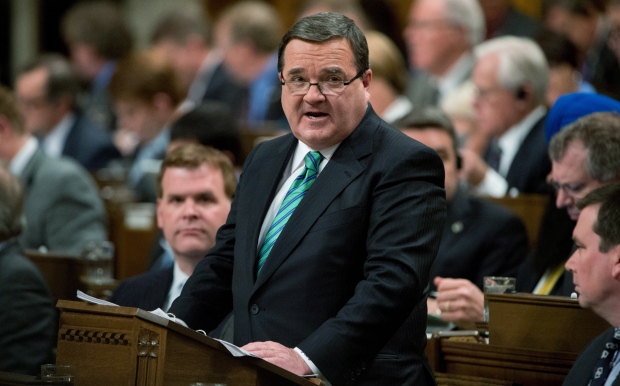
The Commons: Jim Flaherty toasts his fine work

Stopping by the House of Commons on his way to China, Jim Flaherty received the customary ovation afforded a finance minister upon him arriving to deliver the budget. He received another standing ovation when he stood to table the four books that apparently comprised this year’s Action! Plan!

The Conservatives did not stand to applaud again for another 400 words. Until precisely this.