Democracy Gone Astray

Democracy, being a human construct, needs to be thought of as directionality rather than an object. As such, to understand it requires not so much a description of existing structures and/or other related phenomena but a declaration of intentionality.
This blog aims at creating labeled lists of published infringements of such intentionality, of points in time where democracy strays from its intended directionality. In addition to outright infringements, this blog also collects important contemporary information and/or discussions that impact our socio-political landscape.

All the posts here were published in the electronic media – main-stream as well as fringe, and maintain links to the original texts.

[NOTE: Due to changes I haven't caught on time in the blogging software, all of the 'Original Article' links were nullified between September 11, 2012 and December 11, 2012. My apologies.]

Friday, January 27, 2012

'Radical' federal remarks boost fundraising, support for enviro groups

Tough talk from Ottawa about radical environmentalists and foreign-funded adversaries seems to be actually strengthening support for those groups under attack.

Environmental groups involved in the debate over Enbridge Inc.'s Northern Gateway oilsands pipeline to the west coast report that donations have soared in recent weeks — especially after Natural Resources Minister Joe Oliver said U.S.-funded environmentalists and jet-setting celebrities are trying to hijack the regulatory hearings.

"We've seen an unprecedented surge of support," said Emma Gilchrist of the Dogwood Initiative, a B.C.-based group which has received $12,000 in unsolicited donations since Oliver's letter.

"We've got cheques that say, in the memo section, 'Thanks to Joe Oliver.'"

Dogwood also got nearly 25,000 new signatures on its anti-tanker petition — more than it got all of last year. Traffic to its Facebook site increased 10,000 per cent.

"We're quite disappointed to hear the things coming out of the federal government, but it has brought people together," Gilchrist said.

They're not alone.

Gateway panel urged to affirm it’s impartial


As the federal government prepares to make major changes to the way Canada reviews industrial projects, environmentalists are challenging the panel assessing the Northern Gateway pipeline to prove it’s not biased.

Over the past few weeks, federal ministers have carried out a high-profile dispute with environmental groups, some of which have been labelled “radicals.” Prime Minister Stephen Harper has said he is working quickly to bring forward new rules creating more rapid review processes that can’t be “hijacked” by such groups. He has warned about “foreigners” gumming up regulatory processes. The clear inference was to the Gateway review.

Now, Ecojustice, a legal group representing environmental advocates, is questioning whether that political pressure is affecting the ability of the three-person joint federal review panel to properly assess Gateway, a $6.6-billion project that would carry Alberta crude to the West Coast for export to Asia and California.

In a motion filed Friday, Ecojustice asks the panel to determine whether statements from Mr. Harper and Natural Resources Minister Joe Oliver, “constitute an attempt by those ministers to undermine or have had the effect of undermining the panel” in a way that would create “unfairness in the hearing process.”

Ecojustice, which filed the motion on behalf of Living Oceans Society, Rainforest Conservation Foundation and ForestEthics, urges the panel to issue a statement confirming its independence.

No Conviction, No Freedom: Immigration Authorities Locked 13,000 In Limbo

WASHINGTON -- On a single day this past fall, the United States government held 13,185 people in immigration detention who had not been convicted of a crime, some of whom will not be charged with one, according to information The Huffington Post obtained through a Freedom of Information Act request. Instead, at a cost of roughly 2 million taxpayer dollars per day, the men and women were detained while immigration authorities sorted out their fates.

This case stands in stark contrast to the stated goal of immigration policy under the administration of President Barack Obama: to detain and deport unauthorized immigrants who've been convicted of crimes.

"ICE is focused on smart, effective immigration enforcement that prioritizes the removal of convicted criminal aliens, fugitives, recent illegal border crossers and egregious immigration law violators, such as those who have been previously removed from the United States," Immigration and Customs Enforcement spokeswoman Nicole Navas said in a statement. "ICE's enforcement approach is enhancing public safety in communities around the country."

As the GOP presidential contest moves to Florida -- a key primary state and home to 1.5 million Latino voters -- the issue of immigration policy will move to center stage. Former Massachusetts Gov. Mitt Romney has positioned himself to appear as the candidate who is toughest on immigration, arguing that any of the roughly 11 million undocumented immigrants here without documentation should be removed regardless of circumstances -- a policy that would jam already overcrowded detention centers. Former House Speaker Newt Gingrich, meanwhile, has argued that law-abiding people with deep ties to their community and a long tenure in the United States should be given the opportunity to stay.

The End of Privacy

A few days ago Google announced a new privacy policy: If you're signed into any Google service, the information that Google collects from you can be combined with information from every other Google service to build a gigantic profile of your activities and preferences. On Tuesday I wrote that I was pretty unhappy about this, and a lot of people wanted to know why. After all, Google says this new policy will mean a better computing experience for everyone:
Our recently launched personal search feature is a good example of the cool things Google can do when we combine information across products. Our search box now gives you great answers not just from the web, but your personal stuff too…But there's so much more that Google can do to help you by sharing more of your information with…well, you. We can make search better—figuring out what you really mean when you type in Apple, Jaguar or Pink. We can provide more relevant ads too. For example, it's January, but maybe you're not a gym person, so fitness ads aren't that useful to you. We can provide reminders that you're going to be late for a meeting based on your location, your calendar and an understanding of what the traffic is like that day.
So what's my problem? Easy. In that mass of good news, the real reason for Google's announcement was stuffed quietly into the middle: "We can provide more relevant ads too."

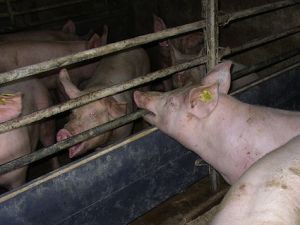
Supermarket Meat Comes From Sick Animals

At Maverick Farms, we keep a flock of chickens for eggs. It seems axiomatic to me that the happier and healthier the birds are, the better the eggs will be. So if a salesperson showed up pitching a product that would, say, boost egg production by 5 percent, while making our birds sick, but just healthy enough to keep laying, I'd send him packing. Who wants to eat eggs from a sick chicken? And why would I intentionally harm the animals who provide my eggs?

The US meat industry has different ideas. Its main goals are to maximize production while minimizing costs. Animal health matters only to the extent that the animals need to be well enough to scuttle down the slaughter line (or produce eggs, in the case of hens). Thus the industry routinely feeds livestock stuff that makes them sick.

Reporting for the newly hatched Food and Environment Reporting Network, the excellent food-safety reporter Helena Bottemiller exposes one major example: the widespread use on factory-scale hog farms of ractopamine, a drug that boosts meat production but makes hogs miserable. The drug—fed to 60 to 80 percent of pigs, Bottemiller reports—"mimics stress hormones, making the heart beat faster and relaxing blood vessels." Its effects are pretty dire:
Since it was introduced [13 years ago], ractopamine had sickened or killed more than 218,000 pigs as of March 2011, more than any other animal drug on the market, a review of FDA veterinary records shows. Pigs suffered from hyperactivity, trembling, broken limbs, inability to walk and death, according to FDA reports released under a Freedom of Information Act request.

Inside Apple's Hidden Factories. Finally.

Almost everyone I know owns something made by Apple, and while most of us spend a fair bit of time obsessing about our gadgets—which apps are worth paying for? Is Siri useful or annoying?—rarely do we talk about where they came from. In part, that's because Apple wants it that way: The company is famously tight-lipped about its manufacturing process, and few outsiders have ever made it into their factories.

But now, Apple's tough facade has finally begun to crack: Recent coverage (more on this below) has provided a glimpse into Apple's vast supply chain and the massive profits it produces—more than $400,000 for every employee, according to a New York Times investigation. Here at Mother Jones, we've got a somewhat related investigation in the pipeline—come back in a few weeks for the details. Meanwhile, my colleague Dave Gilson made this handy tool.

This week, the New York Times has launched a series called "The iEconomy," and the first piece in the series focused on Apple's massive outsourcing of jobs to China. No task is too big, no deadline too tight:
One former executive described how the company relied upon a Chinese factory to revamp iPhone manufacturing just weeks before the device was due on shelves. Apple had redesigned the iPhone's screen at the last minute, forcing an assembly line overhaul. New screens began arriving at the plant near midnight.
A foreman immediately roused 8,000 workers inside the company's dormitories, according to the executive. Each employee was given a biscuit and a cup of tea, guided to a workstation and within half an hour started a 12-hour shift fitting glass screens into beveled frames. Within 96 hours, the plant was producing over 10,000 iPhones a day.

Rogers Misleading Advertising Case: Truth-In-Advertising Laws Violate Our Rights, Telecom Giant Says

Telecom giant Rogers is arguing before an Ontario court that truth-in-advertising rules are a violation of its right to freedom of expression, according to a news report.

Postmedia’s Sarah Schmidt reports that Rogers is challenging a $10-million fine levied on it for misleading advertising by the federal Competition Bureau by arguing that being forced to test its products before making claims about them is a violation of freedom of expression under the Charter of Rights and Freedoms.

The case involves Rogers’ Chatr wireless brand, which the Competition Bureau found last November had engaged in “misleading advertising” with its claims that Chatr users experience "fewer dropped calls than new wireless carriers" and have "no worries about dropped calls".

After reviewing technical data, the bureau concluded that “there is no discernible difference in dropped call rates between Rogers/Chatr and new entrants.”

According to Rogers' submission to the Superior Court of Ontario, the testing rule "prohibits and penalizes entirely truthful claims, including claims made on a reasonably held belief that such claims are entirely accurate and claims that are proven to be entirely accurate through post-claim testing. Not only are these types of claims entirely harmless, but they play an important role in consumer choice and may have a significant positive impact on prices and product innovation.”

Labour And Globalization: As Conflicts Go International, Unions Follow Suit

On any battleground, common wisdom has long held that defeating an adversary often owes a great deal to one’s ability to think like the enemy.

So it comes as little surprise that as transnational corporations use their global reach to cut costs -- and workers’ pay -- the labour movement has begun to take a similar tack. From picket lines to backroom discussions, big labour is banding together across sectoral, national and international borders in an attempt to capitalize on the very forces that for years have been employed against them.

As Sid Ryan, president of the Ontario Federation of Labour, explains, “There’s only one way we can fight globalization, and that’s to reach out to unions around the globe.”

It’s a strategy that’s being implemented on many fronts in an effort union leaders describe as labour’s best -- and only -- chance for survival.

This week in Washington, D.C., Public Services International, an umbrella organization representing 20 million workers from nearly 150 countries, is holding a meeting of North American public sector unions -- which Canadian Union of Public Employees national president Paul Moist says is the first of its kind in more than 30 years.

Clement signals tough stance with public service unions

Treasury Board President Tony Clement served notice Thursday that he won’t allow federal public service unions to get in the way of the government carrying out its multibillion-dollar deficit reduction action plan.

Speaking to the Empire Club in Toronto, Clement accused public service unions of collaborating with the NDP to frustrate the government’s plans.

“Sustainable services by a right-sized public service should be uncontroversial goals,” Clement said. “Unfortunately, public sector union bosses, working hand-in-glove with the NDP opposition, only want to perpetuate the status quo. Their only solutions seem to be: hire more, tax more, spend more.”

“Ladies and gentlemen: this is both irresponsible and unsustainable. This stand pat approach by the unions and the NDP will actually translate into mediocre public services, at high cost, to a frustrated public.”

Clement vowed not to give in.

An alternative budget: Economists warn against austerity

The Harper government should avoid fiscal austerity while the Bank of Canada keeps monetary policy loose, a group of economists warned on Thursday.

“If you follow austerity measures — yes, your fiscal deficit will go down, but so will growth,” Stephany Griffith-Jones, program director at Columbia University’s Institute for Policy Dialogue, told a group that included many NDP MPs on Parliament Hill Thursday.

“Because the debt-to-GDP indicator is accounted not just by the amount of debt, but also by the level of GDP, you can have debt to GDP actually increase,” Griffith-Jones said.

Griffith-Jones was one of many economists invited to weigh in at the Canadian Centre for Policy Alternatives’ Alternative Federal Budget Roundtable 2012.

The full-day event, which was sponsored by NDP finance critic Peter Julian, also attracted other NDP MPs including Guy Caron, Raymond Côté and Wayne Marston, all of whom were repeatedly told the government should never have stopped its fiscal stimulus.

“We have to question some of the conventional wisdom on fiscal affairs, even though everyone is concerned about budgets, deficits and debt,” Canadian Auto Workers economist Jim Stanford argued.