Democracy Gone Astray

Democracy, being a human construct, needs to be thought of as directionality rather than an object. As such, to understand it requires not so much a description of existing structures and/or other related phenomena but a declaration of intentionality.
This blog aims at creating labeled lists of published infringements of such intentionality, of points in time where democracy strays from its intended directionality. In addition to outright infringements, this blog also collects important contemporary information and/or discussions that impact our socio-political landscape.

All the posts here were published in the electronic media – main-stream as well as fringe, and maintain links to the original texts.

[NOTE: Due to changes I haven't caught on time in the blogging software, all of the 'Original Article' links were nullified between September 11, 2012 and December 11, 2012. My apologies.]

Showing posts with label Amazon. Show all posts

Saturday, September 23, 2023

"Control, humiliation, and unabating anxiety": Amazon's labor conditions under fire in new report

A new research paper accuses Amazon of spying on its employees in order to thwart potential unionization efforts — a characterization that aligns with the corporation's recently-posted job opening for a pair of intelligence analysts to monitor "labor organizing threats" among its employees.

The research paper, which was written by an anti-monopolist research and advocacy group called the Open Markets Institute, found that Amazon uses analytics to try to catch workers before they can unionize. As one example, Open Markets describes how the company uses demographic and socioeconomic data points to figure out which Whole Foods stores (which the company owns) are at risk of unionizing, something that had been alluded to in previous reports. Open Markets writes that Amazon does so by studying data which includes the number of families below the poverty line and how diverse the staff is. It also claims that Amazon has created a "heat map" so that management can better assess who might unionize and uses security cameras to spread out workers who are potentially discussing unionizing activity.
Monday, August 06, 2018

How Amazon Is Holding Seattle Hostage

SEATTLE ― The 9:30 a.m. meeting of the Seattle City Council’s Finance and Neighborhoods Committee ― the most boring name imaginable ― was overflowing. People in the crowd held up signs: “Don’t vote our jobs away” or “Tax the rich.”

The committee was taking public comment on the proposed Progressive Tax on Business, a fee on Seattle’s largest corporations to support homeless services. Last week, Amazon — the employer of more than 45,000 Seattleites that is on the hook for an estimated $20 million under the tax — announced it was pausing construction planning on a tower downtown and would consider renting some of its office space to other companies if the fee goes through.

Tuesday, December 27, 2016

What Happens to a Town When Amazon Moves In?

A few years ago, the greatest menace to the mom-and-pop shop was the Big Box store—“Walmartization”—cannibalizing Main Street’s small businesses and pauperizing workers. But the Big Box has lately started to crumple under a blast of digital trade winds, and the Amazon Empire could prove far more disruptive to labor and communities.

According to a study of Amazon’s community impact by the Institute for Local Self Reliance (ILSR) the mega-retailer has transformed shopping into an increasingly dehumanized process, while consolidating the labor infrastructure into a giant network of low-wage logistical chains where workers’ economic security shrinks and community-based businesses wither.

Thursday, December 08, 2016

Amazon Says It Puts Customers First. But Its Pricing Algorithm Doesn’t

One day recently, we visited Amazon’s website in search of the best deal on Loctite super glue, the essential home repair tool for fixing everything from broken eyeglass frames to shattered ceramics.

In an instant, Amazon’s software sifted through dozens of combinations of price and shipping, some of which were cheaper than what one might find at a local store. TheHardwareCity.com, an online retailer from Farmers Branch, Texas, with a 95 percent customer satisfaction rating, was selling Loctite for $6.75 with free shipping. Fat Boy Tools of Massillon, Ohio, a competitor with a similar customer rating was nearly as cheap: $7.27 with free shipping.

Monday, March 28, 2016

Obviously Men Make More Money Than Women At Amazon

When the most senior, well-paid people at your company are almost exclusively male, is it really accurate to say your business pays men and women about the same amounts?

The question comes up now because Amazon, under pressure from activist shareholders, said Wednesday there’s almost no gender pay gap at the company. Women at Amazon make 99.9 cents for every dollar that men earn in the same jobs, and minorities earn 100.1 cents for every dollar that white employees earn. The company, which employs more than 200,000 full-time workers, said it considered salary and stock.

Friday, October 30, 2015

Amazon Prime Now Drivers Claim They Were Paid Below Minimum Wage

Well, that didn't take long.

It was just a few weeks ago that Amazon launched its Amazon Prime Now service in Los Angeles and several other metropolitan areas, promising customers one- and two-hour delivery for tens of thousands of products.

On Tuesday, four former Amazon Prime Now drivers in Southern California sued the online retail behemoth, claiming the labor model behind the service is a sham. The drivers had made deliveries for roughly a month before they filed their complaint, which alleges violations of minimum wage and overtime pay laws.

Saturday, October 24, 2015

The Life and Death of an Amazon Warehouse Temp

On Jan. 18, 2013, as the sun went down, Jeff Lockhart Jr. got ready for work. He slipped a T-shirt over his burly frame and hung his white work badge over his broad chest. His wife, Di-Key, was in the bathroom fixing her hair in micro-braids and preparing for another evening alone with her three sons. Jeff had been putting in long hours lately, and so the couple planned a breakfast date at Shoney’s for when his shift ended around dawn. “You better have your hair done by then,” he teased her.

Amazon Still Pretty Angry About That New York Times Story

Two months after the New York Times published a damning investigation into its workplace culture, Amazon is fighting back.

In a blog post on Medium published Monday morning, Amazon spokesperson Jay Carney claims that the Times' reporters Jodi Kantor and David Streitfeld failed to check the accuracy of the anecdotes in the piece.

Monday, October 05, 2015

Amazon Lashes Out At Competitors, Banning Apple TV And Chromecast

The war for your attention just became a bit more divided.

Bloomberg reported Thursday that Amazon's online store will stop selling Apple TV and Google Chromecast devices.

Why would Amazon do this? Simple: Google and Apple don't offer Amazon's video product on their devices, so Amazon's not offering those devices on its store.

Sunday, September 13, 2015

Lawyers Have Worked in Amazon-Style Conditions For Decades

Over the last several weeks, many have learned of the workplace experiences of white collar workers at Amazon. How they cry at their desks. How they are given little time off even when sick, or to recover from a health issue. That workers are expected to respond to e-mails they receive late into the night. Add to that the conditions of blue collar workers at Amazon warehouses, and one gets the distinct impression that Amazon may be a pretty bad place to work.

Friday, September 04, 2015

Amazon's Environmental Record May Be As Bad As Its Work Culture

Amazon's quasi-dystopian workplace culture is far from its only moral failure in a corporate world that increasingly expects big companies to do the right thing.

Its environmental record is badly smudged.

Unlike some of its biggest rivals, the e-commerce giant refuses to release information about energy consumption at its data centers. Only last November did it start using renewable energy to power some of these electricity-guzzling facilities. In addition, the company offers to recycle customers' old devices, but the program is far from comprehensive.

Saturday, August 29, 2015

Is the Workplace Culture at Amazon Progressive or Destructive?

I've been reading some pretty horrifying posts this week about Amazon's business culture. There was the front page New York Times article, written by Jodi Kantor and David Streitfeld, a fascinating op-ed piece in the Times by Joe Nocera, and many compelling letters to the editor, responding to the original article.

Kantor and Streitfeld describe a work environment at Amazon that's exceedingly demanding, unforgiving, and adversarial. While some workers are rewarded for doing well, they're constantly made to compete with one-other for these rewards.

Amazon Offers Free Delivery of Workplace Hell

A lengthy exposĂ© by The New York Times about Amazon’s work environment recently revealed the depths to which American workplace culture has plummeted, particularly for white-collar workers. Journalists Jodi Kantor and David Streitfeld interviewed more than 100 current and former Amazon employees and concluded, “The company is conducting an experiment in how far it can push white-collar workers to get them to achieve its ever-expanding ambitions.”

Thursday, August 27, 2015

The Amazon Economy

A recent New York Times piece describes Amazon.com as Lord of the Flies for engineers and managers. Relentless culling, hyper-critical supervision, and channels for informing on allegedly slacking co-workers create an artificial State of Nature, where many employees careers are brutish and short. The article tells the stories of workers placed under special scrutiny upon returning from cancer treatment and stillbirths, and quotes a chain of forty-year-olds fearful of being replace by thirty-year-olds, twenty-five-year-olds afraid of being replaced by college students, and so forth. In the world the reporters portray, wanting work-life balance, or just a rest, is an aberration that gets punished as soon as it is discovered.

Inside Amazon: Wrestling Big Ideas in a Bruising Workplace

SEATTLE — On Monday mornings, fresh recruits line up for an orientation intended to catapult them into Amazon’s singular way of working.

They are told to forget the “poor habits” they learned at previous jobs, one employee recalled. When they “hit the wall” from the unrelenting pace, there is only one solution: “Climb the wall,” others reported. To be the best Amazonians they can be, they should be guided by the leadership principles, 14 rules inscribed on handy laminated cards. When quizzed days later, those with perfect scores earn a virtual award proclaiming, “I’m Peculiar” — the company’s proud phrase for overturning workplace conventions.

Monday, March 30, 2015

Amazon makes even temporary warehouse workers sign 18-month non-competes

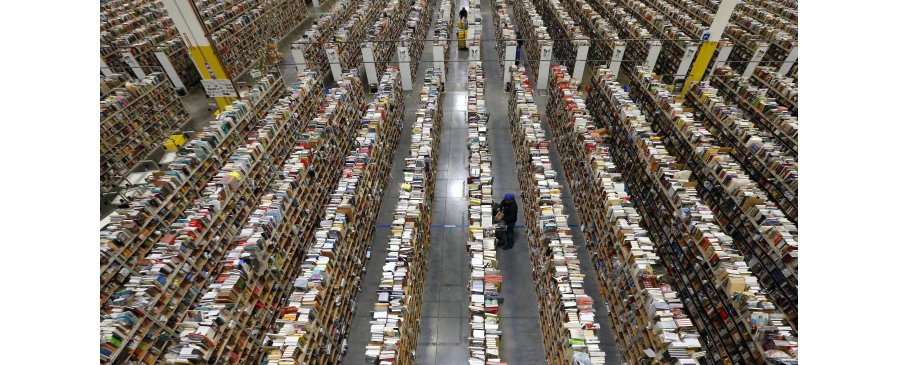
Amazon is the country’s largest and most sophisticated online retailer, but it still runs largely on manual labor. Scattered around the country are massive warehouses staffed by workers who spend their days picking objects off shelves and putting them in boxes. During the holiday season, the company calls on a huge reserve army of temporary laborers.

The work is repetitive and physically demanding and can pay several dollars above minimum wage, yet Amazon is requiring these workers — even seasonal ones — to sign strict and far-reaching noncompete agreements. The Amazon contract, obtained by The Verge, requires employees to promise that they will not work at any company where they "directly or indirectly" support any good or service that competes with those they helped support at Amazon, for a year and a half after their brief stints at Amazon end. Of course, the company’s warehouses are the beating heart of Amazon’s online shopping empire, the extraordinary breadth of which has earned it the title of "the Everything Store," so Amazon appears to be requiring temp workers to foreswear a sizable portion of the global economy in exchange for a several-months-long hourly warehouse gig.

Monday, October 20, 2014

Amazon’s Monopsony Is Not O.K.

`
Amazon.com, the giant online retailer, has too much power, and it uses that power in ways that hurt America.

O.K., I know that was kind of abrupt. But I wanted to get the central point out there right away, because discussions of Amazon tend, all too often, to get lost in side issues.

For example, critics of the company sometimes portray it as a monster about to take over the whole economy. Such claims are over the top — Amazon doesn’t dominate overall online sales, let alone retailing as a whole, and probably never will. But so what? Amazon is still playing a troubling role.

Saturday, October 11, 2014

Amazon Must Be Stopped

Before we speak ill of Amazon, let us kneel down before it. Twenty years ago, the company began with the stated goal of creating a bookstore as comprehensive as the great Library of Alexandria, and then quickly managed to make even that grandiloquent ambition look puny. Amazon could soon conjure the full text of almost any volume onto a phone in less time than a yawn. Its warehouses are filled with an unabridged catalogue of items that comes damn close to serving every human need, both basic and esoteric—a mere click away, speedily delivered, and as cheap as capitalism permits.

Thursday, October 09, 2014

Amazon Warehouse Workers Head To Supreme Court Over Unpaid Theft Screenings

WASHINGTON -- Anyone who's ever worked filling orders in an Amazon warehouse knows the drill: Once your shift is over, you must stand in line and wait to be screened for stolen goods before you can leave. The process can take 20 minutes or more depending on how busy the warehouse is, and you don't get paid a dime for the wait, according to numerous lawsuits.

Workers across the country have sued to be paid for that time, and now they'll have their day at the Supreme Court, where oral arguments in Integrity Staffing Solutions v. Busk are expected to begin this Wednesday. Integrity, the temp firm that helps staff Amazon's warehouses, is arguing that the screenings aren't "integral and indispensable" to the work, and that therefore it shouldn't have to pay workers for the time.

Friday, October 03, 2014

The Return of the Corporate Court

Jesse Busk has almost no chance of winning his lawsuit when it comes before the Supreme Court for oral argument Wednesday during the opening week of the new 2014-15 term. His dismal prospects stem not from any legal weaknesses in his case but from one overriding fatal flaw—he’s an ordinary working person challenging the prerogatives of corporate power. Cases like his seldom succeed before the panel led by Chief Justice John Roberts, rated by many observers and scholars as the most pro-business iteration of the high tribunal since the early 1930s.