Democracy Gone Astray

Democracy, being a human construct, needs to be thought of as directionality rather than an object. As such, to understand it requires not so much a description of existing structures and/or other related phenomena but a declaration of intentionality.
This blog aims at creating labeled lists of published infringements of such intentionality, of points in time where democracy strays from its intended directionality. In addition to outright infringements, this blog also collects important contemporary information and/or discussions that impact our socio-political landscape.

All the posts here were published in the electronic media – main-stream as well as fringe, and maintain links to the original texts.

[NOTE: Due to changes I haven't caught on time in the blogging software, all of the 'Original Article' links were nullified between September 11, 2012 and December 11, 2012. My apologies.]

Showing posts with label Paul Krugman. Show all posts

Tuesday, April 19, 2016

Elizabeth Warren Has Basically Had It With Paul Krugman’s Big Bank Nonsense

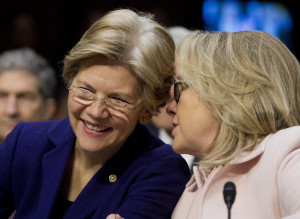
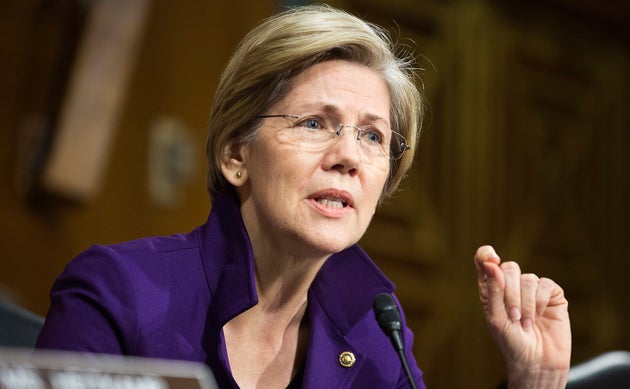
WASHINGTON — Sen. Elizabeth Warren (D-Mass.) appeared to offer a thinly veiled rebuke of liberal economist Paul Krugman on Wednesday by highlighting a “scary” too-big-to-fail ruling from federal bank regulators.

The Federal Reserve and the FDIC said Wednesday that five of the biggest banks in the country cannot credibly be unwound safely without bailout money from taxpayers.

Thursday, April 14, 2016

Who Has Two Thumbs And Is Wrong About The Financial Crisis?

Somebody is wrong on the Internet, and his name is Paul Krugman.

It is hard for liberal America when Krugman is wrong, because he is liberal America’s best — and most important — economic columnist.

In a column on Friday devoted to hitting Bernie Sanders for a long list of transgressions, Krugman said the financial “crisis itself was centered not on big banks but on ‘shadow banks’ like Lehman Brothers that weren’t necessarily that big.”

Tuesday, June 30, 2015

Paul Krugman Urges Greeks To Vote 'No' On Bailout Referendum

Paul Krugman is urging Greeks to vote “no” in a referendum that could determine their country’s future in the European Union.

In a New York Times blog post published Sunday evening, the Nobel Prize-winning economist argued that the July 5 referendum would simply preserve the same dysfunctional austerity regime that has left Greece languishing for five years.

Thursday, March 19, 2015

Israel’s Gilded Age

Why did Prime Minister Benjamin Netanyahu of Israel feel the need to wag the dog in Washington? For that was, of course, what he was doing in his anti-Iran speech to Congress. If you’re seriously trying to affect American foreign policy, you don’t insult the president and so obviously align yourself with his political opposition. No, the real purpose of that speech was to distract the Israeli electorate with saber-rattling bombast, to shift its attention away from the economic discontent that, polls suggest, may well boot Mr. Netanyahu from office in Tuesday’s election.

But wait: Why are Israelis discontented? After all, Israel’s economy has performed well by the usual measures. It weathered the financial crisis with minimal damage. Over the longer term, it has grown more rapidly than most other advanced economies, and has developed into a high-technology powerhouse. What is there to complain about?

Monday, February 16, 2015

Weimar on the Aegean

Try to talk about the policies we need in a depressed world economy, and someone is sure to counter with the specter of Weimar Germany, supposedly an object lesson in the dangers of budget deficits and monetary expansion. But the history of Germany after World War I is almost always cited in a curiously selective way. We hear endlessly about the hyperinflation of 1923, when people carted around wheelbarrows full of cash, but we never hear about the much more relevant deflation of the early 1930s, as the government of Chancellor Brüning — having learned the wrong lessons — tried to defend Germany’s peg to gold with tight money and harsh austerity.

Tuesday, November 11, 2014

In Defense of Obama

When it comes to Barack Obama, I've always been out of sync. Back in 2008, when many liberals were wildly enthusiastic about his candidacy and his press was strongly favorable, I was skeptical. I worried that he was naive, that his talk about transcending the political divide was a dangerous illusion given the unyielding extremism of the modern American right. Furthermore, it seemed clear to me that, far from being the transformational figure his supporters imagined, he was rather conventional-minded: Even before taking office, he showed signs of paying far too much attention to what some of us would later take to calling Very Serious People, people who regarded cutting budget deficits and a willingness to slash Social Security as the very essence of political virtue.

And I wasn't wrong. Obama was indeed naive: He faced scorched-earth Republican opposition from Day One, and it took him years to start dealing with that opposition realistically. Furthermore, he came perilously close to doing terrible things to the U.S. safety net in pursuit of a budget Grand Bargain; we were saved from significant cuts to Social Security and a rise in the Medicare age only by Republican greed, the GOP's unwillingness to make even token concessions.

Friday, October 24, 2014

Paul Krugman: How About A Clinton-Warren Ticket Instead Of A Matchup?

Nobel Prize-winning New York Times columnist Paul Krugman has an interesting vision of the 2016 Democratic presidential ticket: Hillary Clinton for president and Sen. Elizabeth Warren “looking over her shoulder so she doesn't stray too far."
Speaking on HuffPost Live Wednesday about Clinton’s domestic policy, Krugman said, “When she talks now, she sounds substantially to the left of the old Hillary Clinton.”
“If she becomes president and then turns ... [and] runs back to the right, that’s going to be a problem. ... I guess part of one's hope, if she becomes president, [is that] she will in fact feel some need to avoid alienating the Democratic wing of the Democratic Party, which is for all practical purposes led by Elizabeth Warren right now,” Krugman said.
As for a presidential bid from the Democratic senator from Massachusetts, he said it “would be an interesting thing” but predicted it would be unsuccessful.
Warren has pushed back on rumors that she might go for the White House, telling ABC’s David Muir in April that she's "not running for president" but thinks "Hillary Clinton is terrific."
Watch the full interview here.
Original Article
Source: huffingtonpost.com/
Author: The Huffington Post | By Amber Ferguson

Monday, October 20, 2014

Amazon’s Monopsony Is Not O.K.

`
Amazon.com, the giant online retailer, has too much power, and it uses that power in ways that hurt America.

O.K., I know that was kind of abrupt. But I wanted to get the central point out there right away, because discussions of Amazon tend, all too often, to get lost in side issues.

For example, critics of the company sometimes portray it as a monster about to take over the whole economy. Such claims are over the top — Amazon doesn’t dominate overall online sales, let alone retailing as a whole, and probably never will. But so what? Amazon is still playing a troubling role.

Tuesday, May 13, 2014

Paul Krugman: American inequality isn’t about education or opportunity — it’s about oligarchs!

Institutional Investor’s latest survey of the 25 highest-paid hedge fund managers is out, and — if you can believe it — the 25 men who made the “rich list” are very, very, very rich.

These men (they are all men, natch) made a combined $21 billion in 2013. And while it’s tempting to dismiss a report on an assorted crew of hedge funders as just another of many generic and demoralizing reminders about the of the obscene wealth of the .01 percent, New York Times columnist Paul Krugman points out in his Friday column that the “good fortunes” of these rich dudes actually expose a lot of the lies we’re told about income inequality in America:

Wednesday, January 29, 2014

Enemies of the Poor

Suddenly it’s O.K., even mandatory, for politicians with national ambitions to talk about helping the poor. This is easy for Democrats, who can go back to being the party of F.D.R. and L.B.J. It’s much more difficult for Republicans, who are having a hard time shaking their reputation for reverse Robin-Hoodism, for being the party that takes from the poor and gives to the rich.

And the reason that reputation is so hard to shake is that it’s justified. It’s not much of an exaggeration to say that right now Republicans are doing all they can to hurt the poor, and they would have inflicted vast additional harm if they had won the 2012 election. Moreover, G.O.P. harshness toward the less fortunate isn’t just a matter of spite (although that’s part of it); it’s deeply rooted in the party’s ideology, which is why recent speeches by leading Republicans declaring that they do too care about the poor have been almost completely devoid of policy specifics.

Krugman Nails WSJ Pulitzer Winner For Misleading Inequality Claim

Breaking news: The Wall Street Journal editorial page is full of it.

OK, that's not really news. But an unusually flagrant example of the WSJ editorial page's hogwash artistry caught the world's eye on Thursday, when New York Times columnist Paul Krugman pointed out several big problems with a column published this week by the WSJ's Bret Stephens. Krugman cited an earlier blog post from economist Miles Kimball, who first noted what he called the WSJs "analytical errors."

Monday, June 24, 2013

Paul Krugman: Greg Mankiw Forgets 'We Are A Much More Unequal Society Now'

Paul Krugman thinks Harvard economist Greg Mankiw forgot an important detail in his new paper, "Defending The One Percent": Social inequality just keeps growing.

The Nobel Prize-winning economist and New York Times columnist wrote in blog posts Saturday and Sunday that rising social inequality makes it less likely for children born into poor families to earn more money later in life. Krugman illustrates this point with a chart from Miles Corak, an economics professor at the University of Ottawa, that shows a widening gap between how much money the rich and poor spend on their children.

Saturday, June 22, 2013

Paul Krugman's Comments About Canada Have Bank Economists Seeing Red

Pulitzer Prize-winning economist Paul Krugman’s New York Times blog post forecasting a possible “deleveraging shock” to Canada’s economy has some Canadian bank economists visibly unhappy.

Krugman said last week that Canada “ought to be quite vulnerable to a big deleveraging shock despite its boring banks.” (“Boring” is a compliment in Krugman’s vocabulary, and “deleveraging shock” means stagnant retail sales and falling house prices as Canadians reduce their debt.)

Monday, June 17, 2013

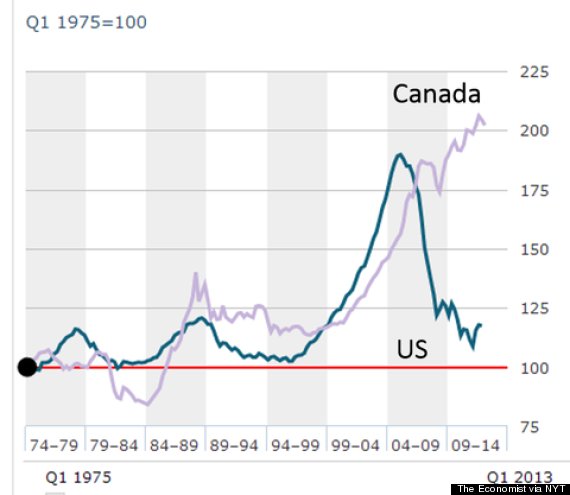
Paul Krugman: Canadian Economy Vulnerable To 'Shock' Due To Debt Levels, House Prices

Renowned economist Paul Krugman is worried about Canada’s economy.

The Nobel Prize winner and New York Times columnist wrote in a blog post Saturday that Canada “ought to be quite vulnerable to a big deleveraging shock despite its boring banks.”

By “ought,” he means he’s not quite sure. But he sees warning signs in the fact that a very large spread has developed between U.S. and Canadian house prices, and Canadian household debt levels are reaching levels seen in the U.S. just before that country’s own “deleveraging shock.”

Monday, June 10, 2013

The Big Shrug

I’ve been in this economics business for a while. In fact, I’ve been in it so long I still remember what people considered normal in those long-ago days before the financial crisis. Normal, back then, meant an economy adding a million or more jobs each year, enough to keep up with the growth in the working-age population. Normal meant an unemployment rate not much above 5 percent, except for brief recessions. And while there was always some unemployment, normal meant very few people out of work for extended periods.

Tuesday, May 28, 2013

The Obamacare Shock

The Affordable Care Act, a k a Obamacare, goes fully into effect at the beginning of next year, and predictions of disaster are being heard far and wide. There will be an administrative “train wreck,” we’re told; consumers will face a terrible shock. Republicans, one hears, are already counting on the law’s troubles to give them a big electoral advantage.

No doubt there will be problems, as there are with any large new government initiative, and in this case, we have the added complication that many Republican governors and legislators are doing all they can to sabotage reform. Yet important new evidence — especially from California, the law’s most important test case — suggests that the real Obamacare shock will be one of unexpected success.
Friday, May 24, 2013

Japan the Model

A generation ago, Japan was widely admired — and feared — as an economic paragon. Business best sellers put samurai warriors on their covers, promising to teach you the secrets of Japanese management; thrillers by the likes of Michael Crichton portrayed Japanese corporations as unstoppable juggernauts rapidly consolidating their domination of world markets.

Then Japan fell into a seemingly endless slump, and most of the world lost interest. The main exceptions were a relative handful of economists, a group that happened to include Ben Bernanke, now the chairman of the Federal Reserve, and yours truly. These Japan-obsessed economists viewed the island nation’s economic troubles, not as a demonstration of Japanese incompetence, but as an omen for all of us. If one big, wealthy, politically stable country could stumble so badly, they wondered, couldn’t much the same thing happen to other such countries?

Sunday, May 19, 2013

Paul Krugman: Today's Austerity Policies Based On 'A Mythical 70s That Never Was'

They say hindsight is 20/20, but according to Paul Krugman it may actually be much worse than that when it comes to economic policy-making.

The Nobel-Prize winning economist and New York Times columnist wrote in a blog post Sunday that current policymakers are basing their decisions to cut spending, leading in many cases to high unemployment, on the false notion that the recession of the late 1970s and early 1980s was caused by too much government debt and too many government handouts.

Monday, May 06, 2013

Paul Krugman's call to arms against austerity

Paul Krugman has just passed the landmark 1 million followers on Twitter. Not bad for an academic economist, albeit one with a Nobel prize under his arm, a prominent position at Princeton University, and a New York Times blog.

His following is a reward for battling the conventional wisdom that austerity can foster a recovery. From the moment Lehman Brothers was allowed to crash, it seemed that only Krugman, his compatriot Joseph Stiglitz, another Nobel prizewinner for the liberal cause, and New York professor Nouriel Roubini, who had loudly predicted the crash, consistently confronted the "austerians" in Washington, Brussels and the UK Treasury.

Tuesday, April 16, 2013

Pop, Charts: On Paul Krugman

Pop culture, née mass culture, once possessed a dual meaning: the shared experience of mass-produced cultural commodities, and persisting folk traditions. These senses pitted mass culture as a populist bulwark against both high culture's gleaming exclusions and the alienations of industrial development.

This chain of meaning swiftly contradicts itself: one can scarcely celebrate mass production while denouncing the assembly line. Riven by such inconsistencies, pop culture has forfeited its birthrights, structuring antagonisms long since collapsed. Today every artwork belongs to the market, while the market appears as a kind of mass spectacle. In the sharpest formulation on offer, culture has become economic and the economic has itself become cultural.