Democracy Gone Astray

Democracy, being a human construct, needs to be thought of as directionality rather than an object. As such, to understand it requires not so much a description of existing structures and/or other related phenomena but a declaration of intentionality.
This blog aims at creating labeled lists of published infringements of such intentionality, of points in time where democracy strays from its intended directionality. In addition to outright infringements, this blog also collects important contemporary information and/or discussions that impact our socio-political landscape.

All the posts here were published in the electronic media – main-stream as well as fringe, and maintain links to the original texts.

[NOTE: Due to changes I haven't caught on time in the blogging software, all of the 'Original Article' links were nullified between September 11, 2012 and December 11, 2012. My apologies.]

Showing posts with label Border. Show all posts

Sunday, September 27, 2015

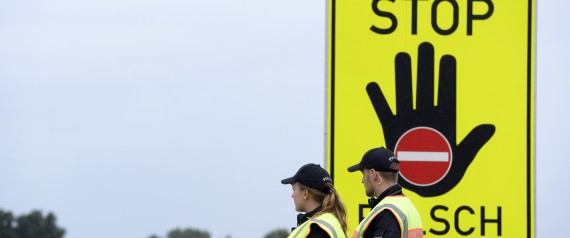
Why Greece Shut The Shortest, Safest Route For Migrants And Refugees

ATHENS, Greece -- As thousands of refugees arrived on Greece's shores this summer on their way to western Europe, and the harrowing images of young children who drowned in the Eastern Aegean Sea made headlines around the world, attention is shifting to Greece's land borders.

The record numbers of migrants and refugees arriving in Greece from Turkey by boat -- more than 2,500 on Wednesday alone -- are a recent phenomenon. Not so long ago, the shortest, and safest, route was the 125 mile land border that runs along the Evros river in northern Greece.

Tuesday, September 15, 2015

Refugees confounded by Merkel’s decision to close German borders

Angela Merkel, Germany’s chancellor, has cut a chequered figure this summer: scorned for taking Greece to the wall, and praised for welcoming large numbers of Syrians to Germany. But nowhere and at no time has she been more of an enigma than she was in Vienna’s central station on Monday where crowds of refugees struggled to reconcile how the same “Mama Merkel” had opened Germany’s borders one week, and closed them again barely eight days later – leaving those at the station stranded.

Closing the Border Is Voodoo Politics, and It Will Lead to Catastrophe

Imagine you had sold your house and valuable belongings to pay a dubious smuggler, whom you didn't even know personally. And now imagine you had risked your own life and that of your loved ones to cross the Mediterranean in the middle of the darkest night.

You would have defended yourself against brutal border patrol officers in Macedonia, endured the bleakness of Belgrade train station and had even escaped the deliberately induced misery in Budapest.

Sunday, September 13, 2015

Germany Closes Its Border With Austria, Hoping to Stop the Refugee Flow

Two weeks ago I wrote about what might happen if Germany decided to start policing its borders again in response to the huge numbers of refugees and migrants entering the country. Now we're going to find out.

The German government has announced that the country is closing its border with Austria and also suspending train traffic its southern neighbor, the route by which tens of thousands of refugees have entered Germany in recent days. Those borders have been open for nearly 20 years under the Schengen Agreement, which turned most of the European Union into one large free-travel zone with no internal border checks. Until now, you could go from Berlin to Amsterdam or Paris much like you were going from New York to DC. Along with the euro, the Schengen zone is considered one of the EU's most important achievements, a powerful symbol of European unity as a well as a major booster of trade and tourism. All of that now hangs in the balance as the refugee crisis strains internal EU politics.

Friday, November 14, 2014

The Most Heartbreaking Place In America Is Called ‘Friendship Park’

SAN DIEGO, CALIFORNIA — When former First Lady Pat Nixon traveled to the U.S.-Mexico border in 1971 to inaugurate what is now Friendship Park just south of San Diego, California, she observed the then-thin string of barbed wire separating the two countries and reportedly said, “I hate to see a fence anywhere.” The implication, people thought, was that neither nation would ever build one.

Saturday, June 23, 2012

Border Agency Policy Spells Out Surveillance Rules

The Canada Border Service Agency is reluctant to explain the extent to which it monitors passengers across the country, but internal documents obtained by CBC News make it clear that overt audio-video surveillance occurs at "all CBSA offices."

The explanation is contained in a 15-page document, entitled Policy on the Overt Use of Audio-Video Monitoring and Recording Technology, which spells out CBSA’s surveillance policy in detail.

Monday, April 09, 2012

U.S. filmmaker repeatedly detained at border

One of the more extreme government abuses of the post-9/11 era targets U.S. citizens re-entering their own country, and it has received far too little attention. With no oversight or legal framework whatsoever, the Department of Homeland Security routinely singles out individuals who are suspected of no crimes, detains them and questions them at the airport, often for hours, when they return to the U.S. after an international trip, and then copies and even seizes their electronic devices (laptops, cameras, cellphones) and other papers (notebooks, journals, credit card receipts), forever storing their contents in government files. No search warrant is needed for any of this. No oversight exists. And there are no apparent constraints on what the U.S. Government can do with regard to whom it decides to target or why.

In an age of international travel — where large numbers of citizens, especially those involved in sensitive journalism and activism, frequently travel outside the country — this power renders the protections of the Fourth Amendment entirely illusory. By virtue of that amendment, if the government wants to search and seize the papers and effects of someone on U.S. soil, it must (with some exceptions) first convince a court that there is probable cause to believe that the objects to be searched relate to criminal activity and a search warrant must be obtained. But now, none of those obstacles — ones at the very heart of the design of the Constitution — hinders the U.S. government: now, they can just wait until you leave the country, and then, at will, search, seize and copy all of your electronic files on your return. That includes your emails, the websites you’ve visited, the online conversations you’ve had, the identities of those with whom you’ve communicated, your cell phone contacts, your credit card receipts, film you’ve taken, drafts of documents you’re writing, and anything else that you store electronically: which, these days, when it comes to privacy, means basically everything of worth.

Border controls need better monitoring: CBSA, Health Canada should work more closely, says AG

Controls on commercial imports at the border are generally working, but in a small percentage of cases some missing policies, miscommunication and sloppy record-keeping are hurting the ability of the Canada Border Services Agency and other federal departments to target shipments of potentially dangerous goods coming into Canada, according to the auditor general’s report released last week.

“We found monitoring problems with controls reserved for higher-risk items, such as pharmaceuticals and pest control products,” Auditor General Michael Ferguson told reporters after the release of his first report on April 3.

His office’s audit of border controls examined Canada Border Services Agency as well as Health Canada, the Canada Food Inspection Agency, Natural Resources and Transport Canada—four entities with a stake in making sure imported goods don’t hurt the health and safety of Canadians.

The five departments spent $200-million on border safety programs in 2010-2011, according to the audit.

The audit found that while in “most cases” products potentially harmful to Canadians’ health and safety were “adequately controlled” when they reached the border, administrative oversights and a lack of policies resulted in some potentially dangerous products getting through.