Democracy Gone Astray

Democracy, being a human construct, needs to be thought of as directionality rather than an object. As such, to understand it requires not so much a description of existing structures and/or other related phenomena but a declaration of intentionality.
This blog aims at creating labeled lists of published infringements of such intentionality, of points in time where democracy strays from its intended directionality. In addition to outright infringements, this blog also collects important contemporary information and/or discussions that impact our socio-political landscape.

All the posts here were published in the electronic media – main-stream as well as fringe, and maintain links to the original texts.

[NOTE: Due to changes I haven't caught on time in the blogging software, all of the 'Original Article' links were nullified between September 11, 2012 and December 11, 2012. My apologies.]

Showing posts with label Child Labor. Show all posts

Friday, March 13, 2015

Born Slaves: Child Labor in an ‘Adultocratic’ World

“Well, my papa hit me with a board if I didn’t bring 20 bundles of firewood, which he sold in town. I was about 8 years old, and this is how I became a man—pure punches.”

Rafael is 28 years old and is incarcerated in a Chiapan jail in southeast Mexico for running a child-panhandling network. For him, child labor is part of life, part of poverty. The use of violence to control children is normal for Rafael. He forced the children to beg for eight to 10 hours a day from tourists and locals in San Cristóbal de las Casas in southern Mexico, and he took a large percentage of the earnings they received.

Thursday, May 15, 2014

Children Work U.S. Tobacco Farms At The Ripe Age Of 7: Human Rights Watch

RICHMOND, Va. - You may have to be at least 18 to buy cigarettes in the U.S., but children as young as 7 are working long hours in fields harvesting nicotine- and pesticide-laced tobacco leaves under sometimes hazardous and sweltering conditions, according to a report released Wednesday by an international rights group.

The Human Rights Watch report details findings from interviews with more than 140 children working on farms in North Carolina, Kentucky, Tennessee and Virginia, where a majority of the country's tobacco is grown. The group acknowledges that most of what it documented is legal under U.S. law but aims to highlight the practice and urge both governments and tobacco companies to take further steps to protect children from the hazardous harvesting of the cash crop that has built businesses, funded cities and influenced cultures.

Sunday, February 02, 2014

The Subhuman Conditions That Slaves And Child Laborers Face In India Are Worse Than You Imagined

During the largest firsthand investigation into slavery and child labor, a group of Harvard researchers documented more than 3,000 cases of forced labor in India’s handmade carpet sector.

And they say that figure is just "the tip of the iceberg."
Eight researchers from Harvard University’s FXB Center for Health and Human Rights found that the practices of forced and child labor are thriving and many workers in the world’s largest exporter of handmade carpets are subjected to abhorrent conditions.

Slavery in the Modern World

The Problem of Slavery in the Age of Emancipation
By David Brion Davis.
Buy this book

With this book, David Brion Davis brings to a conclusion one of the towering achievements of historical scholarship of the past half-century, his three-volume study of the “problem of slavery.” It must also set a record for the length of time—forty-eight years—between the appearance of the first and last works in a three-part series, a point I raise not to chide Davis for being dilatory but to commend him for perseverance. As in the previous volumes, Davis exhibits his command of a remarkable range of primary and secondary sources and of different nations’ historical experiences. And like its predecessors, the new volume reflects how scholarship on slavery has evolved, partly under the impact of the first two works in this trilogy.

Tuesday, December 03, 2013

Paul LePage Pushing To Loosen Maine's Child Labor Laws In 2014

Maine Gov. Paul LePage (R) will continue his push to loosen the state's child labor laws in the new year, arguing that 12-year-old children should not be restricted from working and learning life skills.

Currently, children in Maine younger than 16 who want to work must be enrolled in school, be passing a majority of their courses and obtain a work permit before starting a job. School-age children get those permits from a local school superintendent, and from there, the paperwork is sent to the Department of Labor.

Friday, November 29, 2013

The Turkey Lobby Helped Block Child Labor Regulations

When Congress moved to regulate most child labor in 1938, an exception was carved for the agriculture industry. Children as young as 12 are allowed to engage in dangerous farmwork, which has lead to dozens of deaths and serious injuries for America’s rural youth. Though the Obama administration’s Labor Department moved better regulate child farm labor, industry pressure forced officials to back down. Mariya Strauss published a deeply reported investigation into the matter for The Nation earlier this month.

Tuesday, November 19, 2013

Why Are Children Working in American Tobacco Fields?

The air was heavy and humid on the morning the three Cuello sisters joined their mother in the tobacco fields. The girls were dressed in jeans and long-sleeve shirts, carried burritos wrapped in aluminum foil, and had no idea what they were getting themselves into. “It was our first real job,” says Neftali, the youngest. She was 12 at the time. The middle sister, Kimberly, was 13. Yesenia was 14.

Their mother wasn’t happy for the company. After growing up in Mexico, she hadn’t crossed the border so that her kids could become farmworkers. But the girls knew their mom was struggling. She had left her husband and was supporting the family on the minimum wage. If her girls worked in the tobacco fields, it would quadruple the family’s summer earnings. “My mom tends to everybody,” Neftali says. This was a chance to repay that debt.

Friday, April 27, 2012

Child Labor Farm Rules Scrapped By White House Under Political Pressure

WASHINGTON -- Facing political pressure from Republicans and farming groups, the White House has decided to scrap rules proposed last year that would have prevented minors from performing certain agricultural work deemed too dangerous for children.

The Labor Department announced the decision late Thursday, saying it was withdrawing the rules due to concern from the public over how they could affect family farms. "The Obama administration is firmly committed to promoting family farmers and respecting the rural way of life, especially the role that parents and other family members play in passing those traditions down through the generations," the department said in a statement.

While the move is destined to please the many conservatives and agricultural groups who came out in opposition to the rules, it was quickly criticized by workplace and child safety advocates who say the White House is caving to anti-regulatory politics.

"It's very discouraging. I didn't see this happening this way," says Mary Miller, a clinical professor at the University of Washington School of Nursing and a proponent of the rules. "Anyone who's anti-regulation, this was an easy thing to latch on to."

Tuesday, February 07, 2012

Biting into Apple

Consumers are waking up to the ugly truth about how iPads and iPods

“All companies have secrets,” goes an epigram in Adam Lashinsky’s new book. “The difference is that at Apple everything is a secret.” Lashinsky’s Inside Apple shines an X-ray on the bizarre culture of rivalry and silence that Steve Jobs built at the tech giant’s famous campus in Cupertino, Calif. The price of working for Apple in America, it turns out, is security harangues, legal threats, and paranoia—along with extensive explanations of exactly why you, as an Apple employee, ought to be paranoid. Without obsessive secrecy, Apple’s new-product rollouts wouldn’t have the dramatic quality that keeps the cultists mesmerized.

Under Jobs, Apple was traditionally just as secretive about its manufacturing arrangements abroad. Which is what made the company’s Jan. 13 press release so portentous. Its opening words: “The following is an alphabetical listing of Apple production suppliers.” Nothing special for a publicly traded company, you might say, but the list, from AAC Technologies Holdings Inc. to Zeniya Aluminum Engineering Ltd., had long been sought by Apple-watching activists and critics without success.

“For Apple, this is huge, the equivalent of the Berlin Wall coming down,” says Leander Kahney, a tech journalist who edits the Cult of Mac news website. “It goes against all the company’s instincts. There’s a lot of trade-secret stuff the company has released here.”

Thursday, February 02, 2012

Denny Rehberg, GOP Congressman And Senate Hopeful, Blasts Child Labor Regulations

WASHINGTON -- In a speech expounding on the rift between rural America and Washington D.C., Rep. Denny Rehberg (R-Mont.) vowed Thursday to use his funding powers to stop the Obama administration from implementing new child-labor rules pertaining to agricultural work, accusing the "urban" Labor Department of meddling in a "rural" industry it doesn't understand.

"This is one of those situations where I think the Department of Labor is overstepping its boundaries, its knowledge base, and frankly I think you're sitting around watching reruns of "Blazing Saddles" and that's your interpretation of what goes on in the West," Rehberg, who holds the Labor Department's purse strings for the House of Representatives, said as he lectured a labor official during a hearing Thursday. "And it's not anymore."

Last year, the Labor Department proposed new rules governing what kinds of potentially dangerous tasks minors can and cannot perform on farms and in grain facilities. Although child and worker advocates said the new rules were long overdue, the proposals created an uproar among farmers and agricultural trade groups, who argued that the rules could hurt family-farming traditions.

Although the original proposals largely exempted family farms, the Labor Department bowed yesterday to the farming industry, further widening the exemptions it had already put forward. But that didn't stop Rehberg and GOP members of the House agriculture subcommittee from piling on the department Thursday, using the hearing as an opportunity to put forth their rural bona fides.

Wednesday, January 11, 2012

States Attempt to Instill 'Work Ethic' by Rolling Back Child Labor Protections

It’s been a long time since the engines of American industry were driven by tiny fingers. So when Newt Gingrich recently proclaimed, “Young people ought to learn how to work,” and suggested that children could develop a strong work ethic by working as janitors in their own schools, many Americans probably missed the throwback to the early twentieth century, when hundreds of thousands of children toiled in factories. But after decades of campaigns against youth exploitation, the right is rekindling vestiges of the sweatshop era with legislation aimed at rolling back child labor laws.

While they didn’t go so far as to recruit tweens back to the factory floor, throughout 2011 state legislators pushed bills to erode regulation of youth employment. Maine Republicans sought to ease protections for young workers with amicably named legislation to “Enhance Access to the Workplace for Minors.” The original bill, introduced by State Representative David Burns, would remove some limits on working hours for teenagers and expand the number of days a youth under 20 could work for $5.25 an hour—to about half a year. That would be a bargain for employers, who pay adult Mainers a minimum wage of $7.50. Last summer, a more limited teen labor bill passed, which only eased restrictions on working hours.

Dismissing his bill’s critics in a Press-Herald commentary, Burns argued the purpose was simply to provide job-seeking youth valuable opportunities, since many “have no experience, and perhaps no work ethic, and don’t merit the minimum wage until they learn a job.” As for government safeguards against abuse, he added, “We have usurped the responsibility of families to make intelligent decisions and transferred that responsibility to school officials and the state.”

Friday, January 06, 2012

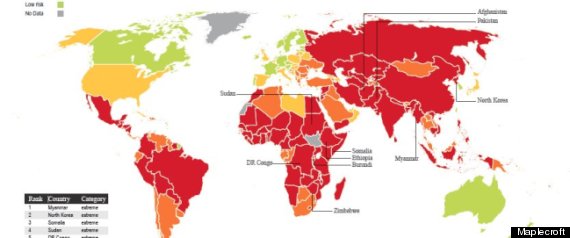
Child Labor By Country: Maplecroft 2012 Index Ranks Risk Of Violations

Where in the world are children forced to work in dangerous conditions, often toiling at the expense of receiving education and basic freedoms?

The risk analysis firm Maplecroft released a report showing that worsening global security and the economic crisis have increased the risk of child labor violations in several countries. Maplecroft studied child labor conditions in 197 countries and concluded that nearly 40% of those countries showed "extreme risk" of violations.

The International Labor Organization (ILO) defines child labor as "work that deprives children of their childhood, their potential and their dignity, and that is harmful to physical and mental development." The ILO argues that not all work carried out by children is harmful or detrimental, but the organization condemns forms of labor that are physically, socially or morally dangerous and harmful to children or interfere with their education and development.

UNICEF, the United Nations Children's Fund, estimates that 158 million children between the ages of 5 and 14 are engaged in child labor, particularly in Sub-Saharan Africa. According to the organization, more than one third of children in Sub-Saharan Africa work, most of them in the agricultural sector.

Maplecroft notes a strong link between household poverty and child labor. When the poor's children are kept out of school to work, they have limited prospects for upward social mobility. This creates a cycle of poverty for generations.

6 countries out of Maplecroft's list of worst child labor offenders are located in Africa. Tens of thousands of children in Congo are employed in the mining sector in often "hazardous conditions," the report shows. In countries hit by conflict such as Sudan, Chad and Ethiopia, the abduction of children and forced labor continue to pose extreme risks.

Original Article
Source: Huff 

Saturday, December 17, 2011

Victoria’s Secret Revealed in Child Picking Burkina Faso Cotton

Clarisse Kambire’s nightmare rarely changes. It’s daytime. In a field of cotton plants that burst with purple and white flowers, a man in rags towers over her, a stick raised above his head. Then a voice booms, jerking Clarisse from her slumber and making her heart leap. “Get up!”

The man ordering her awake is the same one who haunts the 13-year-old girl’s sleep: Victorien Kamboule, the farmer she labors for in a West African cotton field. Before sunrise on a November morning she rises from the faded plastic mat that serves as her mattress, barely thicker than the cover of a glossy magazine, opens the metal door of her mud hut and sets her almond-shaped eyes on the first day of this season’s harvest. (Follow her journey in videos, photos and more here.)

She had been dreading it. “I’m starting to think about how he will shout at me and beat me again,” she said two days earlier. Preparing the field was even worse. Clarisse helped dig more than 500 rows with only her muscles and a hoe, substituting for the ox and the plow the farmer can’t afford. If she’s slow, Kamboule whips her with a tree branch.

This harvest is Clarisse’s second. Cotton from her first went from her hands onto the trucks of a Burkina Faso program that deals in cotton certified as fair trade. The fiber from that harvest then went to factories in India and Sri Lanka, where it was fashioned into Victoria’s Secret underwear -- like the pair of zebra-print, hip-hugger panties sold for $8.50 at the lingerie retailer’s Water Tower Place store on Chicago’s Magnificent Mile.

Monday, November 21, 2011

Newt Gingrich: Child Labor Laws Are 'Stupid'

Republican presidential candidate Newt Gingrich called child labor laws "stupid" Friday in an appearance at Harvard's Kennedy School of Government.

"It is tragic what we do in the poorest neighborhoods, entrapping children in, first of all, child laws, which are truly stupid," said the former House speaker, according to CNN. "Most of these schools ought to get rid of the unionized janitors, have one master janitor and pay local students to take care of the school. The kids would actually do work, they would have cash, they would have pride in the schools, they'd begin the process of rising."

"You're going to see from me extraordinarily radical proposals to fundamentally change the culture of poverty in America," he added.

Generally, the Fair Labor Standards Act allows minors over 14 to work in most jobs, with several exceptions for minors under that age. Hours are limited for minors under the age of 16. Some states have higher age standards.

Tuesday, August 23, 2011

Child Labor Rule Released By White House After 9 Month Delay

WASHINGTON -- After much delay, the White House has finally released a proposed rule that would update child labor regulations in agricultural work. Put forth by the Department of Labor last fall, the rule had been stuck in red tape at the White House for nine months, angering workplace safety advocates who said the regulations need to be modernized.

Although the rule still has not been made public, public health officials believe it will restrict minors from engaging in certain dangerous work activities on farms and perhaps grain facilities. As reported last week by HuffPost, safety advocates claimed that recent accidents involving juveniles may have been prevented had the rule not been held up at the White House's Office of Management and Budget.

“[A]fter so many tragedies involving young workers, OMB finally came to understand the pressing need for this regulation," Justin Feldman, a worker health and safety advocate at watchdog group Public Citizen, said in an email. "At this point we’ll have to wait for the text. I understand that OMB made changes to the Department of Labor’s proposal and it remains to be seen whether or not the revised proposal will be as robust as the original."