Democracy Gone Astray

Democracy, being a human construct, needs to be thought of as directionality rather than an object. As such, to understand it requires not so much a description of existing structures and/or other related phenomena but a declaration of intentionality.
This blog aims at creating labeled lists of published infringements of such intentionality, of points in time where democracy strays from its intended directionality. In addition to outright infringements, this blog also collects important contemporary information and/or discussions that impact our socio-political landscape.

All the posts here were published in the electronic media – main-stream as well as fringe, and maintain links to the original texts.

[NOTE: Due to changes I haven't caught on time in the blogging software, all of the 'Original Article' links were nullified between September 11, 2012 and December 11, 2012. My apologies.]

Showing posts with label Chile. Show all posts

Tuesday, September 26, 2023

Chile's Next President Is A Leftist Millennial

SANTIAGO, Chile (AP) — A leftist millennial who rose to prominence during anti-government protests was elected Chile’s next president Sunday after a bruising campaign against a free-market firebrand likened to Donald Trump.

With more than 90% of polling stations reporting, Gabriel Boric had 56% of the votes, compared to 44% for his opponent, lawmaker José Antonio Kast.

Kast tweeted a photo of himself on the phone with his opponent congratulating him on his “grand triumph” as supporters of Boric gathered in downtown Santiago to celebrate. Outgoing President Sebastian Pinera held a video conference call with Boric to congratulate him.

Thursday, October 15, 2015

Investigators Seek Evidence Implicating the CIA in 1976 Murder of Chilean Diplomat on U.S. Soil

Recently declassified documents make it clear that the brutal Chilean dictator Augusto Pinochet ordered the killing of Chile’s former Foreign Minister Orlando Letelier near the White House in 1976. However, an important question remains: Did the CIA have anything to do with the assassination?

Sunday, September 13, 2015

The TPP Will Finish What Chile’s Dictatorship Started

This September 11 will be the 42nd anniversary of the US-backed coup against the democratically elected Chilean government led by the Socialist Salvador Allende, kicking off a battle that is still being fought: In Chile, protests led by students, indigenous peoples, and workers to roll back the “neoliberalization,” or Pinochetization, of society, are a continuing part of everyday life.

Neoliberalism is hard to define. It could refer to intensified resource extraction, financialization, austerity, or something more ephemeral, a way of life, in which collective ideals of citizenship give way to marketized individualism and consumerism.

Thursday, October 09, 2014

The Planning Machine

In June, 1972, Ángel Parra, Chile’s leading folksinger, wrote a song titled “Litany for a Computer and a Baby About to Be Born.” Computers are like children, he sang, and Chilean bureaucrats must not abandon them. The song was prompted by a visit to Santiago from a British consultant who, with his ample beard and burly physique, reminded Parra of Santa Claus—a Santa bearing a “hidden gift, cybernetics.”

The consultant, Stafford Beer, had been brought in by Chile’s top planners to help guide the country down what Salvador Allende, its democratically elected Marxist leader, was calling “the Chilean road to socialism.” Beer was a leading theorist of cybernetics—a discipline born of midcentury efforts to understand the role of communication in controlling social, biological, and technical systems. Chile’s government had a lot to control: Allende, who took office in November of 1970, had swiftly nationalized the country’s key industries, and he promised “worker participation” in the planning process. Beer’s mission was to deliver a hypermodern information system that would make this possible, and so bring socialism into the computer age. The system he devised had a gleaming, sci-fi name: Project Cybersyn.

Friday, February 28, 2014

Libertarians Plan to Sit Out the Coming Collapse of America…in Chile

Ken Johnson's Jeep crests a ridgetop on a dusty track a few miles off the private tollway that connects Santiago and Valparaíso, Chile. He gets out, takes a swig of beer, and gestures at the hardwood forests rising up to the craggy mountaintops. Below, Pacific coastal scrub stretches toward the lemon groves where cooks are roasting three lambs on an open fire. "Look at that, look at how majestic that is," Johnson says. "That is awesome."

Welcome to Galt's Gulch Chile, a libertarian refuge from the coming economic, social, and political collapse of the United States. The would-be free-market utopia, named after the mountain redoubt of the protagonist of Ayn Rand's Atlas Shrugged, is taking advance payments (Bitcoins gladly accepted) for parcels on its 11,000 acres.

Thursday, September 12, 2013

John Kerry meets coup plotter Henry Kissinger on the 40th anniversary of Chile's Sept. 11

As President Barack Obama's attack on Syria appears to have been delayed for the moment, it is remarkable that Secretary of State John Kerry was meeting, on Sept. 11, with one of his predecessors, Henry Kissinger, reportedly to discuss strategy on forthcoming negotiations on Syria with Russian officials. The Kerry-Kissinger meeting, and the public outcry against the proposed attack on Syria to which both men are publicly committed, should be viewed through the lens of another Sept. 11 ... 1973.

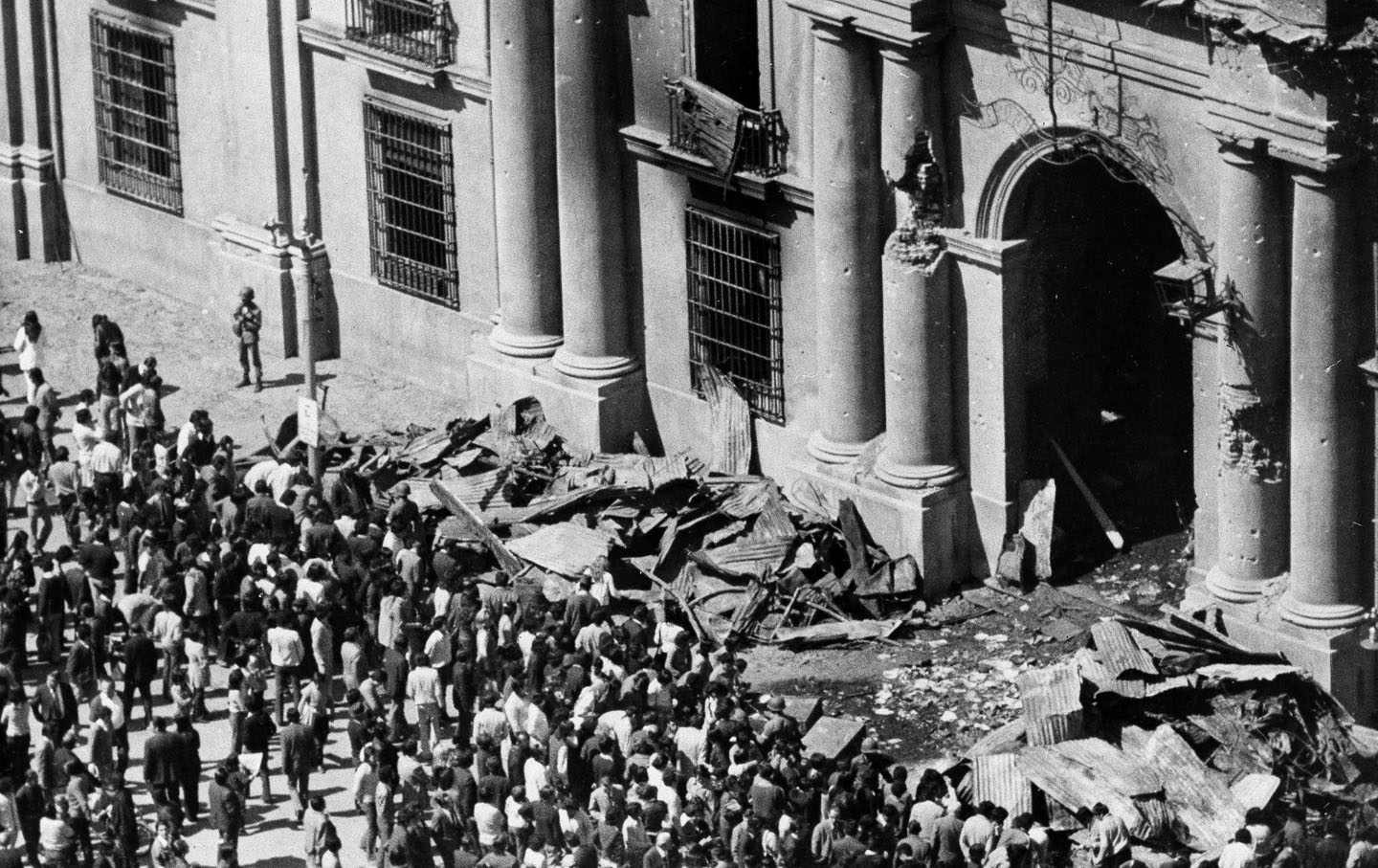
On that day, 40 years ago, the democratically elected president of Chile, Salvador Allende, was violently overthrown in a U.S.-backed coup. Gen. Augusto Pinochet took control and began a 17-year dictatorial reign of terror, during which more than 3,000 Chileans were murdered and disappeared -- about the same number killed on that later, fateful 9/11, 2001. Allende, a socialist, was immensely popular with his people. But his policies were anathema to the elites of Chile and the U.S., so President Richard Nixon and his secretary of state and national-security adviser, Henry Kissinger, supported efforts to overthrow him.

The Right to Live in Peace: Forty years on, the coup in Chile still has lessons for us today

Aerial bombings, tanks in the streets, widespread terrorizing of civilians by soldiers and secret police: this was the horror unleashed on September 11, 1973 by the military coup d’état in Chile. Led by Augusto Pinochet and other generals with U.S. backing, the coup overthrew President Salvador Allende's democratically elected Popular Unity government, and brought in a brutal military dictatorship that lasted for 17 years.

Canada's official attitude towards the coup might be politely called 'ambivalent.' Some Canadian banks and mining interests openly supported the military take-over as a good investment opportunity. Our ambassador to Chile's rather sympathetic attitude toward the generals led to a rapid recognition of the military junta.

Our Other September 11

Let’s not forget Chile.

On September 11, 1973, warplanes began strafing radio stations and newspapers. Images arrived of people scattering in fear ahead of tanks in the streets. Fearsome generals in coats with starred epaulets ordered President Salvador Allende, the world’s only elected Marxist leader, to step down. A military communiqué: “The armed forces and the body of carabineros are united in their historic and responsible mission of fighting to liberate Chile from the Marxist yoke.” Signed; General Augusto Pincohet Ugarte, Commander-in-Chief of the Army.

Monday, September 09, 2013

40 Years After Chile Coup, Family of Slain Singer Víctor Jara Sues Alleged Killer in U.S. Court

This week marks the 40th anniversary of what’s known as the other 9/11: September 11, 1973, when a U.S.-backed military coup ousted Chile’s democratically elected president Salvador Allende and ushered in a 17-year repressive dictatorship led by General Augusto Pinochet. We’re joined by Joan Jara, the widow of Chilean singer Víctor Jara, who has just filed a civil lawsuit in U.S. court against the former military officer who allegedly killed Jara 40 years ago. Jara’s accused killer, Pedro Barrientos, has lived in the United States for roughly two decades and is now a U.S. citizen. Jara’s family is suing him under federal laws that allow U.S. courts to hear about human rights abuses committed abroad. Last year, Chilean prosecutors charged Barrientos and another officer with Jara’s murder, naming six others as accomplices. We also speak with Almudena Bernabeu, an attorney with Center for Justice and Accountability, who helped file the Jara family’s lawsuit last week. "I saw literally hundreds of bodies that were piled up in what was actually the parking place of the morgue," Joan Jara says of finding her husband’s body 40 years ago. "I recognized him. I saw what had happened to him. I saw the bullet wounds. I saw the state of his body. I consider myself one of the lucky ones in the sense that I had to face in that moment what had happened to Victor. I could [later] give my testimony with all the force of what I felt in that moment — and not the horror, which is much worse, of never knowing what happened to your loved one. That happened to so many families, so many women who have spent these 40 years looking for their loved ones who were made to disappear."

Video
Source: democracynow.org
Author: --

Saturday, December 01, 2012

Chilean rebel Camila Vallejo: 'The problem is bigger – it's structural'

I almost didn't meet Camila Vallejo. She missed her flight from Chile, and by the time the allotted hour arrived, she was still 7,000 miles away in Santiago. To my surprise, I got a call the next day. Could we reschedule? Vallejo had charmed her way on to another plane, and was already scudding across the Atlantic. "If she can shut down a city," mused the press officer for the National Union of Students, whose conference for global student leaders Vallejo was due to address, "she can blag some air travel too."

Tuesday, October 16, 2012

Chilean Student Movement Awarded For Organizing Nation’s Largest Protests Since Pinochet Era

Today we look at the Chilean students’ movement, which led last year’s massive citizen democracy movement — the largest protests since the days of opposition marches to General Augusto Pinochet a generation ago. For more than a year, the movement has rallied hundreds of thousands in the streets of Santiago and other major cities to demand greater access to affordable university education, as well as deeper structural changes in Chile. The country has the highest per capita income in the region, but also one of the most unequal distributions of wealth. We are joined in our studio by two of Chile’s most recognizable student protest leaders: Camila Vallejo and Noam Titelman. They are in the United States, in part, to receive the 2012 Letelier-Moffitt Human Rights Award, which is given by the Institute for Policy Studies. It is named for the Chilean diplomat Orlando Letelier and his colleague Ronni Karpen Moffitt, who were murdered in Washington by agents of the U.S.-backed Pinochet regime in September 1976.

Video
Source: Democracy Now!
Author: ---

Friday, June 08, 2012

We are all Quebecers: Chilean students

The undersigned Chilean academics and student leaders denounce before the national and international public opinion the persecution of the Quebec student movement in Canada, asexpressed in Bill 78, enacted on Thursday May 19 by the Provincial Government of Premier Jean Charest.

Bill 78, the "truncheon law", is the most severe piece of legislation since the War Measures Act was used during the October Crisis in 1970, and has been denounced by the President of the Quebec Bar Association, Amnesty International, the League for Human Rights, four major unions, and various academic bodies.

Monday, June 04, 2012

Quebec student protesters should look to Chile for a little perspective

The similarities between protesting students in Quebec and Chile are striking, but not nearly so much as the differences.

Some of the student leaders in Quebec and Chile are glamorous and eloquent, and some of them seek radical social change beyond the changes to university tuition fees they’re after. Also, in Quebec and Chile, protesters like to bang pots and pans. (Chileans thought of it earlier.) And the large demonstrations in both places have brought civic life to a halt.

But there’s good reason for the Chilean students to make noise. In Quebec, there isn’t.

Thursday, August 11, 2011

Student Protests in Chile

For the past several months, students, teachers, and their supporters in Chile have been staging chaotic demonstrations against their government. Their goal is to transform the country's education system. In particular, they're seeking a referendum to significantly increase the funding and quality of public schools. Students have engaged in multiple forms of protest, from hunger strikes and sit-ins to marches and pillow fights. Smaller groups of protesters have engaged riot police directly, hurling stones and firebombs. Chilean authorities have responded by banning demonstrations, pushing protesters back with water cannons, and offering education proposals that have been rejected. Students in the tens of thousands -- with popular backing across Chile -- continue to march without official permission, and public sentiment against president Sebastian Piñera continues to grow. Collected here are some scenes from the streets of Chile over the past few months.

Photos
Source: the Atlantic 

Friday, May 27, 2011

Keep Chilean Patagonia Wild

An environmental review commission in the Aysén region of southern Chile has made a potentially disastrous decision, voting to approve the construction of five hydroelectric dams, two on the Baker River and three on the Pascua. The damage these dams would do to the environment is tremendous, and their construction — in a largely unspoiled natural haven — would open the way for further development, including more dams.

Full Article