Democracy Gone Astray

Democracy, being a human construct, needs to be thought of as directionality rather than an object. As such, to understand it requires not so much a description of existing structures and/or other related phenomena but a declaration of intentionality.
This blog aims at creating labeled lists of published infringements of such intentionality, of points in time where democracy strays from its intended directionality. In addition to outright infringements, this blog also collects important contemporary information and/or discussions that impact our socio-political landscape.

All the posts here were published in the electronic media – main-stream as well as fringe, and maintain links to the original texts.

[NOTE: Due to changes I haven't caught on time in the blogging software, all of the 'Original Article' links were nullified between September 11, 2012 and December 11, 2012. My apologies.]

Showing posts with label Neo Liberalism. Show all posts

Tuesday, February 28, 2017

Neoliberalism – the ideology at the root of all our problems

Imagine if the people of the Soviet Union had never heard of communism. The ideology that dominates our lives has, for most of us, no name. Mention it in conversation and you’ll be rewarded with a shrug. Even if your listeners have heard the term before, they will struggle to define it. Neoliberalism: do you know what it is?

Its anonymity is both a symptom and cause of its power. It has played a major role in a remarkable variety of crises: the financial meltdown of 2007‑8, the offshoring of wealth and power, of which the Panama Papers offer us merely a glimpse, the slow collapse of public health and education, resurgent child poverty, the epidemic of loneliness, the collapse of ecosystems, the rise of Donald Trump. But we respond to these crises as if they emerge in isolation, apparently unaware that they have all been either catalysed or exacerbated by the same coherent philosophy; a philosophy that has – or had – a name. What greater power can there be than to operate namelessly?

Wednesday, May 11, 2016

Brazil’s Democracy to Suffer Grievous Blow Today as Unelectable, Corrupt Neoliberal is Installed

In 2002, Brazil’s left-of-center Workers Party (PT) ascended to the presidency when Lula da Silva won in a landslide over the candidate of the center-right party PSDB (throughout 2002, “markets” were indignant at the mere prospect of PT’s victory). The PT remained in power when Lula, in 2006, was re-elected in another landslide against a different PSDB candidate. PT’s enemies thought they had their chance to get rid of PT in 2010, when Lula was barred by term limits from running again, but their hopes were crushed when Lula’s handpicked successor, the previously unknown Dilma Rousseff, won by 12 points over the same PSDB candidate who lost to Lula in 2002. In 2014, PT’s enemies poured huge amounts of money and resources into defeating her, believing she was vulnerable and that they had finally found a star PSDB candidate, but they lost again, this time narrowly, as Dilma was re-elected with 54 million votes.

Friday, April 22, 2016

Neoliberalism – the ideology at the root of all our problems

Imagine if the people of the Soviet Union had never heard of communism. The ideology that dominates our lives has, for most of us, no name. Mention it in conversation and you’ll be rewarded with a shrug. Even if your listeners have heard the term before, they will struggle to define it. Neoliberalism: do you know what it is?

Its anonymity is both a symptom and cause of its power. It has played a major role in a remarkable variety of crises: the financial meltdown of 2007‑8, the offshoring of wealth and power, of which the Panama Papers offer us merely a glimpse, the slow collapse of public health and education, resurgent child poverty, the epidemic of loneliness, the collapse of ecosystems, the rise of Donald Trump. But we respond to these crises as if they emerge in isolation, apparently unaware that they have all been either catalysed or exacerbated by the same coherent philosophy; a philosophy that has – or had – a name. What greater power can there be than to operate namelessly?

Friday, January 08, 2016

James K. Galbraith on the Human Cost of Inequality in the Neoliberal Age

We live in an age of growing inequality: The policies of neoliberalism and the financialization of economic life have created a social order in which the rich are continually getting richer at the expense of everyone else. It is hardly surprising, therefore, that the middle class is shrinking in many Western societies, while there is a dramatic drop in the standard of living for the majority of the working population, the young and the retirees. It is also hardly surprising that the United States, with its free-market mentality and anti-social policy orientation, is leading the pack in rising inequality. The more than 46 million Americans who are living below the poverty line, meanwhile, are poor by global standards.

Saturday, October 24, 2015

Youth in Authoritarian Times: Challenging Neoliberalism's Politics of Disposability

Following the insight of Hannah Arendt, a leading political theorist of mid-20th century totalitarianism, a dark cloud of political and ethical ignorance has descended upon the United States. (1) Thoughtlessness, a primary condition of authoritarian rule, now occupies a privileged, if not celebrated, place in the political landscape and the mainstream cultural apparatuses. A new kind of infantilism now shapes daily life as adults gleefully take on the role of unthinking children, while children are pushed to be adults, stripped of their innocence and subject to a range of disciplinary pressures that saddle them with debt and cripple their ability to be imaginative. (2)

Sunday, September 13, 2015

The TPP Will Finish What Chile’s Dictatorship Started

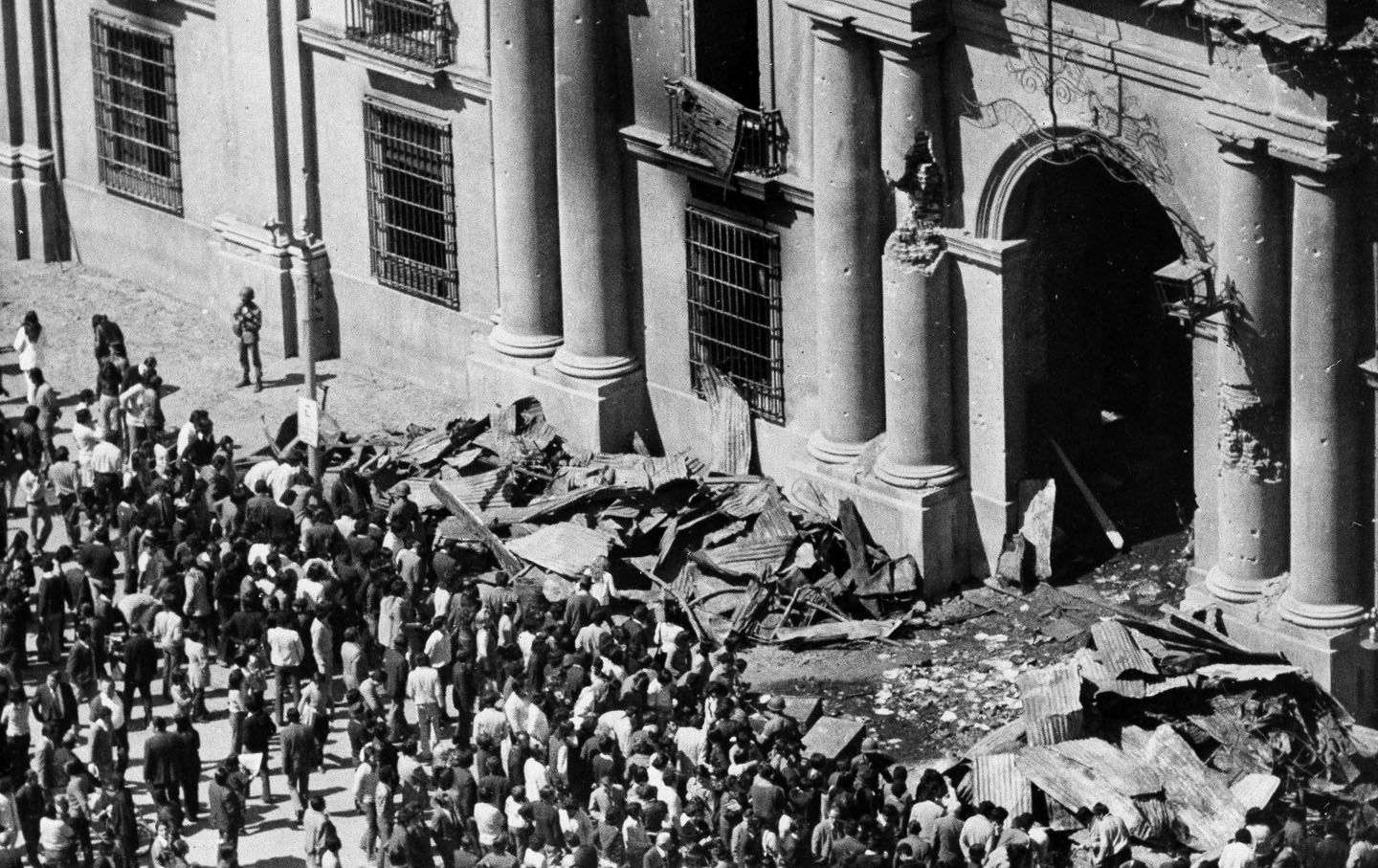
This September 11 will be the 42nd anniversary of the US-backed coup against the democratically elected Chilean government led by the Socialist Salvador Allende, kicking off a battle that is still being fought: In Chile, protests led by students, indigenous peoples, and workers to roll back the “neoliberalization,” or Pinochetization, of society, are a continuing part of everyday life.

Neoliberalism is hard to define. It could refer to intensified resource extraction, financialization, austerity, or something more ephemeral, a way of life, in which collective ideals of citizenship give way to marketized individualism and consumerism.

Monday, August 31, 2015

The Rehabilitationists

IN NOVEMBER 2013, a who’s who of America’s conservative legal establishment descended on the Mayflower Hotel in Washington, D.C., for an annual meeting of the Federalist Society, the most influential conservative legal organization in the country. Current presidential candidates Scott Walker and Ted Cruz each made appearances, ingratiating themselves with the influence peddlers in attendance. Supreme Court Justice Clarence Thomas was a featured speaker at the event’s black-tie-optional dinner.

One of the biggest stars of the conference, however, was neither a Senate-confirmed official nor an elected politician, but a libertarian law professor at Georgetown named Randy Barnett. This wasn’t Barnett’s first turn as a Federalist Society eminence, but his reception that year was especially rapturous.

Sunday, August 23, 2015

Are you voting for policies that hurt you? Neoliberal polices and your paycheque

Another federal election is coming, and the promises are gearing up. But after the election is over and politicians start implementing those promises, do they really work out the way we had hoped? 
We are particularly vexed about one promise that has been tossed around for a long time. Remember "the rising tide that lifts all boats?" Supposedly, politicians would implement policies to boost productivity growth and we were told that this growing economic pie would "trickle down" to our paycheques.

Tuesday, June 30, 2015

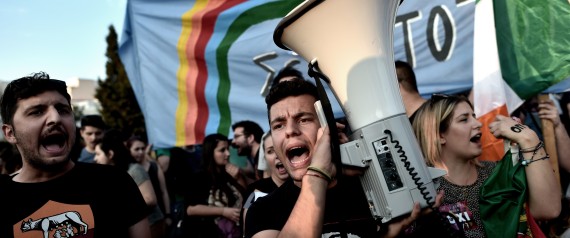
Europe's Attack on Greek Democracy

NEW YORK -- The rising crescendo of bickering and acrimony within Europe might seem to outsiders to be the inevitable result of the bitter endgame playing out between Greece and its creditors. In fact, European leaders are finally beginning to reveal the true nature of the ongoing debt dispute, and the answer is not pleasant: it is about power and democracy much more than money and economics.

Angela Merkel Will Be Responsible For A Greek Exit From The Eurozone

If Greece leaves the eurozone in the coming days, it will be the result of decisions made by German Chancellor Angela Merkel, more than any other institution or leader.

Although Greece has been negotiating with a so-called "troika" of institutional creditors -- the International Monetary Fund, the European Central Bank and the European Commission, which represents the eurozone nations -- Germany is widely believed to be the creditor whose views are most decisive. The country is the single largest creditor in the series of bailout payments that the troika has provided to Greece since 2010. As such, Germany under Merkel’s leadership has been the lead architect of the loans-for-austerity policy Europe has used to manage the Greek debt crisis.

Sunday, June 28, 2015

Neoliberalism steamrolling public education in B.C.

Public education in British Columbia is struggling against a thickening neoliberal framework.
The deterioration of public education is not unique to the region, but to use it as a model paints a rather bleak picture.
In 2014, the British Columbia Teacher's Federation clashed with the B.C. Liberals who had twice appealed a Supreme Court ruling on class size regulation, and would not provisionally fund education while their second appeal was being completed. The school year began three weeks late.

Sunday, October 19, 2014

Beyond Orwellian Nightmares and Neoliberal Authoritarianism

Those who fight against neoliberalism must not settle for reforming a system that is as broken as it is dangerous. Any viable, transformative struggle will need a boldly democratic vision; durable, longstanding organizations and strategies that make politics meaningful.
To be corrupted by totalitarianism, one does not have to live in a totalitarian country.
- George Orwell
Central to George Orwell's nightmarish vision of a totalitarian society was a government so powerful that it not only dominated all of the major institutions in a society, but it also was quite adept at making invisible its inner workings of power. This is what some have called a shadow government, deep state, dual state or corporate state. (1) In the deep state, politics becomes the domain of the ultra-wealthy, the powerful few who run powerful financial services, big corporations and the imperious elite of the defense industries and other components of the military-industrial complex. Corporate interests such as ExxonMobil and other fossil fuel companies, megabanks such as Bank of America, and defense industries such as Boeing, General Dynamics, Northrop Grumman and Lockheed Martin are powerful lobbying groups and as such have control of the major seats of political power and the commanding institutions necessary to insure that the deeply anti-democratic state rules in the interests of the few while exploiting and repressing the many.

Wednesday, August 27, 2014

Neo-Liberal Austerity Keeps Europe Down

Shades of France’s notorious Third Republic! The latest French government has been summarily dismissed after only six painful months. It was certainly time for a change. President François Hollande’s poll ratings have plumbed new depths at 17 percent, while Prime Minister Manuel Valls had lost 9 percentage points in one month, down to 36 percent. With his usual indecision, the President has instructed Mr. Valls to go back and form a new government to carry on the same policies—the third in the space of one year—but excluding the trouble-makers who provoked this crisis.

Friday, April 18, 2014

The three key moments in Canada's neoliberal transformation

The last three decades have witnessed a far-reaching transformation of the Canadian economy, politics and culture. Canada is not unique in experiencing this neoliberal transformation, of course, but it has been as dramatic, thorough and socially destructive here as almost anywhere else in the industrialized world. Even before that transformation began, Canada was hardly a model of inclusion, equality, and democracy. But in the latter years of the postwar expansion, Canada progressed both economically and socially. Living standards were improving quickly for most -- fuelled by rising real wages (which doubled in a generation), and a dramatic expansion of the social wage (including the introduction of national medicare, unemployment insurance and the Canada Pension Plan within six remarkable years, from 1965 through 1971). We were catching up to the U.S. economically (and surpassing it socially), escaping our traditional status as "poor cousins" to the North. And we carved a unique and somewhat independent role for the country in global economic, political and military affairs. This confidence, hope and momentum was symbolized by Canada's hosting of Expo 67 in Montreal, the year of the country's centenary -- officially opened with then-prime minister Lester Pearson's claim that it constituted "one of the most daring acts of faith in Canadian enterprise and ability ever undertaken."

Friday, March 14, 2014

Tech-Sector Neoliberalism Isn’t the Answer to America’s Inequality Problem

Eric Schmidt is the chairman of Google. Last year, he raked in compensation totaling over $100 million from the company, adding to his net worth of over $8 billion. According to The New York Times, Schmidt owns “a Gulfstream V, a 195-foot yacht and multiple homes across the country including a new $22 million Hollywood mansion.”

Last week, he addressed the SXSW conference on the topic of economic inequality—I mean, who better, right? He proposed three basic fixes for the problem.

One is strengthening the safety net for the less well-off. I am definitely with him there. The United States is one of the richest societies the world has ever known, but it has a remarkably ungenerous welfare state. So, so far we’re good. The war on poverty worked, and it would work even better if programs like food stamps, Medicaid and the EITC were expanded.

Sunday, February 23, 2014

Neoliberalism’s Favorite Advice

The cheap slogan, an alleged encouragement for today’s worker, cruelly ignores the fact that very few of us have the opportunity to make a living doing much of anything that sustains our spirits, Miya Tokumitsu writes at Jacobin.
Tokumitsu says:
There’s little doubt that “do what you love” (DWYL) is now the unofficial work mantra for our time. The problem is that it leads not to salvation, but to the devaluation of actual work, including the very work it pretends to elevate?— and more importantly, the dehumanization of the vast majority of laborers.
Superficially, DWYL is an uplifting piece of advice, urging us to ponder what it is we most enjoy doing and then turn that activity into a wage-generating enterprise. But why should our pleasure be for profit? Who is the audience for this dictum? Who is not?
By keeping us focused on ourselves and our individual happiness, DWYL distracts us from the working conditions of others while validating our own choices and relieving us from obligations to all who labor, whether or not they love it. It is the secret handshake of the privileged and a worldview that disguises its elitism as noble self-betterment. According to this way of thinking, labor is not something one does for compensation, but an act of self-love. If profit doesn’t happen to follow, it is because the worker’s passion and determination were insufficient. Its real achievement is making workers believe their labor serves the self and not the marketplace.
Read more here.

Original Article
Source: truthdig.com/
Author: Alexander Reed Kelly

Sunday, December 15, 2013

Blurring Mandela and Neo-Liberalism

On the Monday after Nelson Mandela’s death, The New York Times’ specialist on deals, Andrew Ross Sorkin, dealt the truth a few blows by offering an incomplete and superficial story about Mandela’s infatuation with the “freedom of markets” and, by extension, in Timesspeak, a “Free Economy.”

Rather than frame the story as a case of how the power of global corporations and banks threatened and pressured the new Mandela government—even before it became a government—to embrace their notions of neo-liberalism, to ensure that those who wielded economic power in the past would continue to do so in the future, the paper of record built its story of an event that is on the record: Mandela’s “seeing the light” at a meeting of the World Economic Forum.

That was the tip of an iceberg.

Tuesday, November 26, 2013

The fallacy of corporate taxes in a neo-liberal context

"Make the corporations pay!"

It is a slogan that sounds good, and with which I would fully agree, under conditions where "corporations," or, more accurately, those who control them, were actually paying. But this is not the case in the debate in Canada today where many on the left are falsely proclaiming corporate taxes as an alternative to increasing personal taxes, even on the wealthy, and seem to display little understanding that corporate tax rates have nothing at all to do with inequality socially and are not at all a tax on wealth or the wealthy.

When Thomas Mulcair juxtaposes his "plan" to increase corporate taxes as a "progressive" alternative to Toronto-Centre candidate Linda McQuaig's previously stated notion that taxes should be increased as well on Canada's wealthiest individuals, he is fundamentally juxtaposing McQuaig's plan that might accomplish something to a plan that will accomplish absolutely nothing.

Wednesday, October 30, 2013

The "N" in NDP Now Stands for Neoliberal

This past week may come to be seen as a watershed moment in the NDP's capitulation to neoliberal capitalism. The nominally social democratic party effectively supported a major corporate trade accord all the while opposing an International Monetary Fund call for a more progressive tax code.

Last week the NDP basically endorsed the Comprehensive Economic and Trade Agreement (CETA) the Harper Conservatives have negotiated with the European Union. The accord will greatly expand the power of multinational corporations.

Thursday, September 19, 2013

Four Lost Decades: Why American Politics Is All Messed Up

Political update: the annual showdown over the federal budget and associated topics is about to begin. Over the weekend, President Obama warned that he wouldn’t negotiate with Congressional Republicans about raising the debt ceiling, which is due to be breached sometime next month. But there’s widespread speculation that the G.O.P. will play hardball and shut down the federal government.

If your eyes are already glazing over, don’t feel guilty. I get paid to track this stuff, and I, too, find it a struggle to keep up. If, as Marx said, history repeats itself, first as tragedy and then as farce, how do you describe a four-peat? In 2010, Congress failed to pass a budget. In 2011, we had a debt-ceiling crisis that resulted in the sequester and Standard & Poor’s downgrading treasuries. Last year, it was the fiscal-cliff crisis. And this year, we have a debt-ceiling crisis and a budget crisis—without a new spending resolution, the federal government will run out of money at the end of the month—with the added complication that some Republicans want to defund Obamacare. In short, it’s business as usual on the Potomac.