
Showing posts with label Civil Disobedience. Show all posts
Showing posts with label Civil Disobedience. Show all posts
Sunday, January 01, 2017
The Return of Civil Disobedience
Sunday, June 29, 2014
Why I'm for Massive Civil Disobedience

What we must understand is that there will be spills and serious spills along this pipeline. This is a certainty. Enbridge's own record demonstrates this but the law of averages makes it certain.
It's worse than that. Because of the terrain over which the pipeline would go, access to the spills is all but denied. One only has to look at a map to see that there is no more hostile territory in the world for a pipeline.
Friday, November 08, 2013
Largest Civil Disobedience In Walmart History Leads To More Than 50 Arrests
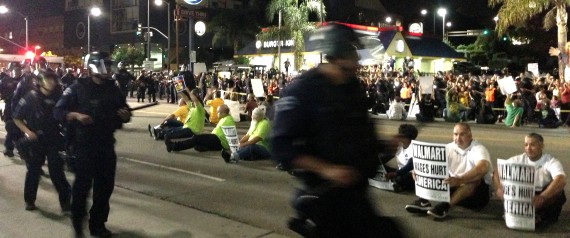
Organizers said it was the largest single act of civil disobedience in Walmart's 50-year history. The 54 arrestees, with about 500 protesting Walmart workers, clergy and supporters, demonstrated outside LA's Chinatown Walmart. Those who refused police orders to clear the street after their permit expired were arrested without incident. Those who fail to post $5,000 bail would be jailed overnight, Detective Gus Villanueva, a Los Angeles Police Department spokesman, told The Huffington Post.
Wednesday, February 06, 2013
A case for civil disobedience

Civil disobedience is breaking an unjust law or breaking a law to draw attention to an unjust law. It has played a major role in creating democracy around the world. We shouldn’t forget that ever.
Wednesday, January 16, 2013
When the law’s an ass: Politicians and civil disobedience

Kinsella’s argument basically boils down to dura lex sed lex — “the law may be harsh, but it’s still the law.” Politicians are expected to demonstrate support for the rule of law. Failure to do so, says Kinsella, surrenders society to the “caprice of despots and ideologues.”
Tuesday, December 06, 2011
Public disorder 'one of main issues facing police'

Public disorder will be "one of the main issues" facing British police for up to the next three years, according to former Metropolitan Police commissioner Lord Stevens.
He said it was his "gut feeling and beyond" that violence on the streets would put officers in "very difficult" situations.
Lord Stevens made the comments at the launch of an independent commission on the future of policing, which has been set up by Labour.
Shadow home secretary Yvette Cooper warned that police face a "perfect storm" of cuts in staff, "chaotic" reforms and evolving threats to the public.
She also said that morale among officers had "dropped through the floor".
"My fear is that policing now faces a perfect storm, from the scale of cuts, the chaos of confused reforms, the escalating demands on the service and declining morale.
"I'm worried in particular about the risk of a growing gap between public concerns about the need for police action but also the capacity of the police to deliver," she said.
Monday, December 05, 2011
Mounties spied on native protest groups
 The federal government created a vast surveillance network in early 2007 to monitor protests by First Nations, including those that would attract national attention or target “critical infrastructure” like highways, railways and pipelines, according to RCMP documents.
Formed after the Conservatives came to power, the RCMP unit’s mandate was to collect and distribute intelligence about situations involving First Nations that have “escalated to civil disobedience and unrest in the form of protest actions.”
The documents, obtained through access to information requests, include an RCMP slideshow presentation from the spring of 2009, which says the intelligence unit reported weekly to approximately 450 recipients in law enforcement, government, and unnamed “industry partners” in the energy and private sector.
A RCMP spokesperson told the Toronto Star the unit was never considered “permanent” and that last year it was “dismantled’’ at least at headquarters. But the Mounties can’t say if the work is continuing in the field.
“Since the dismantling of the Aboriginal (joint intelligence group) JIG, the work done by the JIG is no longer performed at RCMP HQ Criminal Intelligence (CI). However, we cannot confirm that RCMP divisions are not performing Aboriginal JIG activities under another name of program.”
Saturday, October 15, 2011
Giving Wall Street No Quarter
 What do you do when a society socializes losses and privatizes gains? You say no.
This system, whose description I’m taking from a speech Joseph Stiglitz recently gave to the people of Zuccotti Park, is complex, multivalent, pervasive. There is no single solution. There is no tyrant to topple, no proposition to defeat. Occupy Wall Street and its expanding set of subsidiaries can best be understood as a collective no. If it were happening in Germany, it would be a “doch!” accompanied by a stomped foot. We do not agree. You do not have our consent. We will not co-operate. This legalized, institutionalized, calcified inequity must change.
The breadth of the protest has been represented by its opponents as incoherence. With the exception of those who are willfully trying to misrepresent it, I’d say it’s closer to the truth to say it’s their understanding of the issue that lacks cohesion. It’s a mistake to assume that things are too complicated to understand, that because many of these protestors and their allies are not familiar with collateralized debt obligations, they don’t know what they’re talking about. Constituent parts of things often are abstruse, but the bigger things, the things that ultimately matter, are mostly either apparent, or instinctually comprehensible.
Like the current economic situation in the U.S. It’s not naïve to point to the graph of employee-to-CEO pay gaps over the last forty years and say something’s going wrong. Those numbers and their divergent paths are basic and concrete. Sure, they reflect the changing values of a society, but when values and value overlap so literally and completely, there is little room left for subjectivity.
Thursday, September 15, 2011
A call to action: Non-violent civil disobedience against the tar sands
 A defining moment in Canadian history will take place in Ottawa this month.
On Sept. 26, hundreds of individuals from across the country will participate in an act of peaceful civil disobedience. The objective is to send a clear message to the Harper regime, calling on the government to withdraw its unquestioning support of the tar sands industry and to provide leadership by forging the transition to a clean, just and renewable energy that respects Indigenous rights and gives priority to the health of our communities and the environment. It could well turn out to be the largest demonstration of environmental civil disobedience in the history of this country's climate movement.
For several years, many civil society groups and individuals have written letters, signed petitions, participated in actions across the country and sought to educate their elected officials on the moral imperative of stopping our addiction to fossil fuel and building a sustainable future. Yet, most of these efforts have been ignored, while the fragmentation between environmental, health and economic problems continue to intensify and the connections that intertwine them remain unaddressed.
Wednesday, August 24, 2011
Opposition to Keystone XL pipeline grows
The White House was rocked Tuesday, not only by a 5.9-magnitude earthquake, but by the protests mounting outside its gates. More than 2,100 people say they'll risk arrest there during the next two weeks. They oppose the Keystone XL pipeline project, designed to carry heavy crude oil from the tar sands of Alberta, Canada, to refineries on the U.S. Gulf Coast.
A "keystone" in architecture is the stone at the top of an arch that holds the arch together; without it, the structure collapses. By putting their bodies on the line -- as more than 200 have already at the time of this writing -- these practitioners of the proud tradition of civil disobedience hope to collapse not only the pipeline, but the fossil-fuel dependence that is accelerating disruptive global climate change.
Bill McKibben was among those already arrested. He is an environmentalist and author who founded the group 350.org, named after the estimated safe upper limit of carbon dioxide in the atmosphere of 350 ppm (parts per million -- the planet is currently at 390 ppm). In a call to action to join the protest, McKibben, along with others including journalist Naomi Klein, actor Danny Glover and NASA scientist James Hansen, wrote the Keystone pipeline is "a 1,500-mile fuse to the biggest carbon bomb on the continent, a way to make it easier and faster to trigger the final overheating of our planet."
A "keystone" in architecture is the stone at the top of an arch that holds the arch together; without it, the structure collapses. By putting their bodies on the line -- as more than 200 have already at the time of this writing -- these practitioners of the proud tradition of civil disobedience hope to collapse not only the pipeline, but the fossil-fuel dependence that is accelerating disruptive global climate change.
Bill McKibben was among those already arrested. He is an environmentalist and author who founded the group 350.org, named after the estimated safe upper limit of carbon dioxide in the atmosphere of 350 ppm (parts per million -- the planet is currently at 390 ppm). In a call to action to join the protest, McKibben, along with others including journalist Naomi Klein, actor Danny Glover and NASA scientist James Hansen, wrote the Keystone pipeline is "a 1,500-mile fuse to the biggest carbon bomb on the continent, a way to make it easier and faster to trigger the final overheating of our planet."
Tuesday, August 23, 2011
Bill McKibben and the Fight to Stop the Tar Sands

In a defiant act of civil disobedience, protestors stage a sit-in at the White House to implore Obama to stop the Keystone XL pipeline.
At 11 a.m. on Aug. 20, 65 people, many dressed in their Sunday best, walked single file across Pennsylvania Avenue to the White House gate and turned their backs to it, facing Lafayette Park. This group of peaceful protesters is in Washington to petition for U.S. President Barack Obama to prevent construction of the Keystone XL pipeline.
As the crowd of protesters formed, a well-briefed police squad cordoned the area with black fences and yellow tape. By Parks Service regulation, a person holding a sign, or a group of more than 25, may not linger in front of the central White House sidewalk longer than 10 minutes; after three warnings, the Parks Police cuffed and led people, one-by-one, away to Anacostia to process them for central holding.
Sunday, August 21, 2011
Keystone Pipeline Protest Draws More Arrests
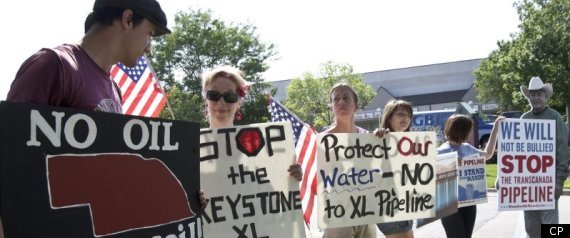 WASHINGTON - A Canadian woman was among as many as 50 environmental activists handcuffed and taken to jail Sunday on the second day of peaceful White House protests against TransCanada's controversial Keystone XL pipeline.
Fifty protesters are already in a downtown D.C. jail following their arrests outside the White House on Saturday, the opening day of a two-week civil disobedience campaign. They're expected to be released Monday night.
By noon on a steamy Sunday, police began arresting more demonstrators, including 68-year-old Patricia Warwick of Toronto. A 65-year-old woman from Massachusetts who's celebrating her birthday was also lead away in handcuffs from a stretch of sidewalk outside the White House.
Tuesday, May 31, 2011
Quebec Shale Gas Development Sparks Civil Disobedience Threat
(CP) -- QUEBEC - Opponents of shale gas development in Quebec have warned that they might engage in civil disobedience to keep the industry from taking off in the province.
One protest leader said people would tie themselves to gas companies' machinery and block their trucks if exploration activities went ahead.
Several dozen opponents of shale gas are marching through Quebec to warn of its possible environmental impact.
Event spokesman Philippe Duhamel said Monday that the march was just the beginning. He said there would also be training sessions on how to organize sit-ins and occupy exploration sites.
He said protesters actually got the idea from a gas-industry executive who said he would pull out of Quebec at the slightest hint of a work stoppage.
Full Article
One protest leader said people would tie themselves to gas companies' machinery and block their trucks if exploration activities went ahead.
Several dozen opponents of shale gas are marching through Quebec to warn of its possible environmental impact.
Event spokesman Philippe Duhamel said Monday that the march was just the beginning. He said there would also be training sessions on how to organize sit-ins and occupy exploration sites.
He said protesters actually got the idea from a gas-industry executive who said he would pull out of Quebec at the slightest hint of a work stoppage.
Full Article
Subscribe to:
Posts (Atom)