Democracy Gone Astray

Democracy, being a human construct, needs to be thought of as directionality rather than an object. As such, to understand it requires not so much a description of existing structures and/or other related phenomena but a declaration of intentionality.
This blog aims at creating labeled lists of published infringements of such intentionality, of points in time where democracy strays from its intended directionality. In addition to outright infringements, this blog also collects important contemporary information and/or discussions that impact our socio-political landscape.

All the posts here were published in the electronic media – main-stream as well as fringe, and maintain links to the original texts.

[NOTE: Due to changes I haven't caught on time in the blogging software, all of the 'Original Article' links were nullified between September 11, 2012 and December 11, 2012. My apologies.]

Showing posts with label Clear-Cutting. Show all posts

Sunday, February 15, 2015

Power Brokers’ Chains Hold Back Forest Protections

LONDON—The world will not, on present rates of progress, reach its goal of ending tropical deforestation within 15 years.

The Global Canopy Programme (GCP), a thinktank based in Oxford, UK, says many of those who could protect the forests by ensuring that deforestation does not contribute to commodity supply chains are failing to act.

The GCP, which draws together international experts on tropical forests, has compiled what it says is the first comprehensive ranking of the “Forest 500” ? power brokers who control the global supply chains that drive over half of tropical deforestation.

Sunday, April 22, 2012

'They're killing us': world's most endangered tribe cries for help

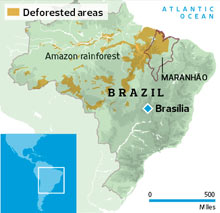
Trundling along the dirt roads of the Amazon, the giant logging lorry dwarfed the vehicle of the investigators following it. The trunks of nine huge trees were piled high on the back – incontrovertible proof of the continuing destruction of the world's greatest rainforest and its most endangered tribe, the Awá.

Yet as they travelled through the jungle early this year, the small team from Funai – Brazil's National Indian Foundation – did not dare try to stop the loggers; the vehicle was too large and the loggers were almost certainly armed. All they could do was video the lorry and add the film to the growing mountain of evidence showing how the Awá – with only 355 surviving members, more than 100 of whom have had no contact with the outside world – are teetering on the edge of extinction.

It is a scene played out throughout the Amazon as the authorities struggle to tackle the powerful illegal logging industry. But it is not just the loss of the trees that has created a situation so serious that it led a Brazilian judge, José Carlos do Vale Madeira, to describe it as "a real genocide". People are pouring on to the Awá's land, building illegal settlements, running cattle ranches. Hired gunmen – known as pistoleros – are reported to be hunting Awá who have stood in the way of land-grabbers. Members of the tribe describe seeing their families wiped out. Human rights campaigners say the tribe has reached a tipping point and only immediate action by the Brazilian government to prevent logging can save the tribe.

Sunday, February 19, 2012

Clear cutting in Gatineau Park starts Monday


The Wakefield Spring and majestic old growth white pines of Gatineau Park need your urgent help!

Residents of Wakefield are continuing to fight the extension of Highway 5 between Chelsea and Wakefield which threaten old growth pine trees and the Valley Drive (Wakefield) Spring. The cutting of trees in Gatineau Park will begin on Monday. A5X, a group who is now leading this fight, was asked to remove all decorations by noon on Thursday. We need your help to save these trees and the Wakefield Spring!

The group and supporters will return to the park on Monday at 10 a.m. when cutting is scheduled to start. Some members of the group will sit up in some of the largest white pines to block the cutting. At the beginning of January, the group set up a camp in the forest off Brown Lake Road, just south of Wakefield.

If we can delay the cutting by even just a few months, we may be able to buy more time to stop the project. The cutting has to stop in early spring so that the trees are not cut when baby birds are in nests.

Over 3,000 people depend on the spring for their drinking water needs year round, while another 2,000 people use the spring seasonally. The West Quebec Post reported that "A federal assessment [which approved the extension] acknowledged [that no one knows the exact source of all the spring water ... ] The 1986 Quebec consultation did not look at hydrology." CBC has also reported, "Transport Canada performed a preliminary assessment and determined that the project -- which would involve lopping off a nearby hilltop -- could contaminate the aquifer." It is unclear how much water some residents will get from the new wells that are to replace a communal well in the path of the construction.

Community members are not opposed to an extension in principle. However, they are demanding a better environmental assessment and an altered plan that would save the old growth trees and the Wakefield Spring.

What you can do:

* Show your support to the tree-sitters on Monday! The location of where the cutting will begin remains unknown. Please check the AX5 website or Facebook page on Sunday evening for the exact location. The protest will begin at 10 a.m. so be ready to come out and let the Quebec government know you don't want the trees to be cut!

* Contact Jean Charest's office -- A sample French and English can be viewed at: http://www.a5x.org/do-something-faites-quelque-chose.html
- Fax:418 643-3924 and/or 514 873-6769
- Email via the website: www.premier-ministre.gouv.qc.ca/premier-ministre/joindre-pm/courriel.asp
- Tel: 418 643-5321 or 514 873-3411


Original Article
Source: rabble.ca
Author: Emma Lui

Wednesday, July 13, 2011

Ruthless clear-cutting bares Myanmar’s hills

For more than two decades, the merchants in the Kunming Southwest Timber Market have conducted a brisk trade in a coveted but controversial resource: teak and other woods harvested from isolated, military-ruled Myanmar.

But these days, the merchants who warehouse their refined timber and raw logs in a muddy maze of garages on the edge of this southwestern Chinese city say they can no longer make a go of it dealing in Myanmar timber alone. Some have started shifting their focus to the relatively unscathed forests of Laos, while others have switched from forestry to mining in Myanmar. Some have already closed their shops for good.

What is happening is a tragedy foretold for years by opponents of the generals who rule the country better known as Burma. Desperate for cash, and hemmed in by international sanctions, Myanmar’s government opened up the country’s bountiful forests, and other natural resources, to companies in China, long the country’s only major trading partner.

After 20 years of almost unhindered clear-cutting, the traders and forestry experts say, only a fraction of Myanmar’s legendary forests of teak and redwood remain standing. Timber merchants in Kunming – the biggest hub anywhere for buying and selling Myanmar timber – say there will be no more Myanmar teak left to harvest in a decade, maybe less.

“It can’t last more than another 10 years, maybe just five or six years if they cut faster,” said Chen Jinian, office manager at Sen Long Timber, a company owned by his uncle that has been importing wood from Myanmar since the early 1990s.

Mr. Chen recently returned from a cross-border trip to negotiate a purchase, and said that his company has had to go deeper and deeper into the heart of Myanmar to find good-quality wood since the once-lush forests in the borderlands were now all but exhausted. In Yunnan province, on the Chinese side of the border, cutting is strictly regulated by authorities and the mountains are still topped with valuable but protected forests.

In Myanmar, Mr. Chen said, it’s a free-for-all, with the central government in Naypyidaw, local military commanders and anti-government ethnic militias that control the border areas all willing to sell the forests under their control in exchange for desperately needed cash. “When you cross the border to the Myanmar side, you can see the mountains that no longer have any trees on them,” he said. “Soon the trees will be all cut. Without the trees, there will be only mountains. So we will look into mining them.”

Mr. Chen’s bleak description is matched by other traders in the Kunming timber market, where the growing scarcity of Myanmar teak and redwood has driven up prices and hurt demand. Traders say business has fallen sharply in recent years, due in part to the global financial downturn, but also to the Chinese government’s efforts to regulate trade across the Myanmar border, which has resulted in the imposition of tariffs of as high as 100 per cent on some wood.

Full Article
Source: Globe & Mail