
Showing posts with label Culture. Show all posts
Showing posts with label Culture. Show all posts
Wednesday, June 05, 2013
Revolution, on Television and in Real Life
Thursday, July 19, 2012
It’s a problem of culture not guns

Council needs to attack the general culture and ideology that infect teens in areas where violence and intimidation are idolized instead of condemned.
I grew up and frequented Scarborough’s Tuxedo Court, Mornelle Court and Galloway, among others, and unfortunately have subscribed to this culture, too. I remember walking my high school hallways or streets like Morningside, Ellesmere, Lawrence, Eglinton and Kennedy and being ready for confrontation with young thugs hoping to impress their peers. Sometimes they wanted money, other times just to make an example of you. It’s like high school bullying only the stakes are higher.
Tuesday, May 15, 2012
Losing Face: Why China Can't Stop Squandering Its Soft Power

That these recent episodes embarrass the Communist Party is probably an understatement. The party's fear of general "instability" is perhaps matched only by the disdain it holds for the airing of dirty laundry. This is in part informed by a cultural psychology at the micro level that manifests in macro political behavior: The ugly stuff and internal bickering get sorted out in the privacy of an inner sanctum, while for the appearance of outsiders, all is well and please don't poke around.
Tuesday, March 20, 2012
Liberals Started the Culture War, and We Should Be Proud of Continuing It

These disasters (from a conservative point of view) were hardly isolated. Richard Nixon appointed Roe v. Wade author Harry Blackmun; Gerald Ford's brief presidency produced long-time Supreme Court liberal John Paul Stevens, and Poppy Bush put the ultimate Stealth Liberal, David Souter, on the High Court, an act for which the later nomination of Clarence Thomas was a very loud apology. Worse yet, St. Ronald Reagan was responsible for Sandra Day O'Connor, and depending on where Anthony Kennedy lands on a series of big upcoming cases, his appointment, too, could wind up earning a conservative Day of Infamy.
You'd have to say everything about Mitt Romney makes him suspect as the kind of Republican president who might make an insufficiently right-wing Court appointment. And this is precisely why I'd bet the farm (if I had one) that by the time November rolls around the Federalist Society wing of the conservative movement will have extracted so many private and public blood oaths from Romney on the subject that should he even think about a less-than-orthodox nominee, Satan would appear in the West Wing and snatch Mitt right down to hell.
Friday, January 27, 2012
Umberto Eco: 'It's culture, not war, that cements European identity'
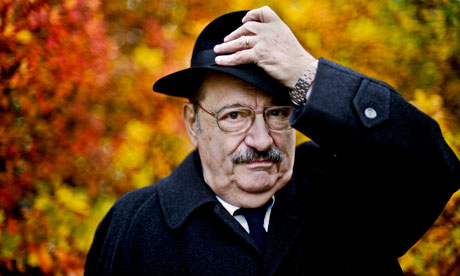
Outside Umberto Eco's office window in Milan looms the intimidating mass of Sforzesco castle, a reminder, with its towers and blackbirds, of various continental wars. Here once stood the 14th-century Castrum Portae Jovis – the Porta di Giove fortress – which was destroyed by the short-lived Aurea Republic of 1447. Between these walls, Leonardo Da Vinci and Donato Bramante once laboured; these very buttresses were conquered by Napoleon. And just beyond the moat – an area now invaded by tourists who have come to visit Michelangelo's La Pietà Rondanini – Marshall Radetzky's Austrian troops bombed the rioting city in 1848.
"When it comes to the debt crisis," says Eco, "and I'm speaking as someone who doesn't understand anything about the economy, we must remember that it is culture, not war, that cements our [European] identity. The French, the Italians, the Germans, the Spanish and the English have spent centuries killing each other. Today, we've been at peace for 70 years and no one realises how amazing that is any more. Indeed, the very idea of a war between Spain and France, or Italy and Germany, provokes hilarity. The United States needed a civil war to unite properly. I hope that culture and the [European] market will do the same for us."
"When it comes to the debt crisis," says Eco, "and I'm speaking as someone who doesn't understand anything about the economy, we must remember that it is culture, not war, that cements our [European] identity. The French, the Italians, the Germans, the Spanish and the English have spent centuries killing each other. Today, we've been at peace for 70 years and no one realises how amazing that is any more. Indeed, the very idea of a war between Spain and France, or Italy and Germany, provokes hilarity. The United States needed a civil war to unite properly. I hope that culture and the [European] market will do the same for us."
Subscribe to:
Posts (Atom)