Democracy Gone Astray

Democracy, being a human construct, needs to be thought of as directionality rather than an object. As such, to understand it requires not so much a description of existing structures and/or other related phenomena but a declaration of intentionality.
This blog aims at creating labeled lists of published infringements of such intentionality, of points in time where democracy strays from its intended directionality. In addition to outright infringements, this blog also collects important contemporary information and/or discussions that impact our socio-political landscape.

All the posts here were published in the electronic media – main-stream as well as fringe, and maintain links to the original texts.

[NOTE: Due to changes I haven't caught on time in the blogging software, all of the 'Original Article' links were nullified between September 11, 2012 and December 11, 2012. My apologies.]

Showing posts with label Dark-Money. Show all posts

Tuesday, October 03, 2023

Virginia’s ‘Moderate’ GOP Governor Is Quietly Funding Anti-Choice Extremists

Despite Gov. Glenn Youngkin’s attempt to appear moderate by calling for a 15-week abortion ban, the Republican governor is quietly funding anti-choice extremist lawmakers, many of whom have said they believe life begins at conception.

Spirit of Virginia, Youngkin’s political action committee previously known as Virginia Wins, donated nearly $100,000 to anti-choice down-ballot Republican candidates in the state so far this year, according to campaign finance records. The governor created the PAC in 2021 to support Republican candidates at every level of government. Youngkin, a former CEO of a global investment firm, was the sole contributor to the PAC when Spirit of Virginia first launched. He remains a major donor and was behind over $295,000 in donations in the 2022-23 fiscal year.

Saturday, September 30, 2023

19 States Cut Income Taxes to Benefit Wealthy — With Help of Dark Money Groups

Amia Edwards lives here because she wants to make a difference. But in this majority-Black city, long starved for funding by the state’s mostly white Legislature, that’s proved a steep challenge.

The city’s recent water crisis came after years of chronic underfunding of Jackson’s aging water infrastructure. The stench lingers in Edwards’ front yard after raw sewage flooded her home twice — neither the city nor the state agreeing to help. Abandoned homes blemish her south Jackson neighborhood as residents fled for better-funded communities. And at her nonprofit that prepares Jackson youth for performing-arts careers, she sees the results of cash-strapped schools when her kids struggle to read scripts and rap lyrics.

Wednesday, September 27, 2023

Fox Executives Are Pouring Cash Into Joe Manchin’s Campaign

Since the 2020 presidential election, when Democrats emerged with a razor-thin majority in the Senate, Joe Manchin has been no stranger to his Republican colleagues: schmoozing with them on his houseboat, meeting to discuss concerns about President Joe Biden’s massive spending packages, and proving a consistent ally in derailing the aspirations of both Blue Dog Democrats and left-wing progressives. 

Thursday, July 13, 2017

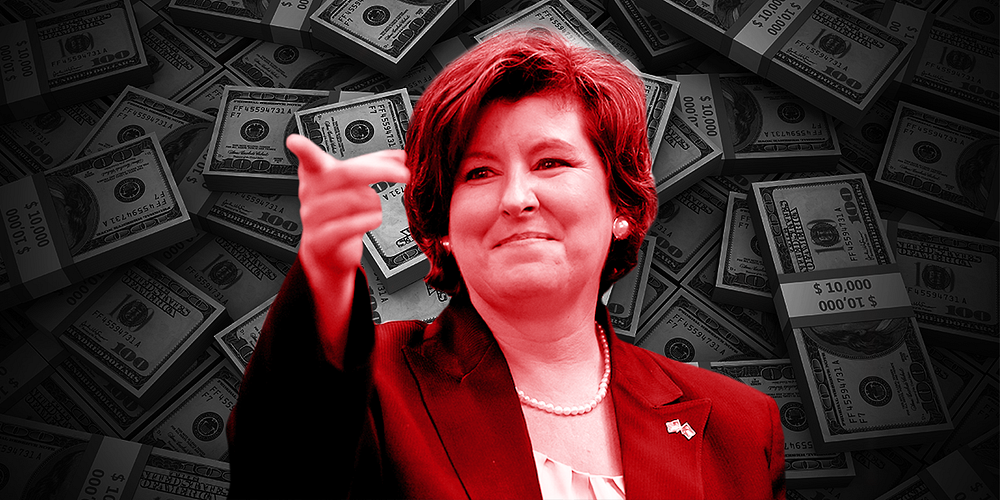
Dark money is fueling Karen Handel’s campaign for Congress

In September 2008 — a time before the Supreme Court’s Citizens United ruling would open the flood gates for dark money to pour into politics — a little-known, conservative state senator in Georgia made a play to help Republicans in his state win elections.

Then–Sen. John Wiles (R) knew that if he could lift Georgia’s law that banned outside groups from purchasing anonymous mailers, he could transform the way his party conducts campaigns. He declared at the time that he would “not support any effort to regulate anonymous political speech.”

Wednesday, March 01, 2017

How Corporate Dark Money Is Taking Power on Both Sides of the Atlantic

It took corporate America a while to warm to Donald Trump. Some of his positions, especially on trade, horrified business leaders. Many of them favoured Ted Cruz or Scott Walker. But once Trump had secured the nomination, the big money began to recognise an unprecedented opportunity.

Trump was prepared not only to promote the cause of corporations in government, but to turn government into a kind of corporation, staffed and run by executives and lobbyists. His incoherence was not a liability, but an opening: his agenda could be shaped. And the dark money network already developed by some American corporations was perfectly positioned to shape it. Dark money is the term used in the US for the funding of organisations involved in political advocacy that are not obliged to disclose where the money comes from. Few people would see a tobacco company as a credible source on public health, or a coal company as a neutral commentator on climate change. In order to advance their political interests, such companies must pay others to speak on their behalf.

Monday, February 29, 2016

Forget Trump — 'Dark Money' from Koch brothers is shaping Republican Party

Given how the race for Republican presidential nomination is shaping up in the United States, you might think it's a party where the loudest mouth has a strong chance of winning.

After all, real estate mogul Donald Trump is the front-runner for the nomination, recently securing the support of New Jersey Gov. Chris Christie, himself no slouch in the volume department.

Sunday, March 29, 2015

Secret $1.5 million donation from Wisconsin billionaire uncovered in Scott Walker dark-money probe

John Menard Jr. is widely known as the richest man in Wisconsin. A tough-minded, staunchly conservative 75-year-old billionaire, he owns a highly profitable chain of hardware stores throughout the Midwest. He’s also famously publicity-shy — rarely speaking in public or giving interviews.

So a little more than three years ago, when Menard wanted to back Wisconsin Gov. Scott Walker — and help advance his pro-business agenda — he found the perfect way to do so without attracting any attention: He wrote more than $1.5 million in checks to a pro-Walker political advocacy group that pledged to keep its donors secret, three sources directly familiar with the transactions told Yahoo News.

Wednesday, November 12, 2014

Obama Can Reform Dark Money With a Stroke of a Pen

There’s a powerful solution for disclosing the secret-money sloshing around in our political system. It does not require an act of Congress or action from any of the effectively toothless campaign-finance watchdogs, like the Federal Election Commission. In fact, this solution could be passed in an instant, and the only requirement for action is political will.

President Barack Obama can issue an executive order today that requires government contractors to disclose their dark-money campaign contributions.

Why doesn’t he? And why don’t campaign-finance-reform organizations push for such a fix?

Friday, September 26, 2014

The $1-Billion-a-Year Right-Wing Conspiracy You Haven’t Heard Of

Are you female, gay, non-Christian, or otherwise interested in the separation of church and state? Get to know The Gathering, a shadowy, powerful network of hard-right funders meeting Thursday in Florida.

Have you heard of the $1,750-per-person “Gathering,” which starts Thursday in Orlando, Florida?

Probably not. But if you’re female, gay, non-Christian, or otherwise interested in the separation of church and state, your life has been affected by it.

Thursday, September 25, 2014

G.O.P. Error Reveals Donors and the Price of Access

WASHINGTON — In politics, it is sometimes better to be lucky than good. Republicans and Democrats, and groups sympathetic to each, spend millions on sophisticated technology to gain an advantage.

They do it to exploit vulnerabilities and to make their own information secure. But sometimes, a simple coding mistake can lay bare documents and data that were supposed to be concealed from the prying eyes of the public.

Monday, September 22, 2014

5 Signs the Dark-Money Apocalypse Is Upon Us

It's the home stretch of the 2014 election season. No single theme or issue has dominated the midterms, but 2014 is on pace to be the Year of Dark Money.
Nonprofit groups, some well known (such as the US Chamber of Commerce and Americans for Prosperity, founded by the Koch brothers) and some obscure (America Inc., anyone?), have dumped huge sums of anonymous money into every competitive Senate race and many House contests. Here are five eye-opening indicators showing the rapid spread of dark money in this year's campaign season—and why it's going to get worse as Election Day approaches.

Sunday, September 07, 2014

It's Time To Name The 2014 Midterms The Dark Money Election

WASHINGTON -- If 2012 was the super PAC election, the 2014 midterms look to be the dark money election. Spending on ads that named federal candidates by nonprofit organizations, which are not required to disclose their donors, has soared in the months leading up to November.

Dark money groups have spent at least $142 million on advertising campaigns naming specific senators, representatives and congressional candidates over the past 20 months, according to a Huffington Post analysis of news reports, press releases and political advertising reports collected by the Sunlight Foundation. This total now surpasses the $122 million spent by independent groups that do disclose their donors and only stands to grow.

Friday, March 21, 2014

This Chart Shows How Little We Really Know About Where Political Money Comes From

More and more money is going into U.S. elections without any disclosure of where it's coming from.
Spending by “dark money” groups -- organizations that do not have to disclose the sources of their political money -- has skyrocketed from about $25 million in 2000 to about $336 million in 2012, according to Federal Election Commission and Internal Revenue Service data that the Center for Responsive Politics, which tracks money in U.S. politics, sent to The Huffington Post.

Thursday, January 30, 2014

Major U.S. Companies Quietly Funnel Dark Money To Politically Active Nonprofits

The U.S. Supreme Court’s Citizens United v. Federal Election Commission ruling in 2010 did not, as some warned, unleash a flood of corporate money directly into elections.

But since then, scores of blue-chip U.S. companies quietly bankrolled politically active nonprofits to the tune of at least $185 million in roughly a single year, according to a new Center for Public Integrity investigation.

Ranking among the biggest donors are energy giant Exelon Corp., health insurer WellPoint Inc. and technology titan Microsoft Corp.

Wednesday, January 29, 2014

Dark Money Groups Have Already Spent Way More Than You Think

WASHINGTON -- Dark money flowed freely in 2013 and into the new year as social welfare nonprofits and corporate trade associations -- groups that are not required to disclose their donors -- spent well over $27 million on electoral campaigns and issue advocacy targeting specific candidates.

A Huffington Post analysis of press releases, news reports and Federal Communications Commission data collected by the Sunlight Foundation found that dark money groups have dropped at least $24.6 million on issue ads naming specific candidates on television, radio and online video since January 2013. That's seven times the $3.5 million these groups spent on campaign activities reported to the Federal Election Commission over the same period.

Friday, December 13, 2013

Bill Moyers: "That Sound You Hear Is the Shredding of the Social Contract"

I met Supreme Court Justice William Brennan in 1987 when I was creating a series for public television called In Search of the Constitution, celebrating the bicentennial of our founding document. By then, he had served on the court longer than any of his colleagues and had written close to 500 majority opinions, many of them addressing fundamental questions of equality, voting rights, school segregation, and—in New York Times v. Sullivan in particular—the defense of a free press.

Those decisions brought a storm of protest from across the country. He claimed that he never took personally the resentment and anger directed at him. He did, however, subsequently reveal that his own mother told him she had always liked his opinions when he was on the New Jersey court, but wondered now that he was on the Supreme Court, "Why can't you do it the same way?" His answer: "We have to discharge our responsibility to enforce the rights in favor of minorities, whatever the majority reaction may be."

Wednesday, December 04, 2013

The End of Dark Money?

Last spring, news that the Internal Revenue Service used keywords like “Tea Party” and “Occupy” to select groups applying for nonprofit status for extra scrutiny prompted media outrage, resignations, internal investigations and a series of congressional hearings. There was comparatively little fury about the fact that many of these “social welfare” organizations were getting tax breaks in exchange for flooding elections with anonymous cash.

The power these dark money groups wield in future elections could be undercut by a new proposal from the IRS, which would put clearer boundaries around the political activities of 501(c)(4) nonprofits. Released just before Thanksgiving, the guidelines lay out some specific definitions of “political activity,” that social welfare groups would have to limit in order to retain their tax-exempt status, such as expressing an opinion about a particular candidate.

Tuesday, December 03, 2013

DonorsTrust—the Right's Dark-Money ATM—Pumps Out Record $96 Million

DonorsTrust is the conservative movement's little-known but hugely influential cash machine, a conduit for millions of dollars in anonymous donations to anti-union legal shops, climate change deniers, pro-life advocates, libertarian think tanks, media watchdog groups, and a panoply of other right-leaning causes. Wealthy conservatives use DonorsTrust as a surefire way to invest their money, fingerprint-free, with the assurance it will end up in the right hands. According to new tax filings obtained by Mother Jones, DonorsTrust is growing increasingly popular among the bankrollers of the conservative movement.

Corporate 'Dark Money' To Get Free Pass After SEC Drops Disclosure Proposal

WASHINGTON -- The Securities and Exchange Commission unceremoniously dropped a proposal to require corporations to disclose contributions to political and nonprofit groups to their shareholders from its list of regulatory priorities for 2014.

The change comes nearly one year after outgoing SEC chair Mary Schapiro placed the proposal, submitted to the commission by consumer advocates and campaign finance reform proponents, on its priority list for 2013.

The commission had largely ignored the proposal since Mary Jo White became chairman in April, despite its having garnered a record 600,000-plus public comments. In May, White told the House Financial Services Committee, "No one is working on a proposed rule."

Wednesday, November 27, 2013

'Dark Money' Nonprofit Political Spending Restricted In Proposed IRS Rules

WASHINGTON -- The Treasury Department and Internal Revenue Service announced on Tuesday new guidelines clarifying the definition of political activity for nonprofit organizations.

The new rules, which still face many procedural hurdles, would limit the political activities of nonprofit organizations and help prevent political actors from using these groups to provide anonymity to donors.

Since the Supreme Court's 2010 Citizens United ruling, nonprofit organizations, particularly social welfare nonprofits organized under section 501(c)(4) of the tax code and trade associations organized under section 501(c)(6), have radically increased their reported political spending. In 2012, these groups reported to the Federal Election Commission spending in excess of $300 million. That was up from $69 million in 2008 and nearly $6 million in 2004, according to the Center for Responsive Politics.