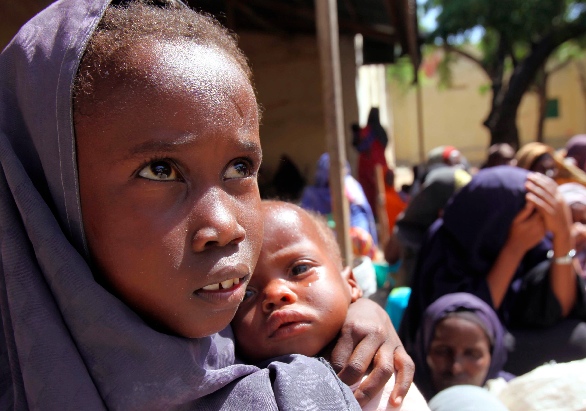
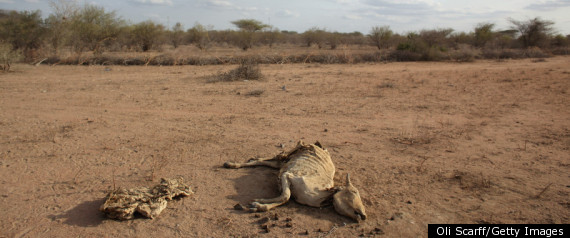
The long-suffering nations in the Horn of East Africa are enduring the worst drought conditions in more than half a century, and are at risk of "massive famine," Rajiv Shah, the administrator of the US Agency for International Development (USAID), told The Huffington Post Wednesday.
The top American aid official said in an interview that the food crisis in countries like Ethiopia, Kenya and Somalia is putting millions of lives at risk, and threatens to further destabilize a troubled region of the world.
"It’s very severe," Shah said. "We know from the data that we’ve been collecting that this is the worst drought in 60 years and it’s going to have severe consequences. Eleven and a half million people are at real risk of malnutrition and famine already."
In its
most recent update on the crisis, USAID declared the food and water shortage in East Africa "the most severe food security emergency in the world today."
"The current humanitarian response is inadequate to prevent further deterioration," the report warned.
Aid workers in East Africa have spent months gearing up for the looming crisis, thanks in part to an early-warning system operated by USAID that first predicted a round of devastating crop failures and food shortages late last year.
But the high number of malnourished children and families so early in the dry season has nonetheless taken them by surprise, and the growing figures suggest the scope of a problem that is only beginning to emerge.
"It’s going to get worse because the next rains aren’t until October, and we’re already seeing people completely reliant on relief," says Anna Ridout, a Nairobi, Kenya-based spokeswoman for Oxfam.
Aid workers say the severity of the famine conditions has been exacerbated by
spiking food prices and the increasing regularity of major African droughts over the past decade, which has made local communities less able to cope with new challenges.
In the Horn of Africa alone, drought conditions have affected crop levels three of the past four years.
"There’s no question that hotter and drier growing conditions in sub-Saharan Africa have reduced the resiliency of these communities," Shah said. "Absolutely the change in climate has contributed to this problem, without question."
Last week, the UN's top humanitarian relief official
Valerie Amos also pointed to environmental change during a tour of a refugee camp in Somalia. "We have to take the impact of climate change more seriously," she said. "Everything I've heard has said that we used to have drought every ten years, then it became every five years and now it's every two years."
This year, aid workers say they are seeing new levels of starvation and suffering.
On a recent visit to the refugee camps in the Ethiopian town of Dollo Ado, along the Somali border, World Food Program official Judith Schuler said she found the area flooded with refugees seeking food and water.
"They are in a desperate state," Schuler said. "I was there there a bit more than a year ago in the same refugee camp, and back then everybody that arrived told me that they came because of violence and conflict. This is not the case anymore. It’s regular people who are coming because they have nothing left to eat."
Some 2,000 hungry refugees arrive at Dollo Ado from Somalia every day,
according to the UN, and two of the camps there are already at twice their maximum capacity.
The vast majority of those arriving at Dollo Ado are children, and Schuler says many of them die at the camp despite finally receiving aid.
"They’ve had nothing to eat during their journey, which often last several days or a week," she said. "The only time they get food is if they can beg for it from villagers along the way. There are people here dying every day."
Save the Children has reported that malnutrition rates among children in Kenya and Somalia have reached 30 percent in some areas -- well above the official rate to classify a famine.
So far this year, USAID has facilitated the distribution of more than $350 million in aid to the Horn of Africa, but Shah says that emergency response efforts are not sufficient to curb a growing -- and seemingly chronic -- problem in the region.
"To me, the reason this is so glaring is it simply doesn’t have to be this way," Shah told HuffPost. "We know how to help countries and work in partnership with countries to build real modern agricultural systems. We know that every few years the lack of rainfall creates a huge depletion of assets that causes kids to be pulled out of schools to work on the farm. And we know that this cycle of agrarian fall-off results in chronic malnutrition for kids, and holds these countries back."
"This is happening precisely in a part of the world that our Defense Secretary Leon Panetta just said is a critical part of our fight against terrorism and our overall international security," he added. "It just underscores the deep link between food security and national security."
Shah continued, "It’s so important to be promoting security and stability in these parts of the world, as opposed to be dealing with these devastating and difficult consequences of failure."
Origin
Source: Huffington  As the last bit of life drained from his frail body, Ahmed Nur was still tethered to an intravenous tube. His father brushed his fingers over the boy’s eyes to close the motionless eyelids. He gently pulled a sheet over his son’s face and removed the tube from his thin arm.