Democracy Gone Astray

Democracy, being a human construct, needs to be thought of as directionality rather than an object. As such, to understand it requires not so much a description of existing structures and/or other related phenomena but a declaration of intentionality.
This blog aims at creating labeled lists of published infringements of such intentionality, of points in time where democracy strays from its intended directionality. In addition to outright infringements, this blog also collects important contemporary information and/or discussions that impact our socio-political landscape.

All the posts here were published in the electronic media – main-stream as well as fringe, and maintain links to the original texts.

[NOTE: Due to changes I haven't caught on time in the blogging software, all of the 'Original Article' links were nullified between September 11, 2012 and December 11, 2012. My apologies.]

Showing posts with label Faith Based Policies. Show all posts

Friday, August 21, 2015

Harper economics: Planets revolve around the earth and austerity creates growth

What a month it's been. While the first half of 2015 has not been kind to Canadians and the economy, July has proven to be worse.
On the economic front, we have had a tumultuous month capping a tumultuous first half of the year. When Bank of Canada governor Stephen Poloz described Canada's economy as "atrocious," little did we know how atrocious it was going to get.
Thursday, May 28, 2015

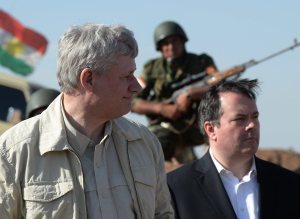
Harper Government Ignoring Key Concerns In War On ISIL: Report

OTTAWA - An independent report on Canada's war against the Islamic State of Iraq and the Levant says the extremist threat is real, but perhaps exaggerated, while the Harper government ignores other important political concerns.

An analysis by the Canadian Defence and Foreign Affairs Institute released Monday says the violence being meted out by extremists is just the latest expression of Sunni alienation in Iraq and is rooted in a philosophy to which few Canadians can relate.

"The threat to homeland security, first, is real, but it should not be overstated," said Thomas Juneau, an assistant professor at the Graduate School of Public and International Affairs at the University of Ottawa.

Tuesday, April 28, 2015

Income-splitting announcement made against advice of top public servant

Prime Minister Stephen Harper announced major fiscal policies in Vaughan, Ont., last fall against the advice of Canada's senior public servant, who said Parliament should be informed first, a newly disclosed document indicates.

Harper's unveiling of the $4.6-billion-a-year package of income-splitting and richer child-benefit cheques was made Oct. 30, about a month after he was advised that the House of Commons was the proper place to do so.

Thursday, March 12, 2015

Poor People Don't Need Better Social Norms. They Need Better Social Policies

In his Tuesday column, "The Cost of Relativism," The New York Times’ David Brooks cites a new book of research on "the growing chasm between those who live in college-educated America and those who live in high-school-educated America," and highlights several "horrific" profiles from the latter group. Brooks uses their stories—which feature drugs, violent crime, unintended pregnancies—to argue for the reintroduction of social norms, which "were destroyed by a plague of nonjudgmentalism." While "intense sympathy" for the disadvantaged is in order, he writes, “It’s not only money and better policy that are missing in these circles; it’s norms.” Reintroducing norms to these poor souls "will require holding people responsible. People born into the most chaotic situations can still be asked the same questions: Are you living for short-term pleasure or long-term good?"

Friday, March 06, 2015

Faith-based policy and the West's dangerous game with Russia

What are the consequences when elected governments make policy based on faith and imperial hubris instead of science and expertise? It's a question that is forcing itself on the world as we watch the U.S., Britain, NATO and the Harper government continue to up the ante in the confrontation with Russia over Ukraine. There are real enough geopolitical dangers in the world without actually creating them out of arrogance and ignorance but that is where we are right now, and the consequences could be catastrophic.
Canada, Britain, the U.S. and the boys with their toys in NATO headquarters are looking for a fight with Russia. Throughout the confrontation and provocations these protagonists treat Russia as if it is some insignificant middle power that can be provoked with impunity. That is just dangerously stupid and stupidity is something the West can ill-afford given all its internal problems -- economic stagnation, unsustainable inequality, collapsing infrastructure.

Monday, December 29, 2014

Stephen Harper government confuses science for mere opinion

The current government has repeatedly proclaimed its belief in the importance of scientific evidence.

In March 2013, then-Minister of Natural Resources Joe Oliver advanced the view that U.S. President Barack Obama is — on the Keystone XL issue, at least — “driven by facts,” adding “and that’s what drives us as well.”

He reiterated this assertion several months later in response to a blistering New York Times editorial that accused the Harper government of muzzling government scientists in an “attempt to guarantee public ignorance.” Americans, said Oliver, are entitled to their opinions but he would find it “refreshing if they confined themselves to the facts and science.”

Finance Department now a fact-free zone

Since Stephen Harper began governing Canada almost nine years ago, one of his goals has been to turn the federal government into a fact-free zone.

The scrapping of the long-form census. The muzzling of government scientists. The systematic elimination of independent voices like the National Roundtable on the Environment and the Economy. Harper simply cannot abide evidence-based advice that gets in the way of his partisan policies.

Saturday, November 29, 2014

Eckerd College President: You Can Stop Rape By Not Drinking Or Having Casual Sex

On Sunday, Eckerd College President Donald Eastman sent an "open letter" to all students and faculty urging students to cut back on alcohol and casual sex in order to prevent sexual assault. He says that by doing so, students will address the "nexus of problems" surrounding sexual assault.

"You know that these incidents are almost always preceded by consumption, often heavy consumption, of alcohol, often by everyone involved in them," the Florida college president wrote. The full letter was published by the Current, Eckerd's student paper.

Wednesday, November 26, 2014

No internal study on $550M job credit: Oliver

OTTAWA - The Harper government passed up conducting its own internal analysis on the job-creation potential of its $550-million small-business job credit, relying instead on numbers produced by an interest group, the finance minister revealed Wednesday.

Joe Oliver told the parliamentary finance committee that Ottawa's decision to introduce the measure was based on the research of the Canadian Federation of Independent Business.

"The department does not analyze every measure that we introduce," Oliver told the hearing as he responded to a question.

Sunday, October 19, 2014

Lawmakers Ignore Experts, Push For Ebola Travel Ban

WASHINGTON -- Growing numbers of lawmakers on Thursday called for a ban on travel from the West African nations at the center of the Ebola epidemic, spurning the advice of the nation's top health officials who testified that such an action would be counterproductive.

Cries to cut off travel from the affected nations escalated dramatically with the arrival in Texas of Thomas Eric Duncan, who contracted the disease in Liberia and became sick after he arrived in the United States, and whose infection has spread to two nurses who cared for him.

Tuesday, September 09, 2014

Creationism can be taught with evolution: Tory

TORONTO - There is no reason creationism could not be taught in addition to evolution and "other theories" if private religious schools are brought into Ontario public school boards, Progressive Conservative Leader John Tory said Wednesday.

The Conservatives are promising to give private religious schools $400 million if they opt into the public system, teach the provincial curriculum, hire accredited teachers and administer standardized tests, Tory said.

Thursday, November 07, 2013

Protecting Alberta's Environment Act Criticized By Opposition

The Alberta government may as well hire a group of ballerinas and a railway engineer to monitor the oilsands, the Alberta Liberals charge, thanks to a bill soon to be made law in the Alberta Legislature.

The Alberta government passed legislation on Tuesday night for an arm's-length panel to monitor the environment and help officials reduce pollution in years to come.

Tuesday, November 05, 2013

Harper's Seven-Year War on Science

Chris Turner's The War on Science: Muzzled Scientists and Wilful Blindness in Stephen Harper's Canada is a solidly researched, well-written book that had to be published. But the people who should read it are not interested in what it tells them about themselves.

If anything has marked the seven years of Conservative rule, it's been the Tories' willingness to repudiate not just previous Liberal and Progressive Conservative governments, but the whole of history since the 18th-century Enlightenment. They're a political vindication of Newton: for every action, there's an equal and opposite reaction.

Friday, August 09, 2013

Harper’s Senate favours experience over academic rank

OTTAWA — Prime Minister Stephen Harper, given an opportunity to re-shape the Senate while he attempts to reform or abolish it, has made the chamber more representative of ordinary Canadians, according to an analysis of the academic qualifications of his appointees.

His appointme nt of Canadians like B.C.’s Nancy Greene Raine, one of the country’s greatest athletes and a businesswoman who attended university but never obtained a degree, has had a marked affect on the typical qualifications of senators.

Friday, July 12, 2013

The Harper government vs. the public servants

Prime Minister Stephen Harper once said he could write a book on what he had learned about the often-tense relationship between politicians and public servants.

“Probably the most difficult job, you know, practical difficult thing you have to learn as a prime minister and ministers, our ministers as well, is dealing with the federal bureaucracy,” Harper told the CBC’s Rex Murphy in 2007, about a year after taking office.

Friday, July 05, 2013

A law that won’t help offenders or their victims

Bill C-54, the Conservative government’s latest salvo in the tough-on-crime war, has passed third reading in Parliament and awaits only Senate approval and royal assent to become law. The legislation has been criticized by many with expertise in criminal law: by criminal lawyers, academics, review boards, forensic psychiatrists, criminologists, etc. But the criticism has fallen on deaf ears; criticism seems to have little effect on this government — they are right, the critics are wrong.

None of the provincial review boards who actually administer the relevant sections of the Criminal Code were consulted on the legislation. Had they been consulted, no doubt they would have made the point that the victims of crime and the mentally ill are not adversaries: this is precisely the point the Conservative government did not want to have expressed because it might undermine the photo ops that the prime minister and his minister of justice stage with victim’s right groups. In other words, Bill C-54 is about votes; it is not about public safety, still less about victim’s rights.

Monday, June 24, 2013

Alberta could have reduced flood damage, critics say

Successive Alberta Conservative governments failed to act on a shelved 2006 flood-mitigation report that critics now say may have significantly reduced flooding, the displacement of thousands of people, and potentially hundreds of millions of dollars in damages.

“[The report] was very prescient,” said Paul Kovacs, executive director of the Institute for Catastrophic Loss Reduction, a think tank at Western University in Ontario.

Saturday, June 22, 2013

Iran vote exposes Canadian extremism

The overwhelming reaction of international governments to the dramatic outcome of Iran’s presidential election was cautious but hopeful. Some even wondered whether it might lead to a historic breakthrough in the dangerous nuclear conflict between Iran and the West.

In contrast, the response of the Canadian government — dismissing the vote as “effectively meaningless” and calling the newly elected Iranian president “one of Ayatollah Khamenei’s puppets” — was cynical and extreme.

Thursday, June 20, 2013

Fetuses Feel Pain at 20 Weeks, and 4 Other Anti-Abortion Myths

The House of Representatives passed a law on Tuesday banning abortions after 20 weeks across the country, based on the scientifically dubious claim that a fetus can feel pain at that point. The federal "Pain-Capable Unborn Child Protection Act" draws from a model bill promoted by the National Right to Life and mirrors laws that have passed in a dozen states in the last three years.

Where does this premise for a 20-week abortion ban come from? In the debate on Tuesday, House members repeatedly cited the research of Dr. Kanwaljeet "Sunny" Anand, a University of Tennessee professor of pediatrics, anesthesiology, and neurobiology who has promoted the idea that 20 weeks post-conception is the point when a fetus begins to feel pain. His work, which has been the go-to resource for anti-abortion groups, was mentioned at least four times on the House floor. Citing Anand's findings, Rep. Virginia Foxx (R-N.C.) argued that "the baby responds the same way you and I respond to pain, by recoiling." She went on to claim that the pain of a fetus at 20 weeks is "possibly more intense than that felt by older newborns."

Monday, June 17, 2013

Birth control trends in Canada not tracked

Canada has fallen behind other countries in collecting statistics on the use of different contraceptives, and this has important public policy implications, according to some experts.

The situation is "in sharp contrast" to the U.S., Australia and many European countries, which collect national data on birth control, UBC professor and family physician Wendy Norman told CBC News.