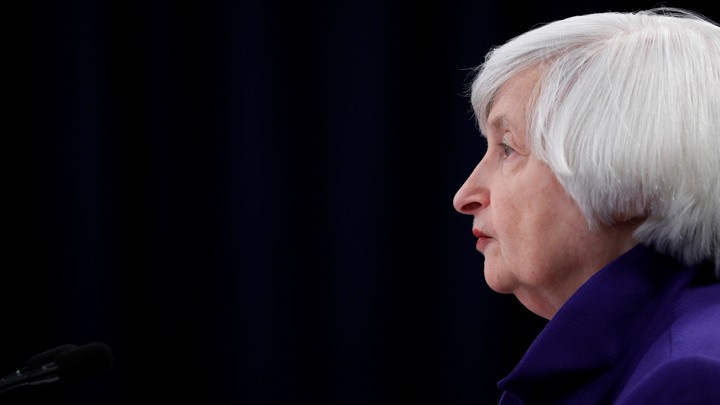
When Janet Yellen leaves her role as the chair of the Fed at the end of her term in February, she will have a pretty impressive record to tout. She has led the Fed during one of the longest market rallies in modern history and presided over one of the biggest declines in unemployment and most significant periods of job creation ever. Despite these successes, critics had hoped that Yellen, who inherited an economy that had stabilized since the recession, would be aggressive in rolling back recession-era policy. Instead she proceeded with a slow and cautious approach to raising interest rates in the face of a strengthening economy.
Democracy Gone Astray
Democracy, being a human construct, needs to be thought of as directionality rather than an object. As such, to understand it requires not so much a description of existing structures and/or other related phenomena but a declaration of intentionality.
This blog aims at creating labeled lists of published infringements of such intentionality, of points in time where democracy strays from its intended directionality. In addition to outright infringements, this blog also collects important contemporary information and/or discussions that impact our socio-political landscape.
All the posts here were published in the electronic media – main-stream as well as fringe, and maintain links to the original texts.
[NOTE: Due to changes I haven't caught on time in the blogging software, all of the 'Original Article' links were nullified between September 11, 2012 and December 11, 2012. My apologies.]
Showing posts with label Federal Reserve. Show all posts
Wednesday, August 01, 2018
Wednesday, November 26, 2014
New Scrutiny of Goldman’s Ties to the New York Fed After a Leak
From his desk in Lower Manhattan, a banker at Goldman Sachs thumbed through confidential documents — courtesy of a source inside the United States government.
The banker came to Goldman through the so-called revolving door, the symbolic portal that connects financial regulators to Wall Street. He joined in July after spending seven years as a regulator at the Federal Reserve Bank of New York, the government’s front line in overseeing the financial industry. He received the confidential information, lawyers briefed on the matter suspect, from a former colleague who was still working at the New York Fed.
Tuesday, September 30, 2014
Secret Recordings Inside The Federal Reserve Prompt Elizabeth Warren To Call For Investigation
Sens. Elizabeth Warren (D-MA) and Sherrod Brown (D-OH) want to investigate the Federal Reserve’s relationships with the banks it oversees after the release of taped conversations between managers and a former bank examiner at the Fed.
The recordings were made surreptitiously by a former Fed employee named Carmen Segarra, who is trying to prove in court that she was fired in retaliation for her attempts to bring a cultural shift to the supervisory work of the powerful central bank. They include a reprimand from her boss that she is “arrogant,” that she should “have a sense of humility” about her work, and should be guided more by the consensus within her working group than by her own instincts as a 10-year veteran of regulatory compliance work in the banking industry.
Monday, September 29, 2014
Secret Recordings Expose Cozy Relationship Between Goldman Sachs And The NY Fed
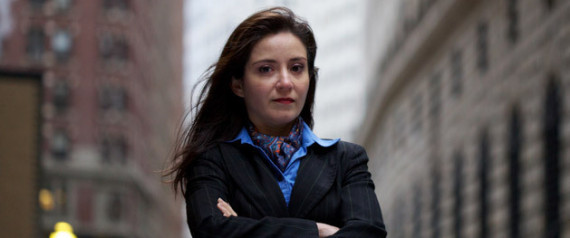
Barely a year removed from the devastation of the 2008 financial crisis, the president of the Federal Reserve Bank of New York faced a crossroads. Congress had set its sights on reform. The biggest banks in the nation had shown that their failure could threaten the entire financial system. Lawmakers wanted new safeguards.
The Federal Reserve, and, by dint of its location off Wall Street, the New York Fed, was the logical choice to head the effort. Except it had failed miserably in catching the meltdown.
Thursday, February 27, 2014
Why the Federal Reserve Needs an Overhaul
The Federal Reserve is celebrating its 100th birthday with due modesty, given the Fed’s complicity in generating the recent financial crisis and its inability to adequately resuscitate the still-troubled economy. Woodrow Wilson signed the original Federal Reserve Act on December 23, 1913. Eleven months later, the Federal Reserve System’s twelve regional banks opened for business. But in a sense the central bank was born in the autumn of 1907, when another devastating financial crisis swept the nation, destroying banks, businesses and farmers on a frightening scale.
J.P. Morgan and his fraternity of New York bankers intervened with brutal decisiveness in the efforts to halt the Panic of 1907, choosing which banks would fail and which would survive. Afterward, Morgan was hailed in elite circles as a heroic figure who had saved the country and free-market capitalism. The nostalgia for Morgan was misplaced, however: as insiders knew, the real story of 1907 was that Washington intervened to save Wall Street—the twentieth century’s own inaugural bailout.
Thursday, January 30, 2014
Wall Street May Win As Federal Reserve Prepares To Punt On Physical Commodities
Big banks are poised to reap a significant victory in their fight to maintain lucrative businesses hoarding, selling and trading physical commodities as the Federal Reserve prepares to punt on the issue, people familiar with the matter said.
The Fed’s move to solicit public input on what it should do, rather than use its authority to regulate the activities of large financial institutions, is expected to be announced by Wednesday afternoon in advance of a Senate Banking Committee hearing on the issue. Some federal financial regulators said the move may be a way for the Federal Reserve’s Board of Governors in Washington to evade calls to curb banks’ risk-taking. It would come despite years of internal warnings at the Fed that Wall Street’s expansion into metals and energy puts the U.S. economy at risk in the form of higher prices due to alleged market manipulation and endangers the financial system because of the possibility that a catastrophic incident such as an oil spill would lead counterparties to flee the affected bank and put it at risk of failure.
Wednesday, January 29, 2014
Federal Reserve Asks Financial Industry Lobbyists For Personnel Recommendations
Financial industry lobbyists are among those being asked to suggest who should replace Sandra Braunstein, the retiring Federal Reserve official who oversaw the regulator’s lackluster efforts to protect consumers in the years preceding the U.S. mortgage meltdown.
Braunstein, who has led the Fed’s consumer affairs division since April 2004, did not respond to an emailed request for comment. Her plan to leave the Fed has not been previously reported, nor has the Fed's outreach to identify potential replacements.
Monday, December 23, 2013
FED up? Hundred years of manipulating the US dollar
Monday 23 December marks the 100th Anniversary of the creation of the Federal Reserve System - the Central Bank of the United States of America.
The mainstream media are keeping remarkably quiet about this key milestone.
No doubt, they know only too well that growing millions of workers inside and outside the US are realizing that a century of central banking monopoly in the hands of a private clique of usurer banksters is enough. More than enough!
The mainstream media are keeping remarkably quiet about this key milestone.
No doubt, they know only too well that growing millions of workers inside and outside the US are realizing that a century of central banking monopoly in the hands of a private clique of usurer banksters is enough. More than enough!
Monday, December 09, 2013
Amend the Fed: We Need a Central Bank that Serves Main Street
December 23rd marks the 100th anniversary of the Federal Reserve. Dissatisfaction with its track record has prompted calls to audit the Fed and end the Fed. At the least, Congress needs to amend the Fed, modifying the Federal Reserve Act to give the central bank the tools necessary to carry out its mandates.
The Federal Reserve is the only central bank with a dual mandate. It is charged not only with maintaining low, stable inflation but with promoting maximum sustainable employment. Yet unemployment remains stubbornly high, despite four years of radical tinkering with interest rates and quantitative easing (creating money on the Fed’s books). After pushing interest rates as low as they can go, the Fed has admitted that it has run out of tools.
Friday, October 25, 2013
Janet Yellen as Federal Reserve Chair Is a Good Start…
Let’s be blunt. Barack Obama is still in denial about the sorry state of the economy, and so are both parties in the stalemated Congress. The government is consumed by wrong arguments about the wrong crisis, while the Federal Reserve keeps pointing out discreetly that the economy is still sick. Prosperity is not just around the corner.
Obama has a way to break out of this mess. Instead of wrangling with know-nothing Republicans over how to cut spending and make things worse, the president should make his “grand bargain” with the Federal Reserve. Together, they can develop an aggressive agenda to stimulate job creation and create the new demand the stagnant economy needs. The president’s explicit support would give the Fed the political cover it needs to use its powers of money creation and directed lending for unusual intervention in the economy. The central bank created $3 trillion in new money to refloat the financial system. It should do something similar, but more modestly, to restore the real economy.
Saturday, September 21, 2013
Janet Yellen’s Harvard Speech
A reporter from our humor department has tried to find a talk on
men and economics given in 2005 by Janet Yellen at Harvard Business
School. But since there’s no sign of a transcript (or such a speech),
here’s how our correspondent imagines it might have gone.
I’d like to thank Harvard for inviting me here today to speak about the issues of diversity that confront the world’s élite financial institutions. Now, there are many fields in which men are significantly overrepresented, but it is especially troubling in the case of economics for one reason: men are so bad at it.
Wednesday, September 18, 2013
Larry Summers Is Out, but the Boys’ Club Is as In as Ever
On Sunday, Larry Summers sent President Obama a letter withdrawing his name from consideration to be the next chairman of the Federal Reserve, and progressives did rejoice. The news came after a protracted and heated debate, particularly for a role that doesn’t tend to get a lot of hearts racing, over who should take over when Ben Bernanke leaves in January. The contest was reportedly between Summers and Janet Yellen, who currently serves as vice-chair for the Fed.
Monday, September 16, 2013
Lawrence Summers Cancels Citigroup Events While Federal Reserve Decision Pending
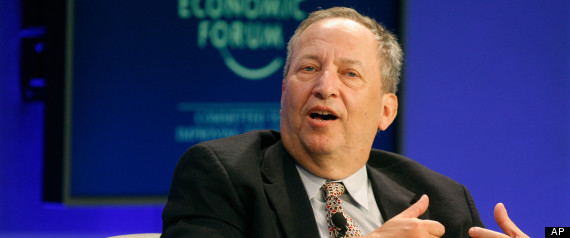
CHICAGO, Sept 14 (Reuters) - Former U.S. Treasury Secretary Lawrence Summers has pulled out of speaking engagements and other events involving Citigroup Inc while President Barack Obama considers whether to nominate the Harvard economist as the next chairman of the Federal Reserve, the bank said in a statement.
"Mr. Summers has withdrawn from participation in all Citi events while he is under consideration to be Chairman of the Federal Reserve," Danielle Romero-Apsilos, a spokeswoman for the third-biggest U.S. lender, said in a statement e-mailed to Reuters on Saturday.
Friday, September 13, 2013
Larry Summers' Citigroup Problem
Former Treasury Secretary Larry Summers' consulting gig with the banking behemoth Citigroup could come back to haunt him if he is nominated to succeed Ben Bernanke as chairman of the Federal Reserve. Bernanke's term expires in January, and Summers and Janet Yellen, the central bank's vice-chair, appear to be front-runners for the post, with media reports suggesting that President Barack Obama is fond of the controversy-prone Summers. But there may be a hitch with a Summers appointment. After Obama took office in 2008, he enacted sweeping ethics rules that say that no presidential appointee can work on matters directly related to a former employer for two years after taking a government job. That means that unless Obama grants Summers an exemption from the rules—a move that could be politically controversial—the former Treasury secretary will have to recuse himself from a slew of Fed decisions involving Citi, which is the third-largest bank in America. Experts say those recusals could hamper Summers' ability to run the Fed effectively.
Thursday, August 29, 2013
Federal Reserve Employees Afraid To Speak Put Financial System At Risk
WASHINGTON -- Regulators overseeing the nation’s largest financial institutions are distrustful of their bosses, afraid to speak out, and feeling isolated, according to a confidential survey this year of Federal Reserve employees.
The findings from the April survey of roughly 400 employees, presented to Fed staff during multiple meetings in June and July and obtained by The Huffington Post, show a workforce that is demoralized, and an institution where teamwork is nonexistent, innovation and creativity are discouraged and employees feel underutilized.
Tuesday, August 27, 2013
Larry Summers and the ‘End-Game’ Memo
A 1997 memo retrieved from the filing cabinet of investigative reporter Greg Palast shows the involvement of Lawrence Summers—Obama’s current favorite for chairman of the Federal Reserve—in a successful plan to help big bank CEOs “rip apart financial regulation across the planet.”
In the memo, future Treasury Secretary Timothy Geithner reminds “his boss to call the then most powerful CEOs on the planet and get them to order their lobbyist armies to march” to tear down financial safety regulations in all 156 nations party to the World Trade Organization.
Friday, August 23, 2013
Matt Taibbi Rips Idea Of Larry Summers Running Federal Reserve
Ever since it leaked that Larry Summers could very well replace Ben Bernanke as Federal Reserve chairman, he's become the intellectual punching bag of many a critic -- Paul Krugman and Bette Midler included.
Add to that list Rolling Stone columnist Matt Taibbi. The bestselling author joined HuffPost Live Thursday and while there expressed his reservations with the idea of the former chief economic adviser to President Barack Obama taking over the Fed.
Wednesday, August 14, 2013
Next Fed Head Should Meet the Bernie Sanders/Elizabeth Warren Standard
No presidential appointment, no Senate confirmation, matters more than the one that will soon come for the post of chairman of the Federal Reserve.
If ever there was a time to ask for more—and better—this is it.
Yet, for the most part, official Washington is on autopilot, preparing for the replacement of outgoing Federal Reserve chairman Ben Bernanke with another predictable insider—perhaps even the ultimate predictable insider: former Treasury Secretary Larry Summers.
If ever there was a time to ask for more—and better—this is it.
Yet, for the most part, official Washington is on autopilot, preparing for the replacement of outgoing Federal Reserve chairman Ben Bernanke with another predictable insider—perhaps even the ultimate predictable insider: former Treasury Secretary Larry Summers.
Monday, August 12, 2013
Four Questions for Fed Chair Candidates
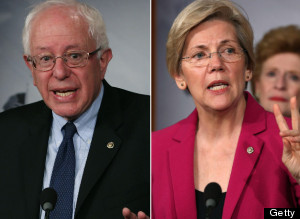
The decisions made by the next chair of the Federal Reserve will have a powerful impact on the economic well-being of every person in America.
While the largest financial institutions and corporations in this country have been bailed out and are now back to making enormous profits and rewarding their executives with outsized compensation packages, recovery hasn't gone so well for the rest of America. Middle class families have continued to lose ground economically, the number of Americans living in poverty is near an all-time high, and the gap between the very rich and everyone else is growing wider.
Obama: Larry Summers Isn't Front-Runner For Fed Chair, Would Make Excellent Fed Chair
WASHINGTON -- President Barack Obama on Friday pushed back against rumors that his former economic adviser Larry Summers has "the inside track" among potential nominees to succeed Ben Bernanke as chairman of the Federal Reserve.
When asked by Major Garrett, a reporter for National Journal and CBS News' Chief White House Correspondent, whether Summers indeed had "the inside track," Obama said that both Summers and another top choice, Janet Yellen, were excellent candidates who would make superb leaders at the Fed. Yellen, who is currently vice chairman of the Fed, has been endorsed by several Senate Democrats and a majority of House Democratic women.
Subscribe to:
Posts (Atom)


