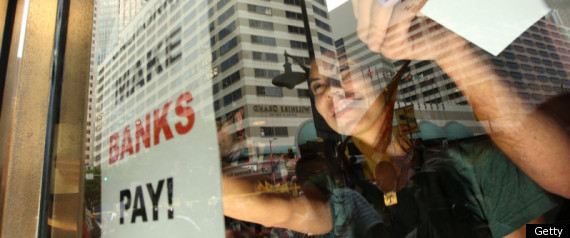
Enter economist Gerald Epstein of the University of Massachusetts, Amherst. He has dived in and crunched the numbers, and the results are eye-popping. Epstein and his colleague Juan Antonio Montecino look at exactly how families, taxpayers and businesses get ripped off by dubious financial activities and tally up the costs in a new paper for the Roosevelt Institute, "Overcharged: The High Cost of Finance." (The Institute for New Economic Thinking has also supported several papers by Epstein).
Democracy Gone Astray
Democracy, being a human construct, needs to be thought of as directionality rather than an object. As such, to understand it requires not so much a description of existing structures and/or other related phenomena but a declaration of intentionality.
This blog aims at creating labeled lists of published infringements of such intentionality, of points in time where democracy strays from its intended directionality. In addition to outright infringements, this blog also collects important contemporary information and/or discussions that impact our socio-political landscape.
All the posts here were published in the electronic media – main-stream as well as fringe, and maintain links to the original texts.
[NOTE: Due to changes I haven't caught on time in the blogging software, all of the 'Original Article' links were nullified between September 11, 2012 and December 11, 2012. My apologies.]
Showing posts with label Financial Industry. Show all posts
Friday, November 11, 2016
How Much Do Shady Financial Practices Cost You, Exactly?
Enter economist Gerald Epstein of the University of Massachusetts, Amherst. He has dived in and crunched the numbers, and the results are eye-popping. Epstein and his colleague Juan Antonio Montecino look at exactly how families, taxpayers and businesses get ripped off by dubious financial activities and tally up the costs in a new paper for the Roosevelt Institute, "Overcharged: The High Cost of Finance." (The Institute for New Economic Thinking has also supported several papers by Epstein).
Friday, March 14, 2014
The Financial Industry Doesn't Want You to Know About Its Lack of Diversity
It's not unusual for the banking industry to challenge a new government rule. Ever since Congress passed the Dodd-Frank Act in 2010, the banks have sent forth their army of lobbyists anytime federal regulators try to enforce a new restriction, often resorting to the courts if they don't get their way. But their latest objection is particularly galling: They don't want the government or public to know about the diversity—or lack thereof—within their industry.
Monday, February 27, 2012
Canada supports dark side of international finance
You can say one thing for the powers that be in the banking industry. They've got a lot of nerve.
This past week, our own finance minister, Jim Flaherty, along with Mark Carney, the Governor of the Bank of Canada, came out strongly in opposition to a modest proposal to regulate the U.S. banking system.
Their interventions followed a concerted effort by American bank lobbyists to spark international opposition to U.S. regulatory reforms.
What a shameful spectacle. Less than four years ago, the world was holding its breath for fear the crisis in the hyper-deregulated U.S. financial system would cause a second Great Depression. Now Canada and other foreign governments, cheered on by U.S. banking interests, are doing their best to block U.S. legislation that would curb the industry's worst excesses.
The initiative Flaherty and Carney attacked is a proposal by Paul Volcker, the former chair of the U.S. Federal Reserve. Simply put, the "Volcker rule" would prevent financial institutions -- U.S. or subsidiaries of foreign banks -- that are backstopped by U.S. taxpayers from behaving like hedge funds and trading for their own account.
This past week, our own finance minister, Jim Flaherty, along with Mark Carney, the Governor of the Bank of Canada, came out strongly in opposition to a modest proposal to regulate the U.S. banking system.
Their interventions followed a concerted effort by American bank lobbyists to spark international opposition to U.S. regulatory reforms.
What a shameful spectacle. Less than four years ago, the world was holding its breath for fear the crisis in the hyper-deregulated U.S. financial system would cause a second Great Depression. Now Canada and other foreign governments, cheered on by U.S. banking interests, are doing their best to block U.S. legislation that would curb the industry's worst excesses.
The initiative Flaherty and Carney attacked is a proposal by Paul Volcker, the former chair of the U.S. Federal Reserve. Simply put, the "Volcker rule" would prevent financial institutions -- U.S. or subsidiaries of foreign banks -- that are backstopped by U.S. taxpayers from behaving like hedge funds and trading for their own account.
Friday, December 16, 2011
Financial Sector A Bigger Share Of Economy Now Than Before Financial Crisis
The financial industry may have taken a hit during the Great Recession. But relative to the overall economy, it's bigger now than it was before Lehman Brothers collapsed.
The financial sector represents a bigger share of the economy today than it did in 2006, recent Commerce Department figures show -- despite the bailouts, bank failures and political efforts at reform that have taken place since.
The findings -- which, indicate that the financial sector accounts for 8.4 percent of the country's GDP, a greater share than five years ago and one of the highest percentages of the past half century, according to The Wall Street Journal -- may come as unwelcome news for anyone who believes that an outsized financial industry doing too much with too many people's money led the country to financial crisis.
The financial sector represents a bigger share of the economy today than it did in 2006, recent Commerce Department figures show -- despite the bailouts, bank failures and political efforts at reform that have taken place since.
The findings -- which, indicate that the financial sector accounts for 8.4 percent of the country's GDP, a greater share than five years ago and one of the highest percentages of the past half century, according to The Wall Street Journal -- may come as unwelcome news for anyone who believes that an outsized financial industry doing too much with too many people's money led the country to financial crisis.
Tuesday, December 06, 2011
Financial Executives Likely Won't Face Criminal Charges For Role In Financial Crisis: Former Investigator
The Justice Department has decided that prosecution of financial executives is "better left to regulators" to take civil-enforcement actions, David Cardona, who was a deputy assistant director at the Federal Bureau of Investigation until last month, told the Wall Street Journal.
"There's been a realization and a more deliberate targeting by the Department of Justice before we launch criminally on some of these cases," Cardona told the WSJ.
Cardona's comments come nearly eight months after Senator Carl Levin released a report on Goldman Sachs' role in the financial crisis, which found the investment bank profited off purposefully deceiving its own clients at the height of the financial crisis. Levin then said he would recommend some of the investment bank's executives for possible criminal prosecution.
Government officials haven't successfully prosecuted a single Wall Street executive or financial firm since the meltdown, despite many Americans and experts blaming them for the decisions that led to the housing crisis and subsequent financial panic, according to CBS News.
Thursday, December 01, 2011
Flaherty's bid to increase in fines puzzles financial industry
Canada’s banking sector is questioning why the Conservative government wants to more than double the maximum fines that can be levied on financial institutions for breaches of consumer-protection laws.
Examples of consumer rules that would be subject to the heavier fines include requirements that banks obtain written permission from customers before raising credit-card borrowing limits and rules that bank ads promoting interest rates include an explanation of how rates are calculated.
The Financial System Review Act tabled last week by the government in the Senate would raise the maximum penalties for breaching such rules from $200,000 to $500,000.
The heftier fines are creating some confusion in the banking sector.
“It’s unclear what the rationale is behind increasing the fines when the existing maximum fine has rarely been levied,” said Canadian Bankers Association president Terry Campbell in a statement.
A federal agency called the Financial Consumer Agency of Canada is responsible for looking into potential violations and issuing fines. Last year it levied a total of $175,000 in fines, down from the $450,000 total a year earlier.
Examples of consumer rules that would be subject to the heavier fines include requirements that banks obtain written permission from customers before raising credit-card borrowing limits and rules that bank ads promoting interest rates include an explanation of how rates are calculated.
The Financial System Review Act tabled last week by the government in the Senate would raise the maximum penalties for breaching such rules from $200,000 to $500,000.
The heftier fines are creating some confusion in the banking sector.
“It’s unclear what the rationale is behind increasing the fines when the existing maximum fine has rarely been levied,” said Canadian Bankers Association president Terry Campbell in a statement.
A federal agency called the Financial Consumer Agency of Canada is responsible for looking into potential violations and issuing fines. Last year it levied a total of $175,000 in fines, down from the $450,000 total a year earlier.
Subscribe to:
Posts (Atom)